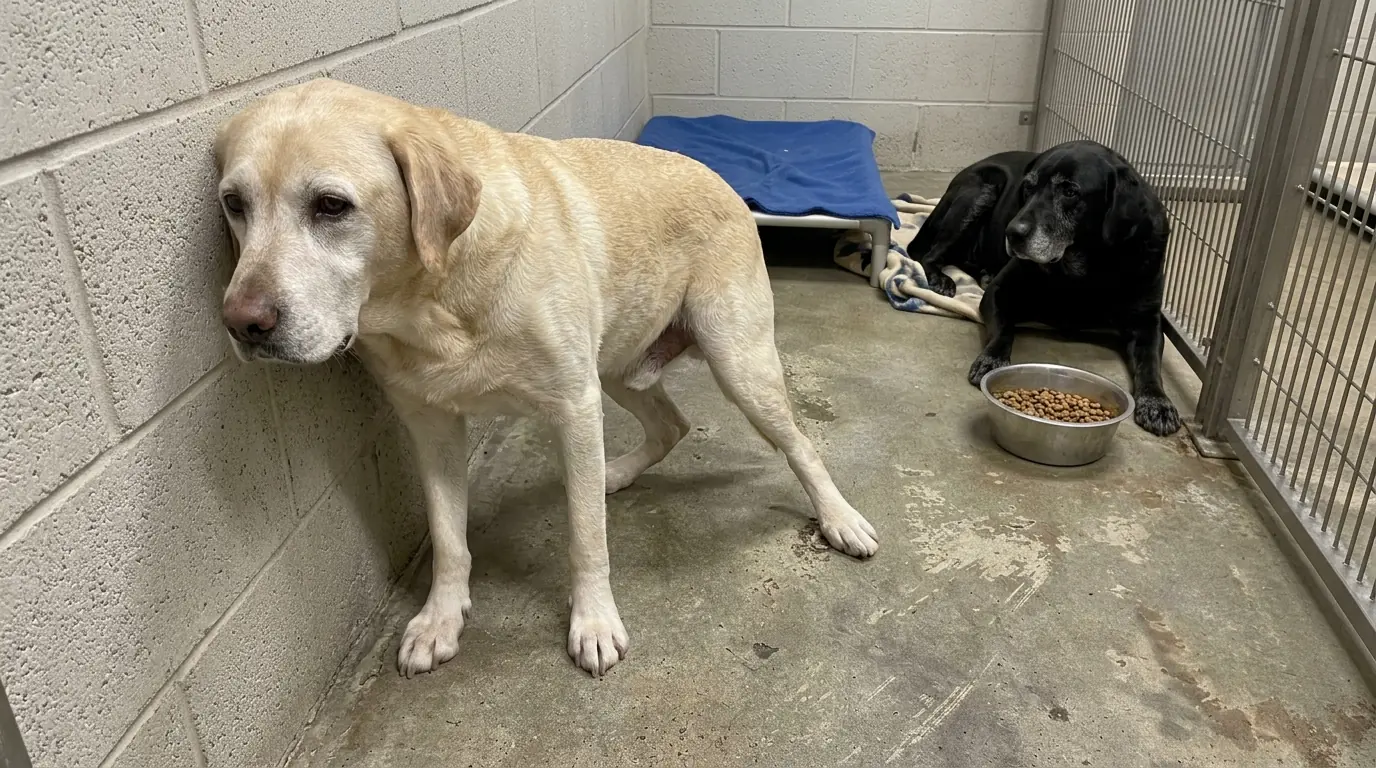
Ranger’s food can sit untouched directly in front of him.
The 10-year-old Labrador Retriever stands near the bowl, smells it, and waits.
Across their shared kennel, Cooper begins the much harder part.
At 12, the older Labrador is dealing with severe arthritis and heart disease. Getting up takes time. Walking across even a small room can be tiring, and remaining on his feet long enough to finish a meal is not always possible.
Still, Cooper slowly makes his way toward the feeding area.
Only when he reaches Ranger does the younger dog finally lower his head toward the food.
But some meals never get that far.
Cooper takes several stiff steps, his hind legs begin to buckle, and he lowers himself before reaching the bowls.
When that happens, Ranger leaves his food.
He walks back to Cooper and lies down beside him.
The bowls remain where staff placed them.
And neither dog eats.
At first, rescue staff saw an emotional routine between two senior dogs who had spent years together.
Then they realized it was becoming a medical problem.
Ranger was waiting for Cooper.
And Cooper’s body could no longer reliably make the trip.
They Had Lost Their Home at the Same Time
Ranger and Cooper entered rescue together after their elderly owner could no longer provide the level of care both senior dogs needed.
For the Labradors, that meant a sudden change late in life.
New surroundings.
New people.
New smells.
A different feeding schedule.
A kennel instead of the home they had known.
Staff did not know exactly how the dogs interpreted that change, but their behavior made one thing clear: they were accustomed to each other.
They rested close together.
They tracked each other’s movement around the kennel.
And at mealtime, Ranger paid almost as much attention to Cooper as he did to his own bowl.
That became increasingly important once veterinary evaluations showed just how physically limited Cooper had become.
Cooper Had Two Problems Working Against Him
Cooper's arthritis was immediately visible in the way he moved.
After lying down, he needed time to rise. His first steps were short and stiff, and standing in one position could become uncomfortable.
But arthritis was not his only concern.
Cooper also had heart disease.
That meant staff could not simply assume every episode of weakness was caused by painful joints.
Exercise tolerance, breathing, heart rate, medications and overall energy all had to be considered as part of his veterinary care.
If Cooper became weak or collapsed, caregivers needed to take that seriously.
His activity had to match what his veterinary team considered safe.
Even something as ordinary as walking across the kennel for dinner could become significant when a dog had both limited mobility and cardiovascular disease.
Meals Became a Daily Test
The pattern was easiest to see at feeding time.
Staff placed the bowls down.
Ranger approached.