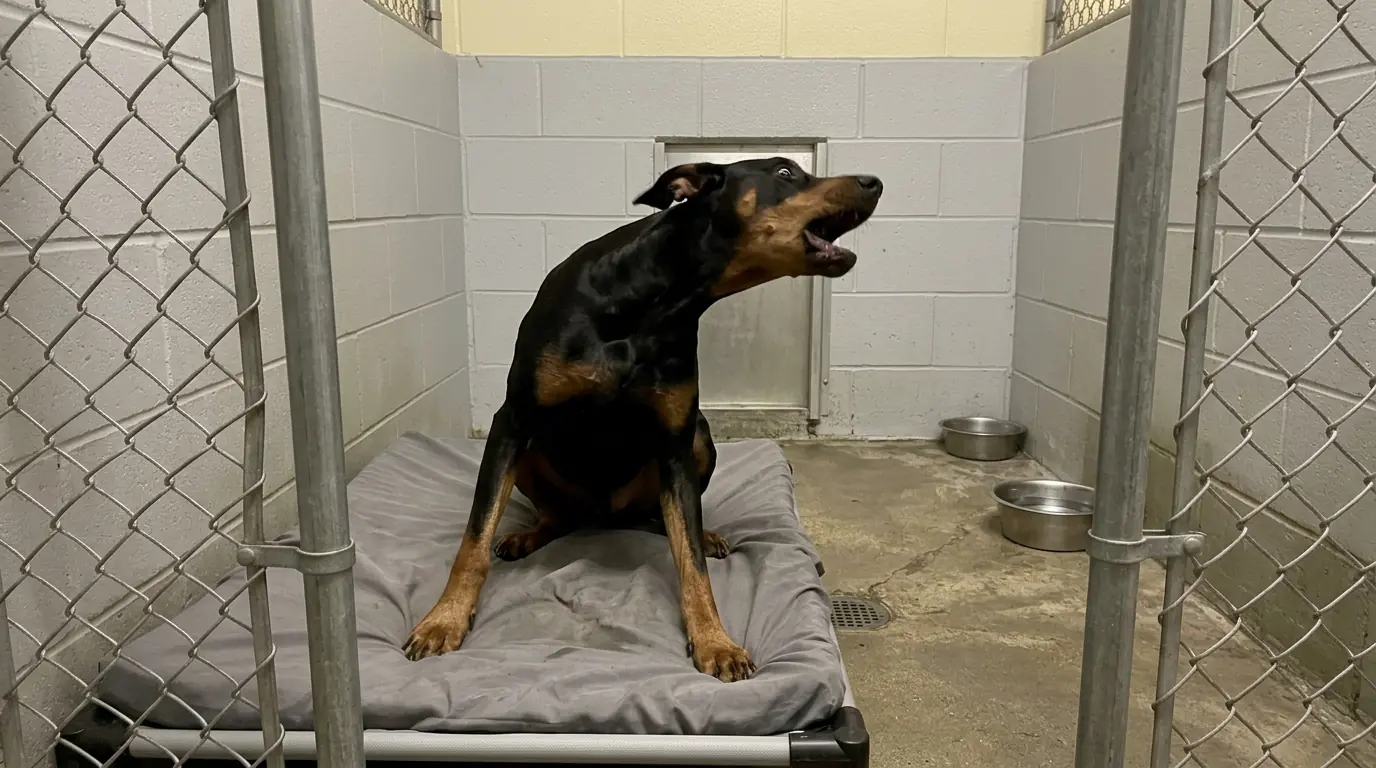
Rocco can look completely peaceful when he is asleep.
The seven-year-old Doberman mix stretches across his shelter cot, his long legs folded loosely beneath him. His breathing slows. His ears relax. Eventually, his head becomes heavy against the bedding.
Sometimes he sleeps deeply enough that ordinary kennel sounds barely seem to reach him.
Then, without warning, Rocco explodes awake.
His head snaps up.
He growls.
His body twists violently toward the empty space behind him.
And before he appears fully awake, Rocco bites at something that is not there.
Once.
Sometimes twice.
Then everything stops.
Rocco looks around.
The growling disappears.
His body seems to realize where he is again.
But he does not simply lie back down.
Instead, Rocco moves to the wall.
He presses his back against it, curls himself tightly, and carefully settles again with his face pointed toward the open kennel.
Whatever frightened him lasted only seconds.
The way Rocco sleeps afterward can last the rest of the night.
The First Episode Happens So Fast It Is Difficult to Understand
Rocco is asleep.
Then he isn't.
There is almost nothing in between.
He does not slowly wake and become frightened by something he sees.
His reaction appears to begin before he is fully oriented.
His body turns.
His mouth opens.
He snaps into empty air behind him.
Only afterward does he seem to recognize the kennel around him.
That distinction matters.
Rocco Isn't Attacking Something He Can Actually See
Staff check the obvious possibilities.
There is no dog behind his bed.
No person has reached into the kennel.
No object has fallen onto him.
Nothing is moving along the wall.
There is no obvious physical target where Rocco is biting.
Yet in those first disoriented seconds after waking, his reaction is intense enough to look as though something has approached him from behind.
Then Comes the Part That Makes the Episode Harder to Dismiss
Rocco does not return to his original sleeping position.
He changes it.
If his back had been exposed to the open kennel, he moves.
He finds the wall.
Then he positions himself so the wall is behind him.
Only after that does he attempt to sleep again.
The Wall Seems to Matter More Than the Bed
Rocco has a cot.
He uses it.
But after one of these episodes, comfort appears to become secondary to position.
If necessary, he will squeeze himself against the rear edge of the cot.
Sometimes he abandons part of the mattress just to keep his back near a solid surface.
He may remain facing outward long after his breathing has slowed.
It Is Tempting to Call It a Nightmare
That is one possibility.
Dogs can move, vocalize, twitch, and show other behaviors during sleep.
Dream-related activity can sometimes look surprisingly dramatic.
But Rocco's episodes are intense enough—and his behavior afterward consistent enough—that staff do not simply assume he is having bad dreams.
There are other possibilities that deserve attention.
Sleep Disorders Can Produce Strange Awakenings
The transition between sleeping and waking is not always clean.
Animals can sometimes show confused or abrupt behavior around arousal from sleep.
A dog may appear partially awake before becoming fully oriented to the environment.
If Rocco's defensive movements begin during that transition, he may not initially be responding to the kennel as it actually exists.
That would fit part of what staff observe.
It still would not explain everything.
Pain Can Also Make Waking Sudden
Rocco is seven.
A Doberman mix of his size can experience orthopedic or spinal discomfort even if he walks relatively normally while awake.
A sleeping position might place pressure on a painful area.
A sudden muscle movement could hurt.
Rolling onto a sore shoulder, hip, neck, or back could trigger an abrupt reaction.