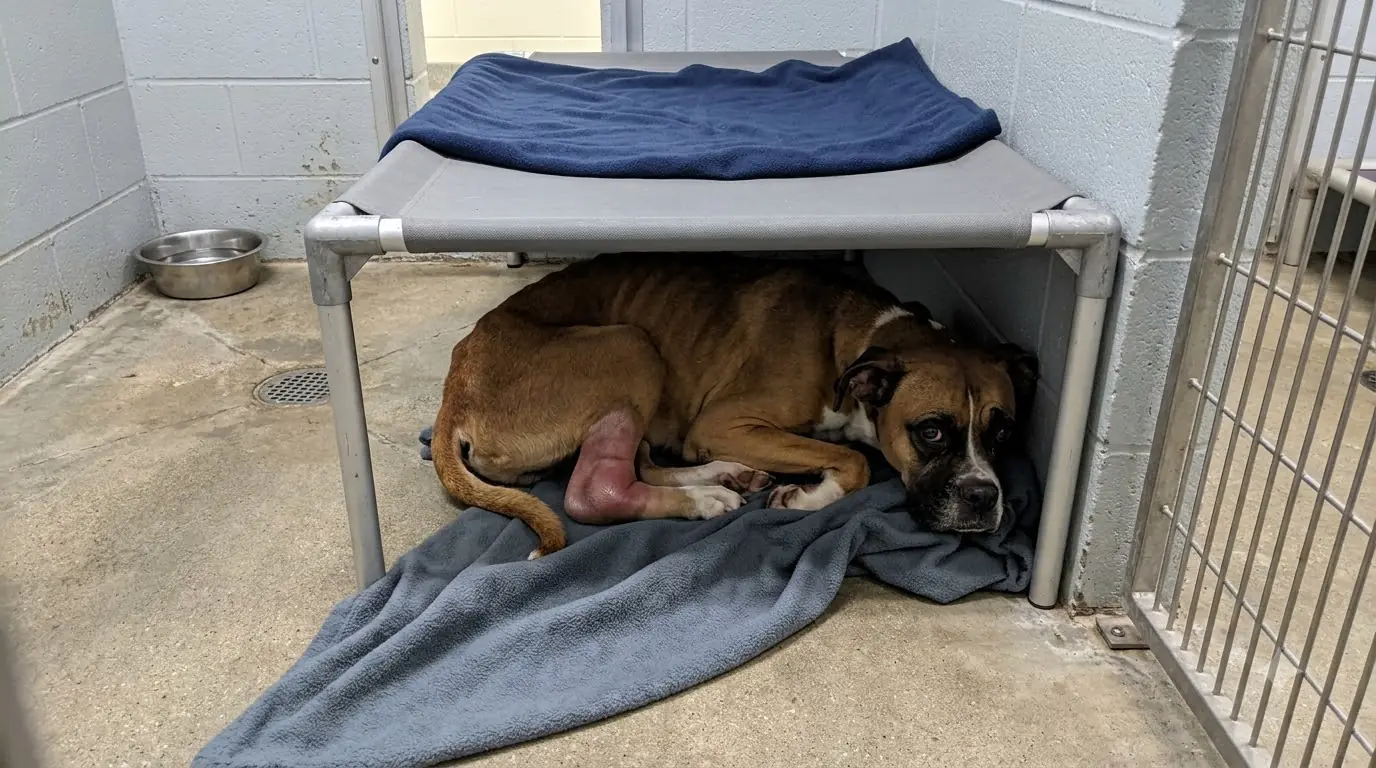
When rescuers entered the abandoned apartment, Rosie wasn't waiting near the door.
She wasn't wandering from room to room.
They found the 6-year-old Boxer curled inside a dark closet.
Her body was tucked into the narrow space as tightly as possible.
She was underweight.
One hind leg was visibly swollen and painful, and when Rosie finally moved, she barely wanted to put the foot down.
Getting her out of that apartment should have changed everything around her.
At the rescue facility, Rosie was given a much larger kennel.
There was room to move.
A soft blanket.
A raised cot where she could rest without lying directly on the hard floor.
But Rosie did something nobody expected.
She grabbed the blanket.
Pulled it underneath the cot.
Then squeezed herself into the narrow space beneath it.
Within days, staff began realizing that although Rosie was no longer inside that apartment closet, she kept finding another small place to disappear.
The Closet Was the First Thing Rescuers Saw
There was no need to invent what had happened before Rosie was found.
The apartment itself could not explain how she had become underweight.
It could not explain the injury to her hind leg.
And the fact that Rosie was hiding in a closet did not prove what she had experienced before rescuers arrived.
Those questions remained open.
What rescuers knew was simpler.
Rosie was there.
She was physically compromised.
And she was reluctant to leave the narrow, dark space where they found her.
That was enough to approach carefully.
Her Injured Leg Made Everything More Difficult
When Rosie tried to move, the problem became obvious.
One hind leg was swollen.
She protected it.
Instead of distributing her weight normally across all four limbs, Rosie tried to keep pressure off the painful side.
That changed the rescue team's priorities.
Rosie did not need to be forced to walk through the apartment.
She needed safe handling and veterinary evaluation.
The cause of the swelling could not be determined simply by looking at her.
Soft-tissue injury, joint involvement, bone injury, infection, or other painful conditions can all affect how a dog uses a limb.
Rosie's veterinary team would need to determine what fit her actual examination.
Her Weight Was Another Concern
Rosie's body condition also needed attention.
She was noticeably thin.
That did not automatically reveal why.
Rescuers could not determine from appearance alone how long she had been eating poorly or whether an underlying medical condition had contributed.
But an underweight dog with a painful leg needed more than a large meal and a night's sleep.
Her nutritional recovery would need to be appropriate for her condition.
Her hydration, appetite and overall health needed monitoring.
And her pain needed to be addressed.
Then Rosie Arrived at the Rescue Facility
For the first time since rescuers had found her, Rosie had a clean space prepared specifically for her.
Her kennel was considerably more open than the closet.
There was a raised cot.
Soft bedding.
Food and water within reach.
Nothing required her to squeeze herself into a tiny corner.
But when staff checked on her later, the blanket was no longer where they had placed it.
Rosie had moved it.
She Pulled the Blanket Under the Cot Herself
At first, caregivers thought the bedding had simply fallen.
Then they watched Rosie do it.
She gripped part of the blanket.
Pulled.
Stopped.
Adjusted her position carefully around the painful hind leg.
Then pulled again.
Little by little, Rosie dragged the material beneath the raised cot.
Once enough of the blanket was underneath, she lowered herself toward the floor.
Then she crawled into the narrow gap.
Rosie curled up.
And stayed there.
The New Kennel Was Bigger, but Rosie Chose the Smallest Part of It
That pattern repeated.
Staff could straighten the bedding.
Later, Rosie would move it again.
Blanket beneath the cot.
Body beneath the cot.
Head tucked away.
The resemblance to the place where rescuers had first found her was difficult to ignore.
But staff were careful about what that resemblance meant.
They could say Rosie repeatedly chose small, partially enclosed spaces.
They could say she had originally been found curled in a closet.
They could not say with certainty what Rosie remembered or why those spaces seemed easier for her to use.
So They Didn't Drag Her Out
It would have been easy to decide that Rosie needed to “learn” that the open kennel was safe.
Someone could have reached beneath the cot.
Pulled her forward.
Placed her on top of the bed.
But that would not necessarily make Rosie feel more comfortable.
And with an injured hind leg, forcing her through unnecessary movement could also cause pain.
Unless she needed to come out for medical care or another essential reason, staff allowed her space.
They began working around the place Rosie had chosen.
The Cot Needed to Be Safe Too
Allowing Rosie to hide did not mean ignoring practical risks.
Caregivers needed to make sure she could enter and leave without catching the injured leg.
They needed to ensure she could reposition herself.
Her blanket could not become dangerously tangled.
Food and water had to remain accessible.
Staff also needed to monitor Rosie well enough to recognize any deterioration.
A hiding place could offer reduced exposure.
It could not become a place where medical problems went unnoticed.
Every Door Opening Made Rosie Tremble
There was another pattern.
The kennel door would open.
Rosie's body would immediately tense beneath the cot.
Then the shaking started.
Sometimes the movement was visible through the blanket.
Her muscles trembled.
Her head stayed low.
If someone approached too quickly, Rosie pulled herself farther underneath.
Staff learned not to treat the open door as an invitation to immediately reach for her.
Instead, some caregivers entered and simply sat down.
One Worker Sat Beside the Cot
No attempt was made to pull Rosie out.
The worker lowered themselves to the floor several feet away.
Rosie remained beneath the cot.
Her body trembled.
The person stayed quiet.
After a while, something small happened.
Rosie's tail moved.
It tapped the floor once.
Then again.
She did not emerge.
She did not stand.
She did not suddenly become relaxed.
Her body was still trembling.
But beneath the cot, the end of Rosie's tail gave another soft tap against the floor.
Staff Didn't Turn the Tail Wag Into More Than It Was
A wagging tail does not always mean a dog is happy.
Dogs use their tails in many emotional states, and the rest of the body matters.
Rosie was still tense.
She was still hiding.
She was still trembling.
So nobody treated those little taps as proof that her fear had disappeared.
But staff did notice when they happened.
Rosie seemed able to remain in the same space with a quiet person nearby.
That gave caregivers a way to interact without asking too much from her.
Sitting Became Part of Rosie's Routine
A worker would enter.
Sit down.
Wait.
Sometimes Rosie remained completely hidden.
Sometimes her nose appeared near the edge of the cot.
On other days, only the tail moved.
No one required a particular response.
That consistency mattered more than producing a dramatic breakthrough.
Rosie could observe someone entering her space without that person immediately reaching beneath the bed.
Then the person would eventually stand and leave.
The next day, someone came back.
Meanwhile, Her Leg Still Needed Medical Care
Rosie's behavior could not overshadow her physical condition.
The swollen hind leg was painful enough that she had nearly stopped bearing weight on it when she was found.