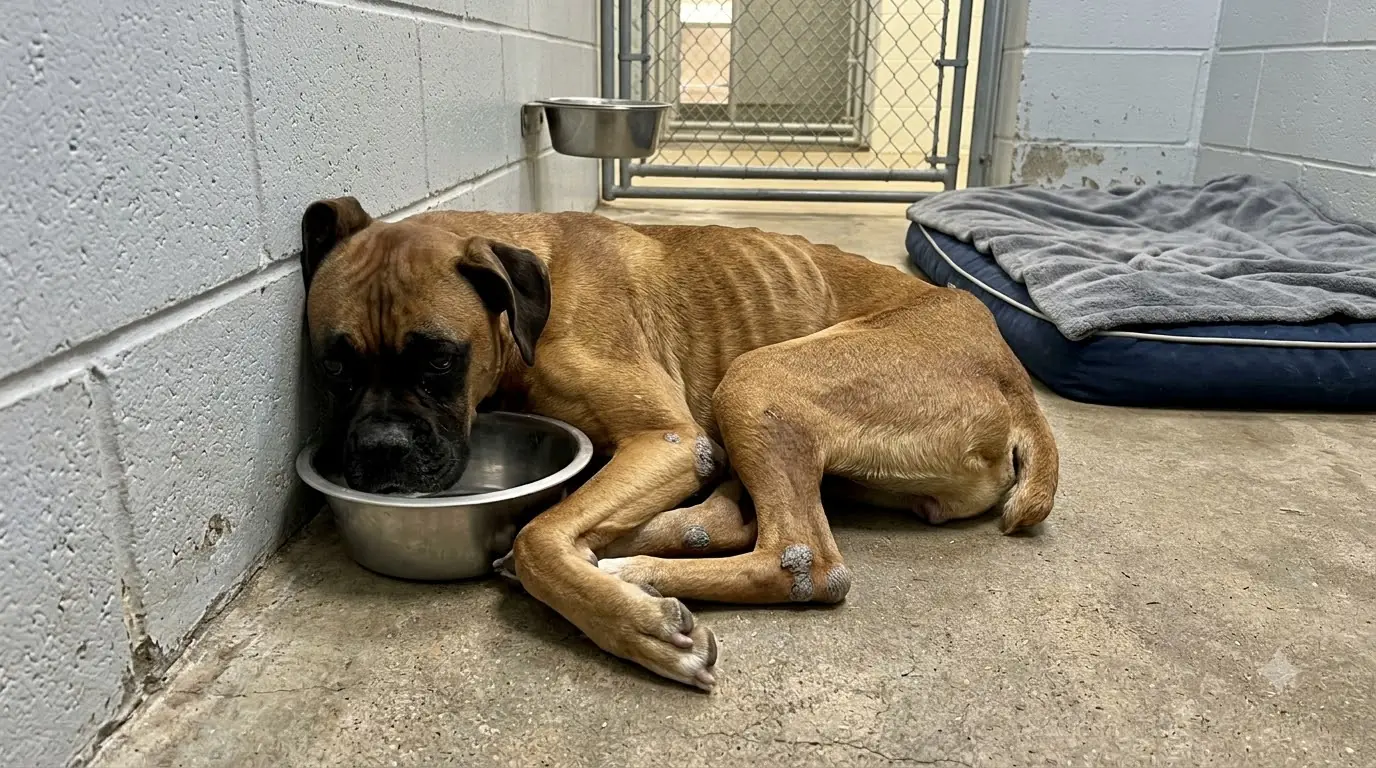
Ruby's bowl was empty.
The 6-year-old Boxer had already eaten every piece of food inside it.
But when the meal was over, she didn't walk away.
Ruby lowered her head, carefully gripped the rim of the stainless-steel bowl between her teeth, and lifted it from the floor.
Then she carried it across the kennel.
She went to the same corner she had chosen the day before.
Ruby placed the bowl down.
Turned around.
Then curled her thin body tightly around it.
The bowl contained nothing.
Ruby stayed beside it anyway.
Later, a shelter worker entered to collect the dishes for cleaning.
The person picked up Ruby's bowl and carried it away.
Ruby didn't follow.
Instead, she stood in the empty corner.
Her head lowered toward the exact spot where the bowl had been.
And she remained there until it came back.
Ruby Had Arrived at the Municipal Shelter Severely Underweight
Before the bowl became something staff noticed, there were much more urgent concerns.
Ruby had been rescued from an abandoned apartment.
She was significantly underweight when she entered the municipal shelter.
Old callused areas were visible on her legs.
There was no complete history available to explain everything about her condition.
Staff knew where Ruby had been found.
They knew what her body looked like when she arrived.
But they could not say exactly how long she had been eating inadequately, how the calluses developed, or what her daily life had looked like before rescue.
Those unanswered questions would remain separate from the care Ruby needed now.
Feeding Her Wasn't Simply a Matter of Filling the Biggest Bowl Possible
Ruby needed nutrition.
But a severely underweight dog also needed to be evaluated as a medical patient.
Staff had to pay attention to her hydration, appetite, digestion, energy and overall physical condition.
Depending on what her veterinary assessment showed, her feeding plan needed to match what her body could safely tolerate.
The goal was steady nutritional recovery.
Not one enormous meal.
So Ruby's food arrived according to the plan established for her.
And from the beginning, she showed plenty of interest in it.
Ruby Ate the Food
That detail mattered.
When her meal was offered, Ruby did not simply ignore the bowl.
She ate.
Staff watched her carefully because appetite could provide useful information during recovery.
But something unusual happened after the food disappeared.
Ruby kept the bowl.
The First Time, Nobody Thought Much of It
Dogs move bowls.
They push them with their noses.
They step on them.
Some carry lightweight dishes around.
A stainless-steel bowl sliding across a kennel floor is hardly remarkable by itself.
Ruby was different because the behavior developed into a consistent sequence.
She finished eating.
Picked up the empty bowl.
Carried it to the corner.
Set it down.
Then curled herself around it.
The next meal ended the same way.
And then the next.
It Was Always the Same Corner
Ruby didn't carry the bowl around randomly.
She had a preferred destination.
Once there, she placed the bowl down and settled around it.
Sometimes her chest rested close to the rim.
Sometimes the bowl sat between her front legs.
Other times Ruby curled her body so tightly that the stainless steel was partly enclosed by her legs and chest.
She wasn't eating from it.
There was nothing left to eat.
She simply remained beside it.
The Behavior Became Even More Noticeable on Cleaning Day
Shelter bowls have to be washed.
So a staff member entered Ruby's kennel and collected hers.
The worker expected Ruby to move on once the empty dish was gone.
Instead, Ruby returned to the corner.
She stood over the place where the bowl had been.
Her head lowered.
She looked toward the floor.
Then she waited.
Ruby Was Still There Several Minutes Later
The corner was empty.
Ruby remained standing there.
Eventually she lowered herself onto the floor.
But her attention stayed centered on that small area.
When the clean stainless-steel bowl was returned, Ruby immediately investigated it.
The object was back.
Only then did she settle more normally.
That made staff pay closer attention the next time the dishes were collected.
It Happened Again
Bowl removed.
Ruby went to the corner.
Head down.
Wait.
Bowl returned.
Ruby remained close to it.
Now the shelter had a genuine behavioral pattern to consider.
But a pattern is not the same thing as an explanation.
It Would Be Easy to Call It Food Insecurity
Ruby was severely underweight.
She had been rescued from an abandoned apartment.
She was now keeping an empty food bowl beside her.
The pieces seemed to fit a simple story.
Maybe Ruby was afraid food would disappear.
Maybe she believed protecting the bowl would guarantee another meal.
Maybe she had learned that dishes were scarce.
All of those interpretations would be emotionally compelling.
None could be established from Ruby's behavior alone.
Staff Didn't Know What the Bowl Meant to Her
The shelter did not have a reliable account of Ruby's previous feeding routine.
They did not know whether she had always carried bowls.
They did not know whether she had previously eaten from a similar dish.
And Ruby could not explain why this particular object repeatedly ended up in her chosen corner.
Her poor body condition made nutrition an obvious concern.
It did not turn every food-related behavior into proof of a specific past experience.
So staff stayed with what they could observe.
Ruby ate.
Ruby carried the empty bowl.
Ruby curled around it.
When the bowl disappeared, Ruby waited where it had been.
There Was Another Important Question: Was Ruby Actually Eating Enough?
The unusual post-meal behavior could easily distract people from the more medically useful information.
Staff needed to know whether Ruby was consuming the food offered to her.
Was she finishing meals?
Could she chew comfortably?
Was she swallowing normally?
Was she keeping food down?
Was her body responding appropriately to the nutritional plan?
Those questions mattered more than solving the mystery of the empty bowl.
Ruby's behavior could be documented without allowing it to replace medical monitoring.
Her Old Calluses Needed Attention Too
The callused areas on Ruby's legs were another visible part of her condition.
Pressure-related calluses can occur in dogs that spend significant time resting on firm surfaces, although their presence alone cannot reconstruct where or how a dog lived.
Staff checked the skin for irritation and made sure Ruby had appropriate soft resting surfaces.
Her thin body had less natural cushioning over prominent areas.
Comfort mattered.
So did allowing her to rest without unnecessary disturbance.
The Bowl Complicated That
Ruby's preferred corner was not necessarily where staff had originally intended her to sleep.
Her bed was elsewhere.
The bowl went to the corner.
Ruby followed it.
Instead of repeatedly moving her back to the bed, caregivers began paying attention to the place she was actually choosing.
If Ruby wanted to spend significant time there, the area could be made more comfortable.
Again, the shelter could adapt.
Ruby did not have to.
Nobody Took the Bowl Away to See What She Would Do
Once staff understood the pattern, deliberately removing the dish would have added little.
They already knew Ruby noticed its absence.
There was no reason to repeatedly provoke the response simply to make sure it still happened.
The bowl still had to leave for normal cleaning.
But that was different from turning its removal into an experiment.
Ruby had enough changes in her life already.
Her feeding routine could become one of the predictable parts.
Meals Began Following the Same Calm Pattern
Food arrived.
Ruby ate.
The bowl remained for a reasonable period.
When it needed cleaning, it was collected.
Then a clean bowl came back.
Day after day.
No missed meal was intentionally created to test her.
Nobody took food away to see whether Ruby would become more protective of the dish.
The shelter's job was not to recreate uncertainty.
It was to provide consistency.
Ruby Still Carried the Bowl After Eating
For a while, nothing about the behavior changed.
The final bite disappeared.
Ruby picked up the bowl.
Clink.
Her teeth caught the metal rim.
She walked toward the corner.
Set it down.
Then curled around it.
Staff let her settle.
The stainless-steel bowl looked strangely large beside her thin body.
That visual alone made it tempting to imagine everything the object might represent.