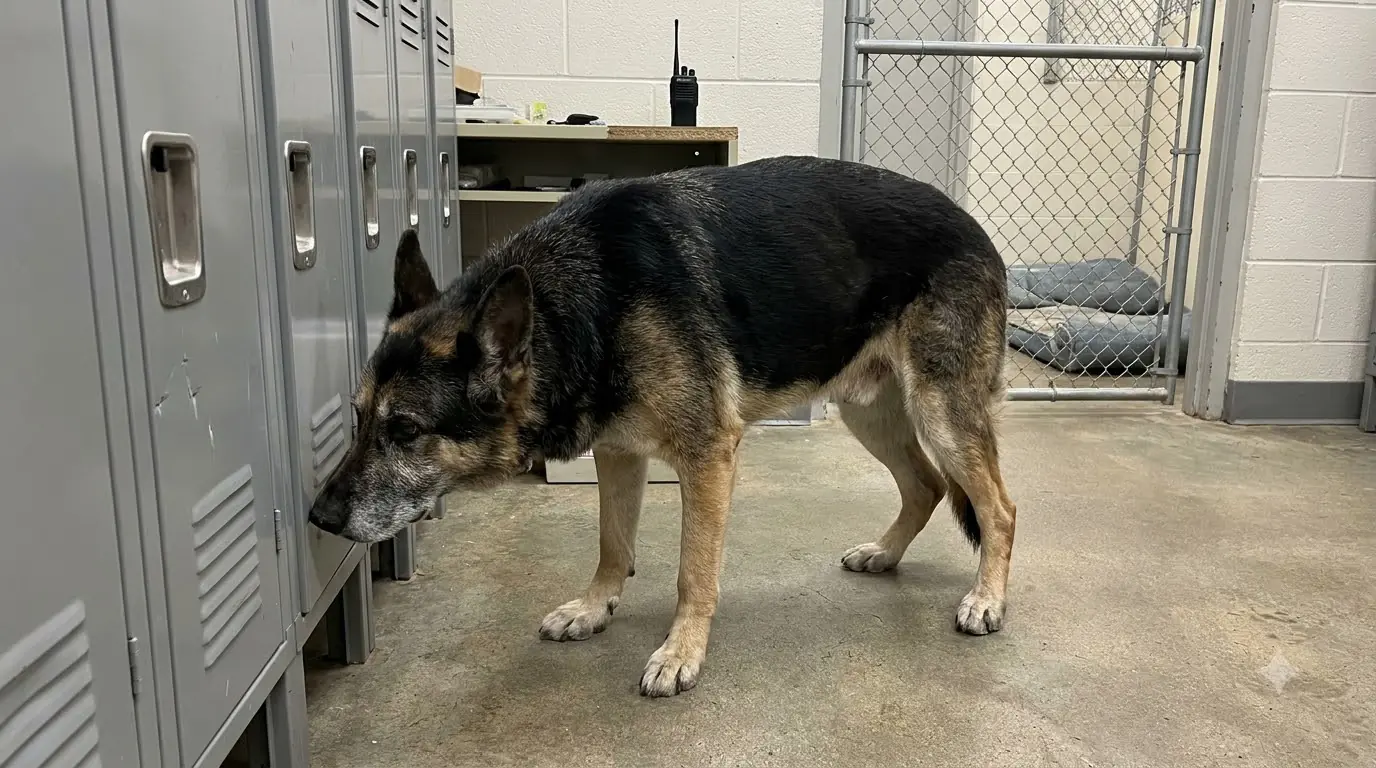
Most voices in the rescue barely make Scout look up.
The 11-year-old German Shepherd spends long stretches resting inside his kennel, his body showing the slower movements of a senior dog whose working years are behind him.
Staff talk in the hallway.
Visitors pass.
Other dogs react to footsteps and voices around them.
Scout often remains where he is.
Then a radio crackles.
The change is immediate.
Scout's head rises.
His ears stand upright.
And before the transmission has even finished, the retired K-9 is getting to his feet.
He walks toward the nearest door.
Sniffs around it.
Then moves to the next.
If there are lockers or storage cabinets nearby, Scout checks those too, putting his nose close to the seams and lower edges.
One after another.
Door.
Locker.
Another door.
Eventually, Scout returns to the front of his kennel.
He sits close to the gate.
His ears remain upright.
And he listens.
Staff Didn't Understand the Search at First
Radios are ordinary equipment around many working environments.
At the rescue, a burst of communication could happen without anyone giving it much thought.
But Scout noticed almost every time.
The first few reactions seemed like simple alertness.
A radio made noise.
Scout looked toward it.
Nothing unusual about that.
Then staff noticed what happened afterward.
Scout did not merely watch the person carrying the radio.
He started checking the surrounding area.
His nose went toward doors.
He investigated lockers.
He searched around places where nobody was standing.
Then he positioned himself at the kennel entrance as though the sound had changed the importance of everything happening beyond the gate.
When the building became quiet again, Scout eventually settled.
Until another radio transmission started the sequence over.
Scout Had Spent Years as a Working K-9
His background gave the behavior important context.
Before retirement, Scout had been a K-9.
He had worked alongside the same handler for years.
That meant his former life had been built around routines very different from those of an ordinary pet.
Equipment.
Vehicles.
Commands.
Work environments.
Repeated sounds associated with activity.
And a human partner who had been present through those routines.
Scout eventually retired.
Then his longtime handler died.
After that loss, Scout came into rescue care.
Staff knew those facts.
What they did not know was exactly what Scout remembered when a radio crackled in the hallway.
Nobody Said Scout Was Searching for His Handler
The interpretation was tempting.
A retired K-9 hears a radio.
He gets up.
He searches doors and lockers.
Then he sits listening.
It would be easy to say Scout believed his handler was somewhere nearby.
But nobody could know that.
Dogs can form strong associations between sounds and routines, particularly when those sounds have been repeated over years.
A radio could have predicted work.
Movement.
Attention.
A handler's activity.
A vehicle ride.
A command.
Or many events combined.
Staff could see that the sound had retained significance.
They could not responsibly translate Scout's behavior into a specific thought.
So they simply watched.
Ordinary Voices Couldn't Produce the Same Reaction
That difference made the pattern especially striking.
Someone could stand in the hallway talking for several minutes.
Scout might glance over.
Then lower his head again.
A visitor could call to him.
Sometimes he responded.
Sometimes he didn't.
But let a staff radio suddenly come alive—
Scout was listening.
Even when the transmission contained nothing meaningful to him, his posture changed.
His body became more upright.
His attention shifted toward the environment.
And if he had enough energy that day, he began his slow search.
At 11, Scout no longer moved like the dog who had once worked beside a handler.
But the sound still seemed capable of reaching him.
His Age Made the Searching Harder
Scout's reaction could look energetic for a few moments.
Staff also saw what happened afterward.
He was a senior German Shepherd.
Getting up repeatedly had a physical cost.
His turns were slower than they would have been years earlier.
Checking several doors required more steps.
After a longer search, Scout sometimes stood quietly before lowering himself again.
That meant caregivers did not deliberately activate radios just to watch what he would do.
The behavior was interesting.
Scout's comfort mattered more.
There was no reason to make an aging dog repeat a physically demanding routine for people to observe.
One Transmission Sent Him Farther Than Usual
A radio sounded while Scout was already outside his kennel with a caregiver.
His ears rose instantly.
Scout turned.
He walked toward a nearby door and sniffed along its bottom edge.
Nothing.
He moved toward a locker.
His nose traveled briefly across the front.
Then another.
The caregiver followed without directing him.
Scout continued until he had checked several nearby places.
Then he stopped.
For several seconds, he simply stood listening.
No second transmission came.
Scout eventually walked back toward his kennel.
He sat at the entrance.
His ears remained upright.
That was when the pattern became difficult for staff to ignore.
The radio did not merely attract Scout.
It appeared to start a sequence.
Years of Repetition Can Outlast the Job Itself
Working dogs learn through enormous amounts of repetition.
Specific cues can become associated with particular actions or states of attention.
Scout's current behavior did not prove exactly what role radios had played during his working career.
But it was plausible that a sound heard repeatedly during those years had become deeply familiar.
His circumstances had changed.
The job was over.
His handler was gone.
Scout was now living in a rescue kennel.
Yet the sound itself still existed.
And when it appeared unexpectedly, Scout's body responded before anything else around him had changed.
Staff Began Paying Attention to What Happened Afterward
The search was only the first part.
What Scout did when he finished became equally important.
He usually returned to the front.
Then he waited.
Sometimes standing.
More often sitting.
His eyes looked through the gate.
His ears moved toward hallway sounds.
A door closing could make one ear turn.
Footsteps might lift his head slightly.
But eventually the alert posture faded.
Scout's ears relaxed.
He lowered himself.
And the senior dog who had suddenly seemed intensely focused returned to resting.
Rescue Staff Wanted His New Life to Have Its Own Cues
Scout's working history would always be part of him.
There was no reason to erase it.
But his caregivers did not want the most meaningful moments of his day to depend entirely on accidental reminders of a life that no longer existed.
So they worked on building new routines.
Predictable walks.
Consistent caregivers.
Quiet one-on-one interaction.
Feeding schedules.
Rest periods.
Simple activities appropriate for his age.
The purpose was not to replace his handler.
Nobody could do that.
It was to give Scout things in his present environment that he could also learn to recognize.
At First, Radios Still Won Every Time
A familiar caregiver could enter.
Scout might stay down.
Food could arrive.
Scout responded when he was ready.
But a radio transmission could still bring his head up instantly.
Sometimes he tried to rise before staff had even finished speaking into it.
Caregivers began being more thoughtful about unnecessary radio noise close to Scout when he was resting.
They could not make the shelter silent.
Nor did Scout need to be protected from every familiar sound.
But there was little reason to repeatedly interrupt his rest if the sound consistently triggered a search.
Then Another Sound Started Getting a Reaction
It wasn't a radio.
It was the approach of one of Scout's regular caregivers.
The footsteps came down the hallway at roughly the same time they often did.
Scout's head lifted.
He looked toward the gate.
The person appeared.
Scout remained lying down, but his tail moved against the bedding.
That reaction was physically smaller than his response to the radio.
For staff, it was just as meaningful.
Scout was beginning to recognize something belonging entirely to his current routine.
The Searches Also Became Shorter on Some Days
A radio crackled.
Scout stood.
He checked the nearest doorway.
Then he paused.
Previously, he might have continued toward several lockers.
This time, he didn't.
A familiar caregiver called him gently from nearby.
Scout turned his head.
For several seconds, he seemed caught between the hallway and the person he knew.
Then he walked back.
Nobody treated it as Scout “forgetting” his old life.
There was no reason to frame it that way.
He had simply made a different choice that day.
His Working Past Still Shows Up in Small Moments
There are other times when Scout's posture changes suddenly.
Certain movements can capture his attention.
A purposeful voice can make his ears shift.
The presence of equipment may earn a longer look than an ordinary object.
Staff do not turn every response into evidence of a specific memory.
Scout cannot tell them what he recognizes.
But his history helps them understand why an elderly dog who seems indifferent to ordinary shelter noise can become intensely alert in a fraction of a second.
He spent years learning that some sounds mattered.
Age does not necessarily make every learned association disappear.
Scout Is Not Being Asked to Work Again
That distinction is important.
His response to familiar cues does not mean he needs a job.
It does not mean staff should recreate old working scenarios to stimulate him.
Scout is retired.
He is 11.
His needs now are different.
Comfort.
Appropriate movement.
Mental engagement that does not overwhelm him.
Reliable people.
Rest.
And the freedom to be an old dog rather than constantly being treated as the K-9 he once was.
His history deserves respect without becoming another demand placed on his body.
Some Days, the Radio Doesn't Bring Him to His Feet
Scout is sleeping.
A transmission comes through somewhere nearby.
His ears move.
His eyes open.
For a moment, he listens.
But his body remains on the bed.
The radio becomes quiet.
Scout lowers his head again.
On another day, the same sound may still bring him upright.
Senior dogs have stronger days and slower ones.
Staff do not use Scout's willingness to search as a measure of his health.
If he stays down, nobody asks him to prove that he still remembers.
But When He Does Get Up, the Pattern Is Still There
A radio crackles unexpectedly.
Scout's ears snap upright.
He rises.
Slowly now.
His aging legs need a moment underneath him.
Then he begins.
The nearest door first.
His nose moves along the edge.
Then a locker.
Another door.
He checks each one with the same quiet concentration staff have seen before.
Nothing appears.
Nobody familiar emerges.
Eventually, Scout returns to his kennel.
He sits close to the gate.
The hallway is quiet again.
But his ears remain raised.
He listens a little longer.
Staff still cannot say exactly what Scout expects after hearing that radio.
Maybe there is no single answer.
The sound belongs to years of his life that the rescue can know only in pieces.
What they do know is that Scout no longer has to keep searching until his old legs are tired.
When the radio falls silent and he returns to the gate, there are familiar people waiting for him there now.
And increasingly, Scout recognizes their sounds too.