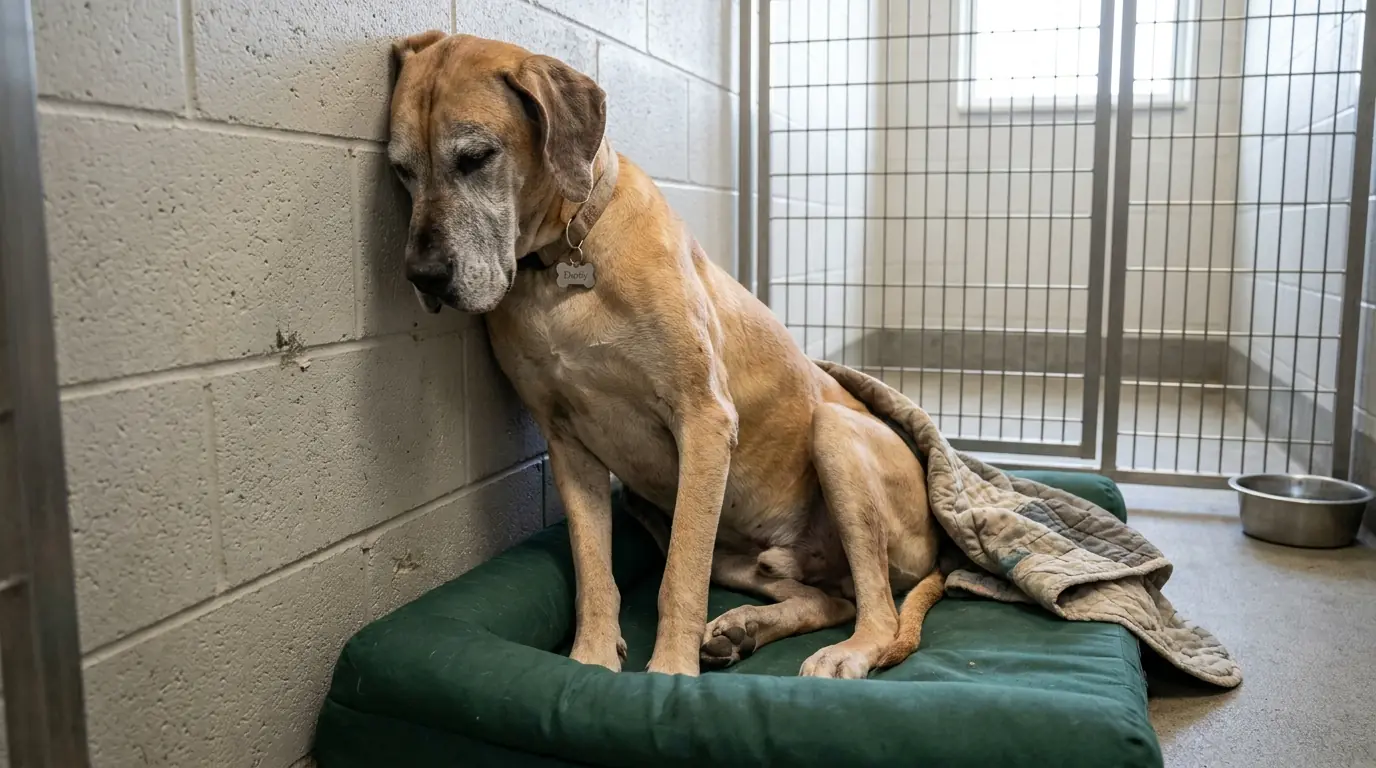
Eleanor Would Fall Asleep Before She Would Let Herself Lie Down
The first unusual thing about Eleanor was not how slowly she walked.
For an older Great Dane, some stiffness would not have been surprising. She was a very large senior dog, and years of carrying that much weight had clearly taken a toll on her body.
What caught our attention happened after she stopped moving.
Eleanor would walk carefully to the back of her kennel, turn until one shoulder was near the wall, and sit.
Then she stayed there.
Minutes passed.
Her eyes became heavy. Her head gradually dropped toward her chest. Sometimes it tipped slightly to one side before she lifted it again.
Then her eyes closed once more.
She was falling asleep sitting upright.
There was a bed only a short distance away, but Eleanor would not lower herself onto it.
At first, it could have looked like an odd preference. Some dogs sleep in unusual positions, especially during their first days in an unfamiliar shelter.
But Eleanor repeated the behavior.
She did it during quiet periods in the afternoon.
She did it after evening activity in the kennel hallway settled.
She did it when she was visibly tired enough that her head repeatedly nodded forward.
She would brace part of her enormous body against the wall and sleep in short stretches without ever fully lying down.
When she did attempt to lower herself, the reason became clearer.
Eleanor's front legs stiffened. She shifted her weight backward, hesitated, and then brought it forward again.
She wanted to rest.
Getting to the floor hurt.
A Great Dane Has a Long Way to Go Before Reaching the Ground
For a small dog, lying down requires lowering only a relatively short distance.
For Eleanor, it was a major movement.
Her shoulders stood high above the floor. Her long front legs supported a large portion of her body weight, and lowering her chest required controlled flexion through joints that had become severely compromised.
Her shoulders and elbows were particularly affected.
When she stood, Eleanor often kept her front legs positioned carefully beneath her. She avoided sudden turns. On the smoothest surfaces, she shortened her steps even further.
Sitting was not effortless, but she had developed a way to do it.
She would back toward something solid, lower her hindquarters gradually, and use the wall for additional support.
Going from that position all the way to lying down was different.
To reach the floor, Eleanor had to bend painful front joints while controlling the weight of her chest and shoulders.
That was the part she resisted.
So when exhaustion won before pain did, she slept sitting up.
We Could See the Problem, but We Could Not Invent Her History
Eleanor arrived without a complete medical record that could explain when her mobility problems began or how quickly they had progressed.
We could not say whether she had received previous treatment.
We could not determine from her behavior alone whether there had been one old injury that contributed to the deterioration.
And we could not responsibly attach a story of neglect to her condition simply because her arthritis was advanced.
Degenerative joint disease can develop over years, particularly in giant-breed dogs. Previous orthopedic problems, conformation, body weight, age, activity, and individual biology can all influence how severely a dog is affected.
What we could document was Eleanor's condition at intake.
She was an older Great Dane with significant difficulty using her front end normally.
She moved slowly.
Her range of motion was limited.
Transitions were especially difficult.
And when she became tired, she repeatedly chose to sleep sitting against a wall rather than perform the painful movement required to lie down.
That behavior became one of the most important clues for understanding how much her joints were affecting ordinary life.
Her Veterinary Examination Had to Be Done Carefully
Eleanor's size made gentle handling especially important.
A frightened or painful Great Dane cannot simply be lifted onto an examination table. Even routine positioning can become difficult when a dog is reluctant to bend compromised joints.
Her veterinary team allowed her to remain on surfaces where she had secure footing.
They watched her walk before asking her to tolerate more hands-on examination.
The way a dog moves into a room, turns, stops, sits, and attempts to rise can provide information that is lost if the examination begins only after the animal has been positioned.
Eleanor's gait showed substantial front-end stiffness.
Both elbows had reduced comfortable movement, and manipulation of the affected joints had to be limited according to her tolerance. Her shoulders were evaluated as well, along with her neck, spine, hind limbs, feet, and other joints.
The goal was not to assume every difficulty came from one location.
In a senior giant-breed dog, multiple orthopedic problems can exist at the same time.
Imaging of the areas of concern supported what the physical examination suggested: Eleanor had advanced degenerative changes affecting her front limbs, including significant osteoarthritis involving the elbows and shoulder region.
This was chronic disease.
There was no procedure that could simply erase years of joint degeneration and give Eleanor young, normal joints again.
The question became how much more comfortable we could make the body she had.
Pain Management Changed the Priorities Immediately
Eleanor's treatment plan centered on multimodal management rather than a single dramatic intervention.
Pain control was essential.
Veterinary treatment for severe osteoarthritis is individualized according to a dog's overall health, examination findings, bloodwork when indicated, medication tolerance, and response over time.
For Eleanor, medication was only one part of the plan.
Her environment mattered almost as much.
Every unnecessary slip could force her to catch a large body on already painful front joints.
Every difficult transition could discourage her from changing positions.
Every bed that was too soft, too high, too unstable, or too small could become another obstacle.
Even the distance between her resting place and water mattered.
Eleanor did not need to be persuaded to act younger.
She needed the physical demands of her day brought closer to what she could comfortably manage.
The Kennel Floor Was One of the First Things We Changed
Bare shelter flooring is practical for sanitation.
It was not ideal for Eleanor.
Large nonslip mats were placed where she needed to stand, turn, eat, and transition into a resting position.
Her bedding required experimentation.
A deeply cushioned bed might sound perfect for an arthritic senior, but if Eleanor sank too far into it, rising could become more difficult. A bed with a high edge could also create something she had to step over.
She needed cushioning without instability.
She needed enough room for the full length of a Great Dane.
And because lowering herself remained difficult, the resting surface had to be positioned so she could approach it without making a tight turn first.
We also paid attention to the wall.
Eleanor had already shown us that she used it deliberately.
Rather than immediately preventing her from sitting there, we made sure the area where she tended to brace herself was safe and that she could not become trapped between furniture or bedding if her legs shifted.
The goal was eventually to help her rest lying down more comfortably.
But until that became possible, taking away the position she trusted would not have helped her.
Sleep Was Becoming a Medical Issue of Its Own
Pain does more than change the way an animal walks.
It changes rest.
Eleanor's upright dozing was one of the clearest examples.
She could close her eyes while sitting, but she could not achieve the same relaxed posture as a dog stretched comfortably on a bed.
Her head would sink.
Her neck muscles would relax.
Then her balance would change enough that she woke slightly and repositioned herself.
Sometimes she shifted her shoulder more firmly against the wall.
Then the cycle started again.
She was sleeping, but not deeply or efficiently.
That gave us another way to evaluate treatment.
A pain plan should not be judged only by whether a dog can walk farther.
For Eleanor, an equally meaningful question was whether she could finally rest.
The First Attempts at Lying Down Were Still Difficult
Pain medication did not transform Eleanor overnight.
She still approached the floor cautiously.
When she attempted to lie down, she often paused midway.
Her hindquarters might already be lowered while her front legs remained extended, leaving her in an awkward position while she decided whether to continue.
Sometimes she abandoned the attempt and pushed herself back upright.
Other times she slowly walked her front feet forward, bending her elbows in tiny increments until her chest finally reached the bed.
There was no reason to rush her.
Pulling her legs into position would have been frightening and potentially painful.
Instead, the environment was arranged to give her time, traction, and space.
If she chose to remain sitting, she remained sitting.
If she started a transition and stopped, she was allowed to reconsider it.
Eleanor's body had probably been teaching her for a long time that certain movements hurt.
Trusting a new surface or a more comfortable medication plan could not immediately erase that learned caution.
Standing Up Was Its Own Challenge
Once Eleanor did lie down, another problem appeared.
Eventually, she had to rise.
For a Great Dane with severe front-limb arthritis, getting up requires considerable force through the shoulders and elbows.
Eleanor usually gathered her legs underneath herself slowly.
Her head and neck moved first.
She shifted her weight.
Her hindquarters engaged.
Then came the difficult front-end push.
On a slick surface, that effort could fail.
On a nonslip surface, she had a much better chance of bringing herself upright without scrambling.
A properly fitted support harness could be used when she needed assistance, but assistance had to be thoughtful.
The purpose was not to suspend Eleanor or force her forward.
It was to reduce some of the load during difficult transitions while still allowing her to participate in the movement.
Some days she needed more help.
Some days she needed almost none.
That variation became normal.
We Stopped Measuring Her Progress in Distance
With an arthritic dog, it is tempting to celebrate longer walks.
For Eleanor, longer was not necessarily better.
Her rehabilitation focused on comfortable, controlled movement.
Short walks helped prevent complete inactivity and allowed her to maintain as much useful muscle as possible. But pushing an older giant-breed dog until she was exhausted could worsen soreness and make the next transition even more difficult.
Her outings were therefore brief and purposeful.
She walked far enough to toilet, sniff, change scenery, and use her body without being asked to prove anything.
Her gait was monitored closely.
If her steps shortened further, if she began compensating differently, or if getting back to her resting area became noticeably harder, that information mattered more than the number of minutes she had been outside.
The same principle applied indoors.
A successful day was not a day when Eleanor spent the most time standing.
It was a day when she could move when she wanted to and rest when she needed to.
One Afternoon, She Finally Lowered Her Chest
The first meaningful change did not happen on a walk.
It happened during a quiet part of the day.
Eleanor had returned to her familiar position near the wall.
She sat.
Her shoulder rested lightly against it.
Her eyes began to close.
For a while, it looked exactly like the behavior we had been seeing since intake.
Then she shifted.
Her hindquarters moved slightly to one side.
One front leg slid forward on the nonslip surface.
She paused.
The other followed.
Slowly, Eleanor allowed her elbows to bend.
There was still hesitation in the movement.
There was still stiffness.
But she continued downward until her chest reached the padded surface.
Then she remained there.
Nobody tried to reposition her into a prettier sleeping posture.
Nobody asked her to roll onto her side.
She had chosen a position she could tolerate, and that was enough.
Her head stayed upright for a while.
Eventually, it lowered onto the bedding.
For the first time since entering our care, Eleanor remained fully down long enough to enter a deeper period of sleep.
It did not mean her arthritis was cured.
The next transition was still difficult.
But it gave us evidence that reducing her discomfort and changing the environment were making rest more accessible.
The Next Day, She Slept Sitting Up Again
Recovery from chronic pain rarely follows a clean upward line.
The following day, Eleanor returned to the wall.
She sat.
Her head drooped.
She slept upright again.
That did not erase what had happened the previous afternoon.
Arthritis fluctuates.
Activity, weather, muscle fatigue, the length of a previous rest period, and many other factors can influence how an older dog moves from one day to another.
There would be better days and harder days.
The important thing was that lying down had become possible sometimes.
Before, Eleanor appeared to avoid the movement almost completely.
Now she had another option.
Our job was to increase the number of times that option felt comfortable enough for her to choose it.
A Foster Home Let Her Establish Her Own Rhythm
Once Eleanor's medical plan was stable, a carefully prepared foster home gave her something difficult to provide in a busy shelter: long stretches of quiet and a predictable daily routine.
Preparing a home for a dog her size required more than buying a large bed.
Walking routes were covered with nonslip rugs.
Stairs were blocked.
Her food and water were placed where she could reach them without navigating unnecessary obstacles.
Several resting areas gave her choices.
The bed she used most was broad, low, supportive, and firm enough that she did not sink deeply into it.
Furniture was arranged to give her wide turning space.
Her foster caregivers also learned not to summon her from room to room.
Eleanor did not need to stand every time a person moved.
If she was comfortably resting, she could remain there.
This preserved her energy for the movements that actually improved her day.
At First, She Found a New Wall
The change in location did not immediately change Eleanor's sleeping habit.
Within her first days in foster care, she found a wall near one of her beds.
She backed toward it.
She sat.
She leaned her shoulder against it.
And eventually her eyes closed.
The behavior had followed her out of the shelter.
That was important.
It suggested that the posture was not simply a response to kennel stress.
It had become part of how Eleanor managed her body.
The foster home did not try to stop it.
Instead, the bed was adjusted closer to the position she already preferred, giving her the opportunity to transition from sitting to lying down without first walking across the room.
Sometimes she ignored it.
Sometimes she sat beside it.
Gradually, she began using it more often.
Her Caregivers Learned to Watch the Transition, Not Just the Destination
There was a temptation to look at Eleanor sleeping on a bed and conclude that she was doing well.
But how she got there remained important.
A dog can reach a resting position only after struggling through substantial pain.
So her caregivers watched the entire sequence.
How long did she hesitate before lowering herself?
Did she repeatedly start and stop?
Did her front feet slide?
Did she drop the final few inches rather than controlling the movement?
How long did she remain down afterward?
How difficult was it to rise?
Those details helped guide veterinary follow-up.
Medication plans for chronic osteoarthritis sometimes require adjustment. Side effects must be monitored. Body weight matters. Muscle condition matters. New pain should not automatically be blamed on an existing diagnosis without reassessment.
Eleanor was an older dog, and aging did not make new medical problems irrelevant.
Her arthritis explained a great deal.
It did not give us permission to stop paying attention.
Her Weight Was Managed With Her Joints in Mind
For a giant-breed dog with advanced arthritis, even modest excess weight can create additional mechanical demand.
Eleanor's nutrition was therefore managed carefully.
The objective was not aggressive weight loss.
It was maintaining an appropriate body condition while protecting muscle.
Meals were measured.
Treats were accounted for.
Her appetite, hydration, stool, and overall condition were monitored alongside her mobility.
Because exercise had to remain limited, food management became especially important.
At the same time, we did not want to reduce nutrition so aggressively that she lost muscle she needed to stabilize painful joints.
Her plan was about balance.
As with nearly everything in Eleanor's care, extremes were not useful.
Rest Slowly Became More Normal
Over the following weeks, the biggest improvements remained quiet ones.
Eleanor began approaching her preferred bed without always sitting against the wall first.
Sometimes she stood beside it for several seconds before starting the descent.
Her front legs still moved cautiously.
Her elbows still did not flex freely.
But the long period of hesitation became shorter on many days.
Once down, she began changing position occasionally rather than remaining rigidly in one posture.
She could stretch her neck forward.
She sometimes extended a front leg.
On especially comfortable days, she settled partly onto one side.
Those were meaningful changes because relaxed posture requires a dog to believe that both remaining down and eventually getting back up are manageable.
Eleanor was beginning to rest rather than simply becoming too tired to stay awake.
Not Every Night Was Easy
There were still evenings when the old pattern returned.
After a slightly more active day, Eleanor might walk past her bed and position herself beside the wall.
Her hindquarters lowered.
Her shoulder leaned into the solid surface.
Her head gradually began to fall.
On those nights, nobody forced her down.
Her pain and mobility were assessed.
Her routine was reviewed.
If a change was significant or persistent, her veterinary team needed to know.
But an occasional difficult day was not treated as a catastrophe.
Chronic osteoarthritis does not disappear because a dog has started treatment.
The aim is management.
For Eleanor, management meant increasing comfort, preserving function, reducing painful demands, and making sure the difficult days did not become the only kind of day she had.
Finding the Right Permanent Home Means Understanding What She Cannot Do
Eleanor's future cannot be planned as though she is simply an older dog who needs a soft couch.
Her physical requirements are specific.
A suitable home needs reliable traction.
Frequent stairs would be a serious problem.
She needs enough room to turn without twisting her front end sharply.
Her bed needs to support a Great Dane-sized body without creating another obstacle.
Her exercise must remain controlled.
Her body condition needs continued attention.
And her veterinary care will not end simply because she becomes comfortable in a home.
Osteoarthritis is progressive.
Her needs may increase.
She may eventually require more assistance rising.
Her walks may become shorter.
Medication may need to be reassessed.
Additional supportive strategies may become appropriate as her condition changes.
A permanent home must be prepared for the dog Eleanor is, including the possibility that her mobility will not always remain at today's level.
That honesty is part of protecting her.
She Is Still a Dog Who Sometimes Chooses the Wall
Eleanor now spends far more time lying down than she did when she first arrived.
There are afternoons when she walks to her bed, turns carefully, lowers her hindquarters, extends her front feet, and gradually brings her chest down.
The process is still slow.
Her joints are still severely arthritic.
She is still an elderly Great Dane moving a very large body on front legs that cannot bend comfortably.
Nothing about that has been magically repaired.
But she can rest.
And then there are harder days.
On those days, Eleanor still sometimes sits beside the wall.
She leans one shoulder against it.
Her eyes close.
Her enormous head begins to sink toward her chest.
The difference now is that the wall is no longer her only workable place to sleep.
Sometimes, after dozing there for a few minutes, Eleanor wakes slightly.
She looks toward the low bed beside her.
She shifts her hindquarters.
One front foot moves forward.
Then the other.
Her elbows bend slowly.
Her chest comes down.
Finally, her head settles onto the bedding.
She still has arthritis. Lying down may never become effortless, and getting back up will continue to require planning, traction, and sometimes help.
But the senior dog who once became so tired that she slept sitting against a kennel wall now has days when the floor no longer feels like an impossible distance away.