By the time Marcus Reed reached number 418 on Willow Lane, he already knew which sound he was supposed to hear.
It happened almost every weekday at roughly the same point in his route. His mail truck rolled past the maple tree at the edge of Ruth Carter’s property, the brakes gave their familiar squeak, and before Marcus had even stepped fully onto the sidewalk, Molly began barking from somewhere inside the house. Sometimes she appeared at the living-room window first. Sometimes the dining room. On warm mornings, when Ruth left the screen door open, Molly’s warning arrived before Marcus had touched the gate.
Marcus used to joke that the dog had spent five years trying to get him fired.
Ruth always laughed.
“She doesn’t hate you,” she would call from the doorway. “She just thinks she runs the neighborhood.”
Molly usually stood several feet behind her, still barking, tail moving so hard that the entire back half of her body seemed involved. Marcus would hand Ruth the mail, pretend to glare at the dog, and say something like, “One day she’s going to realize I come here six times a week and have never stolen anything.”
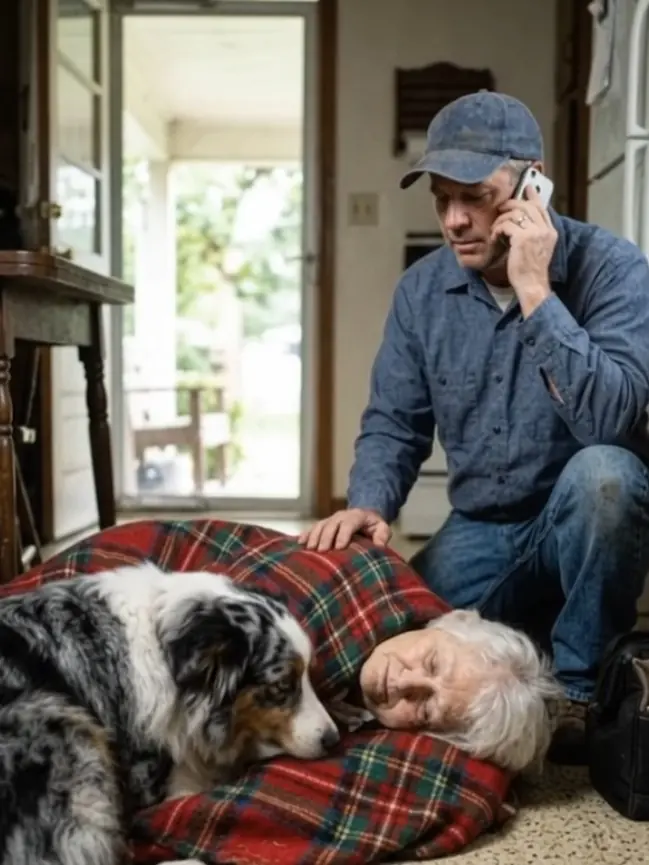
Molly never appeared convinced.
That routine became so ordinary that Marcus stopped thinking about it.
Which was why the silence on that Tuesday morning felt wrong before he could explain why.
The truck stopped.
Marcus stepped out.
Nothing.
No bark from the living room.
No nails racing across hardwood.
No Ruth opening the door before he reached the porch.
He glanced toward the house.
The curtains were still closed.
That was unusual too.
Ruth was seventy-eight and lived alone, but she kept the kind of schedule that would have made a military officer seem careless. Curtains open by seven. Coffee before seven-thirty. Molly outside shortly after. Newspaper retrieved. Mail checked almost immediately after Marcus delivered it.
Marcus knew none of this because Ruth had formally explained her routine.
He knew because mail carriers notice things.
The same porch.
The same people.
The same cars.
A flowerpot moved three feet can feel like a major renovation when you have walked past the same house five days a week for years.
Marcus climbed the steps.
Yesterday’s mail was still partly visible inside the box.
He stopped.
Ruth never left mail overnight.
Not once in five years.
He looked toward the kitchen window.
That was when he saw Molly.
The dog stood behind the glass.
No barking.
Her face was close enough that her nose almost touched the window, and she was looking directly at Marcus.
He lifted one hand.
“Hey, trouble.”
Molly did not move her tail.
She disappeared.
Marcus waited.
Several seconds later she came back.
She looked at him again.
Then she turned and ran toward the rear of the house.
Marcus frowned.
“Ruth?”
He knocked.
Nothing.
He rang the bell.
Nothing.
Molly returned to the window.
Still silent.
Marcus stepped backward from the porch.
The dog disappeared again.
This time he could hear her moving through the house toward the kitchen.
Then came one short bark from somewhere near the back.
Marcus looked at yesterday’s mail again.
Something inside him shifted.
He set his mailbag down.
The entire story people later told about that morning usually began there, with a mail carrier deciding to walk around a house instead of continuing his route.
What most people did not know was that Marcus’s decision had been built over five years.
And what even Marcus did not fully understand until later was that Molly had been building her own routine for much longer than that.
Ruth Carter had never intended to own a dog at seventy-two.
Her husband, Daniel, had died the previous spring after forty-nine years of marriage. For most of her adult life, Ruth had lived inside a house full of noise. Three children. Their friends. Grandchildren later. Daniel’s television too loud in the den. The washing machine running at strange hours because somebody always needed something clean by morning.
Then the children grew up.
Daniel died.
The house became quiet.