Fall arrived early in Vernon County that year.
By the second week of October, the hills of western Wisconsin had already lost most of their green. Maples burned red along the ridges, oak leaves collected against fence posts, and every morning began beneath a thin skin of frost that disappeared only after the sun climbed above the limestone bluffs.
Farmers watched the sky differently in October.
They watched for rain before harvest.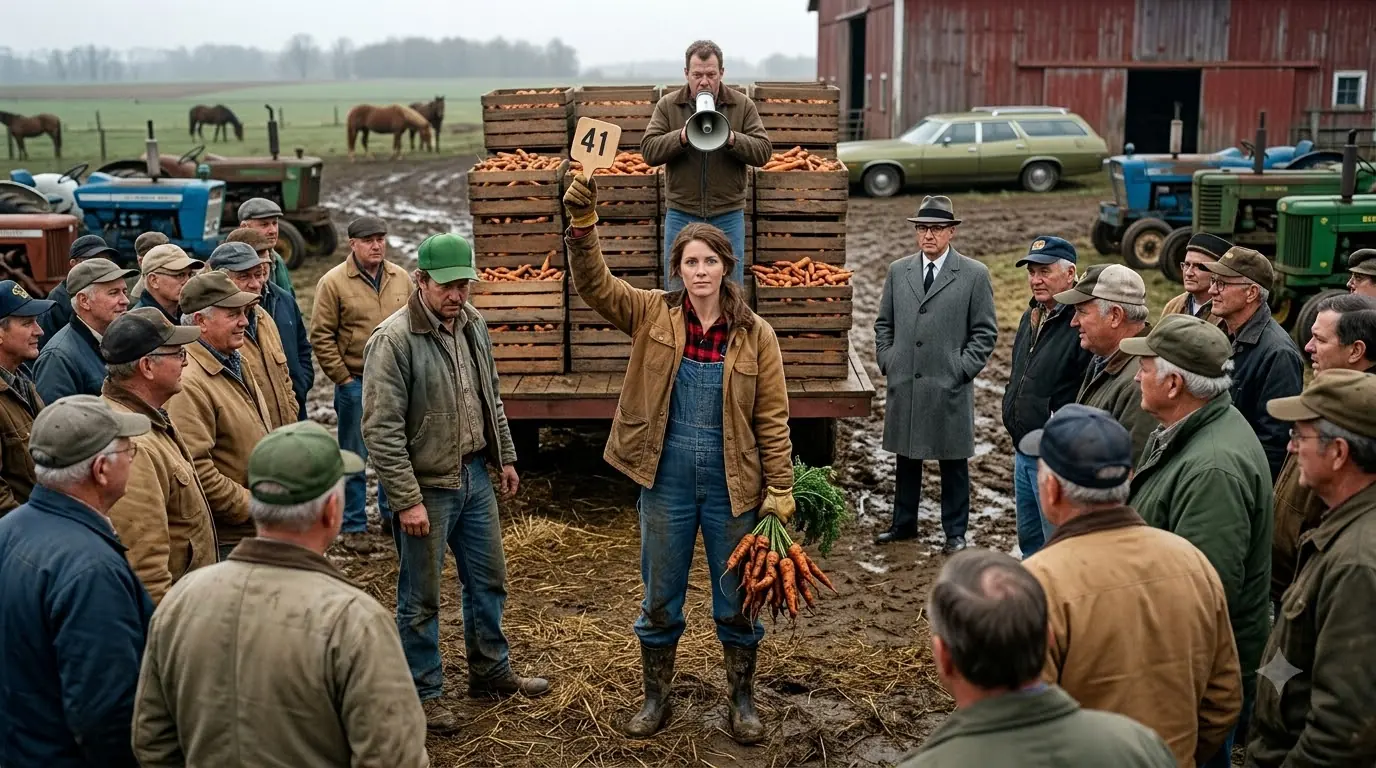
They watched for early snow.
They watched for the kind of cold that could turn a month of work into a field of frozen loss overnight.
Mariabel Thorson watched numbers.
She had been doing that for two years.
Numbers kept a widow alive when sympathy stopped paying bills.
Feed prices.
Diesel.
Seed.
Veterinary invoices.
Interest.
Repair parts.
Fence posts.
Property taxes.
Every expense had a number, and every number eventually found its way into the green composition notebook she carried inside her coat.
That notebook had belonged to her husband.
Daniel had bought it at a drugstore in Viroqua for twenty-nine cents and used the first six pages to track fencing materials.
After he died, Mariabel tore those pages out.
Not because she wanted to forget him.
Because looking at his handwriting made it impossible to think.
She needed the notebook for something else.
Survival.
So every evening after the animals were fed and the barn lights went dark, she sat at the kitchen table beneath a yellow hanging lamp and wrote.
Hay.
Oats.
Mineral salt.
Veterinarian.
Fuel.
Mortgage.
Repair.
She wrote until grief became arithmetic.
Arithmetic was easier.
On October 16, 1971, the notebook told her something she did not want to know.
If winter feed costs rose another fifteen percent, she would not have enough operating cash to reach spring without borrowing again.
And borrowing again meant returning to First County Bank.
Returning to First County Bank meant sitting across from Howard Breslin.
Howard Breslin always folded his hands when he explained bad news.
He had folded them when Daniel died.
He had folded them when Mariabel first requested that the farm note remain in her name.
He had folded them when he told her that lenders preferred “predictability.”
By predictability, Howard meant men.
Men with wives.
Men with sons.
Men whose farms looked like the farms on bank calendars.
Mariabel’s farm did not look predictable anymore.
It had a widow running it.
Twenty-six cattle.
Four horses.
Thirty-eight acres of corn.
A machinery shed with one patched roof panel.
A tractor that consumed oil.
And not nearly enough money.
That was why she went to the Holdridge auction.
Not because she needed equipment.
Not because she expected opportunity.
Because auctions were where desperate farms revealed what things actually cost.
The Holdridge family had farmed north of Westby for almost sixty years.
By 1971, three brothers owned the place together and none of them wanted to continue.
One worked construction in La Crosse.
Another had moved to Minnesota.
The youngest wanted to sell the land and buy a trucking business.
So they held an auction.
Tractors first.
Wagons.
Cultivators.
A manure spreader.
Milk cans.
Fence posts.
Old tools.
Then the crops nobody wanted.
The carrots came last.
They sat in wooden field crates and in long dirty piles beside the sorting shed, orange beneath a gray Wisconsin sky.
They were ugly.
Forked.
Bent.
Twisted.
Some looked like hands.
Others looked like roots pulled from a fairy tale.
The local cannery had refused them because its cutting equipment worked best with uniform carrots.
At least, that was the story everyone had heard.
Auctioneer Earl Mink stood beneath a canvas canopy and lifted his microphone.
“All right, boys, last agricultural lot.”
Men moved closer.
Mariabel remained near the rear.
“Approximately sixty tons of off-grade carrots.”
Someone laughed.
Earl continued.
“Buyer responsible for loading and hauling.”
Another laugh.
That was the real problem.
Sixty tons of vegetables were not merely worthless if nobody wanted them.
They were expensive to move.
Earl started optimistically.
“One hundred dollars.”
Silence.
“Seventy-five.”
Someone shouted, “You paying us?”
Laughter.
Earl grinned.
“Fifty.”
No hands.
“Twenty-five.”
Mariabel studied the carrots.
She had already calculated something.
A ton of oats cost real money.
Good hay cost more every month.
Carrots were not a complete livestock ration, but horses could eat them in sensible quantities.
Cattle could consume chopped root vegetables when mixed properly with other feed.