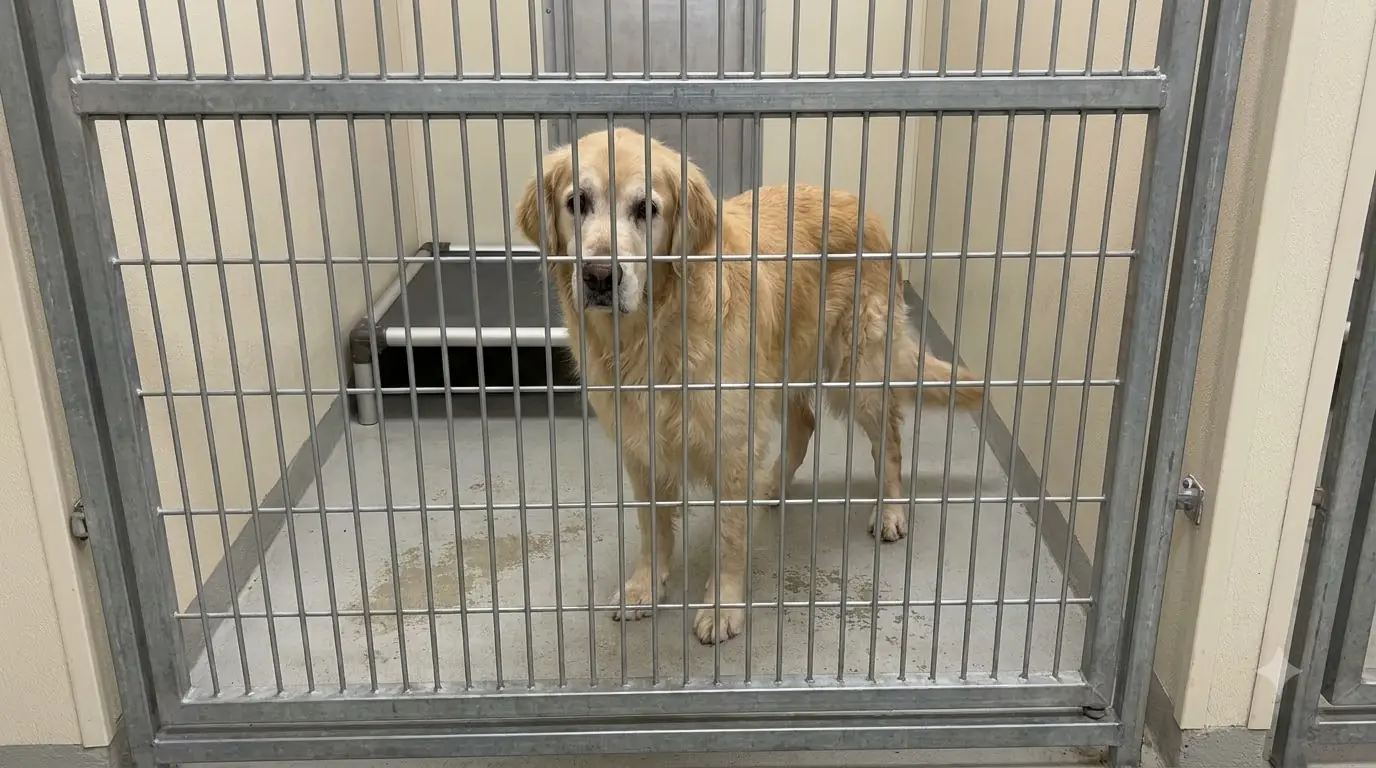
Teddy has a comfortable bed at the back of his kennel.
Most of the time, that is where the 11-year-old Golden Retriever needs to be.
Severe arthritis has made movement difficult, and significant muscle loss through his hindquarters means his back legs can support him for only short periods.
When the hallway is quiet, Teddy rests.
Then someone stops in front of his kennel.
His head comes up.
His front paws move underneath his chest.
And before the visitor has done anything else, Teddy begins trying to stand.
It is not an easy movement.
He pushes through his front legs first, lifting his chest from the bedding. His hindquarters follow more slowly.
For a moment, Teddy is upright.
He walks the short distance to the kennel gate and stands as close to the bars as possible.
His tail starts wagging.
Then the shaking begins.
First in one hind leg.
Then both.
Within seconds, Teddy can no longer hold himself up.
His back end slowly sinks toward the floor.
But Teddy doesn't return to his bed.
He lies down directly against the kennel gate instead.
And if the visitor stays, Teddy stays too.
Staff Quickly Realized Teddy Was Doing It for Almost Everyone
At first, there seemed to be nothing unusual about a Golden Retriever wanting to greet people.
Then staff saw how physically difficult each greeting was.
Teddy didn't get up only for familiar caregivers.
A visitor could stop.
A volunteer could crouch outside.
Someone Teddy had never met could pause for a few seconds.
His response was remarkably similar.
Head up.
Front paws underneath him.
Push.
Stand.
Gate.
Tail wag.
Then trembling legs.
Sometimes staff barely had time to reach him before his hindquarters began giving way.
The behavior was consistent enough that caregivers started facing a strange problem.
Teddy clearly wanted to approach people.
His body could no longer comfortably keep doing it.
His Front Half Could Hide Just How Weak His Back Legs Had Become
When Teddy first pushed himself upright, he could look stronger than he actually was.
His front legs still provided substantial support.
His shoulders could lift his chest.
Once standing, he could sometimes manage several careful steps.
But his hindquarters told a different story.
Muscle loss had left his rear legs visibly weaker.
Severe arthritis added pain and stiffness to movements that already required considerable effort.
Standing still could be especially difficult.
Within moments, the muscles began trembling under Teddy's weight.
That tremor was not something staff wanted visitors to interpret as excitement.
It was physical fatigue.
Teddy had reached his limit.
Yet Going Down Didn't End the Greeting
This was the detail that made his routine especially noticeable.
Once Teddy's legs failed, he did not immediately try to get back to the orthopedic bed.
He stayed at the front.
Sometimes he lowered himself relatively smoothly.
Other times a caregiver helped support his body as he went down.
Then Teddy settled against the bars.
His nose remained near the opening.
His eyes followed the person outside.