The gun was already pressed into my ribs when my eleven-year-old daughter realized the man wearing the police patch was not a real police officer.
I knew it several minutes earlier.
Lily only knew that a large stranger had grabbed her father, shoved him against the side of our truck, and drawn a handgun while an older woman in pearl earrings watched from the curb with satisfaction.
The muzzle dug harder into my left side.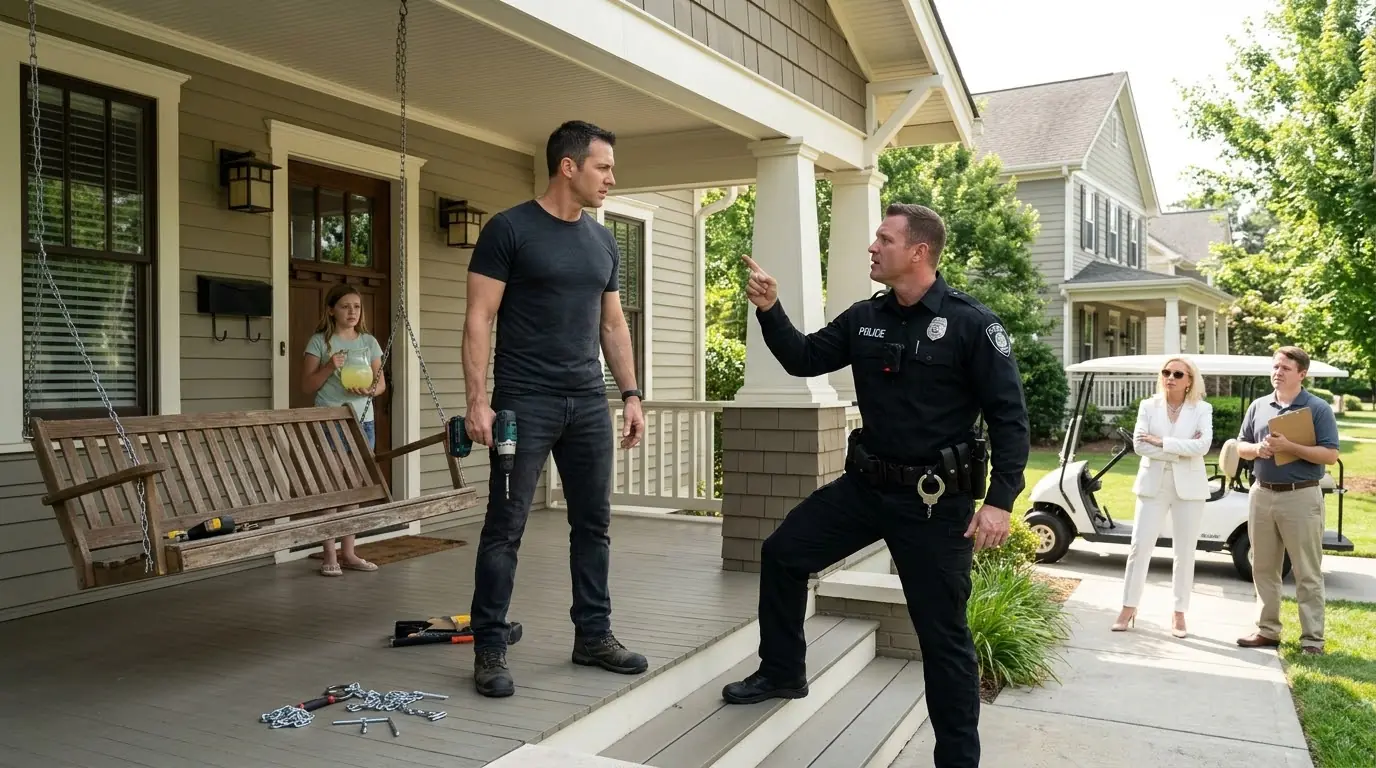
“Take one more step, hero,” the man whispered, “and your daughter gets to watch you fall.”
Six feet behind him, Lily stood frozen on our front porch.
She still held the glass pitcher of lemonade she had brought outside for me. Her fingers were locked around the handle so tightly I could see her knuckles whitening.
I kept my hands away from my waist.
Away from my pockets.
Away from the weapon concealed beneath my shirt.
Most importantly, away from him.
Years of training screamed possibilities into my head.
His right elbow was too high.
His stance was narrow.
The gun sat badly against my ribs, angled upward.
If I trapped the wrist, stepped off line, drove my shoulder forward, I could probably take it.
Probably.
That word matters when your child is watching.
I had spent fifteen years arresting fugitives for the United States Marshals Service. I had entered motel rooms with murder suspects behind the door, chased armed men through apartment complexes, and stood in hallways while people on the other side promised to kill anyone who came through.
But none of those situations had included my daughter standing six feet away.
So I did nothing.
Not because I was afraid of the man.
Because I was terrified for Lily.
Behind him, Gloria Whitcomb adjusted one sleeve of her immaculate white pantsuit and smiled.
“Maybe now you’ll learn to follow community rules.”
She had driven to our house in a white golf cart as though she were arriving to inspect a landscaping violation instead of supervising an armed threat.
Her pearl earrings caught the morning sun.
Two neighbors watched from across the street.
A third had cracked open an upstairs window.
Beside Gloria stood Evan Holt, the quiet HOA board treasurer who had spent the previous week looking as though he wanted to disappear every time Gloria spoke.
He held his clipboard against his chest.
His face had gone gray.
I looked at the man holding the gun.
Black tactical shirt.
Navy cargo pants.
Duty belt.
Handcuffs.
Cheap plastic badge.
A rectangular patch that said POLICE without naming a department.
Crooked nameplate.
MERCER.
Then I looked at the small camera clipped above his shirt pocket.
A red light blinked.
Recording.
Good.
If I survived the next thirty seconds without doing anything stupid, that blinking red light might become the most honest witness on the street.
I lowered my voice.
“Lily.”
Her eyes moved from the gun to me.
“Dad?”
“Put the pitcher down.”
Her lip trembled.
“Dad, he—”
“I know.”
I kept my tone soft.
“Set it down for me.”
She crouched slowly and placed the pitcher on the porch boards.
The glass touched wood with a tiny click.
That sound has stayed with me longer than the gun.
Mercer glanced toward her.
I used the moment to study the safety position on his pistol.
Real gun.
Not a prop.
Not an airsoft pistol.
A compact nine-millimeter that looked as though it had spent more time being displayed than properly maintained.
His thumb was nowhere near the safety.
His trigger finger was indexed along the frame.
At least he had learned that much somewhere.
“Wallet,” he said.
I looked at him.
“What?”
“I want identification.”
I almost laughed.
Not because the situation was funny.
Because five minutes earlier I had offered to identify myself and he had refused.
Now, with a gun against me, he wanted to know who I was.
Gloria gave an impatient sigh.
“For once in your life, Mr. Brooks, cooperate.”
Nine days.
We had lived in Pine Hollow Estates for nine days.
Apparently that was long enough for Gloria Whitcomb to develop opinions about my entire life.
I looked at her.
“You want him to see my identification?”
She folded her arms.
“Yes.”
“Fine.”
I returned my attention to Mercer.
“My credentials are in my right front pocket.”
His eyes narrowed.
“What credentials?”
“You asked for identification.”
“Slow.”
“Tell me when.”
He removed the gun from my ribs and stepped half a pace back.
Not enough.
But enough that I could breathe differently.
“Two fingers,” he said.
I slid two fingers into my pocket.
Pulled out the brown leather credential case.
Mercer’s eyes stayed on my hand.
The body camera stayed on everything.