General Isaiah Montgomery noticed the patrol cruiser before the emergency lights ever came on.
That was not unusual.
Thirty-five years in uniform had trained him to notice vehicles that slowed without reason, doors that remained open too long, windows reflecting movement, people who watched without appearing to watch, and the subtle changes in a room when someone decided violence might become necessary.
Some habits survived retirement from combat long before a soldier ever retired from service.
The black-and-white cruiser had been behind him for almost two blocks.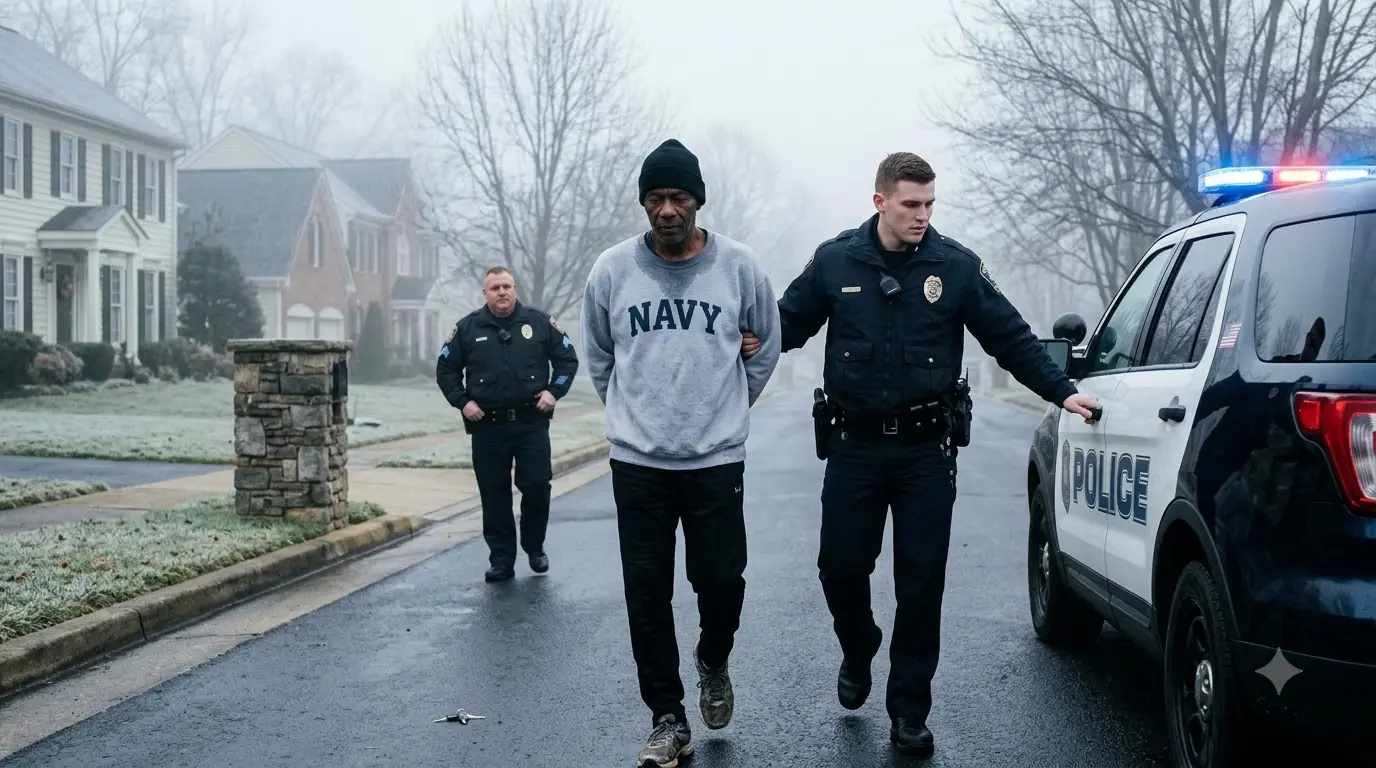
At first, it matched his pace from a distance.
Then it slowed.
Isaiah kept jogging.
The Virginia morning was cold enough that each breath appeared faintly before him. Fog settled low over the expensive lawns of Pine Valley, softening the edges of stone walls, white columns, perfect hedges, and houses large enough to make his new one-story home seem almost modest despite what it had cost.
He wore black running pants, worn athletic shoes, a dark knit beanie, and a faded gray sweatshirt with NAVY printed across the chest.
The sweatshirt had been given to him years earlier by Admiral Daniel Ross after an argument about which service branch had produced the most stubborn officers in American history.
Isaiah had lost the argument deliberately.
The admiral never knew.
Isaiah had kept the sweatshirt.
That morning, he had chosen it without thinking.
He had been awake since four.
His daughter was coming home.
That was the only thought that had mattered when he left the house.
Captain Leah Montgomery would arrive from Walter Reed shortly after two in the afternoon.
Thirty-two years old.
Combat engineer.
Sharp enough to challenge generals and stubborn enough to make Isaiah simultaneously proud and exhausted.
She had lost part of her right leg six months earlier after an attack overseas.
The official citation described what happened in language that sounded clean.
Enemy attack.
Burning transport vehicle.
Multiple casualties.
Captain Montgomery exposed herself to direct fire while assisting wounded personnel.
Those sentences did not describe what Isaiah remembered.
The hospital call.
The flight.
The way his daughter looked when he first entered her room and she immediately said:
“Dad, don’t make that face.”
He had not known he was making one.
“What face?”
“The one where you’re pretending I’m not hurt because you think that will help.”
Isaiah had sat beside her.
“You’re hurt.”
“Thank you.”
“You’re alive.”
“That too.”
Then Leah had taken his hand.
“I need you to understand something.”
“What?”
“I am not coming home so you can turn your entire life into taking care of me.”
He had almost laughed.
“You think you can stop me?”
“Yes.”
“How?”
“I outrank you emotionally.”
Even lying in a hospital bed, pale from surgery and exhausted by medication, she had managed to make him smile.
The house on Willow Creek Lane had been his compromise.
One story.
Wide hallways.
Minimal steps.
A shower that could be adapted without looking like a hospital room.
A backyard facing woods.
Enough privacy for Leah to recover without feeling watched.
Enough space for Isaiah to stay close without hovering.
He had purchased it three weeks earlier.
That Tuesday morning, before Leah’s arrival, he needed to run.
Six miles.
Maybe seven.
Enough distance to quiet the thoughts he would never admit were fear.
Not fear that his daughter would fail.
Isaiah had never doubted Leah.
He feared becoming the kind of father who loved her so fiercely that he accidentally made recovery harder.
So he ran.
At 6:21 a.m., the police cruiser’s lights came on.
A single siren chirped.
Isaiah immediately moved from the road onto the damp grass beside the curb.
He stopped.
Turned slightly.
Kept both hands visible.
The cruiser stopped behind him at an angle.
The driver’s door opened first.
Officer Blake Higgins stepped out.
Young.
Maybe twenty-eight.
White.
Athletic build.
Short brown hair.
Pine Valley Police Department patch on the shoulder.
One hand already positioned near his duty belt.
Isaiah noticed everything in less than two seconds.
The passenger door opened.
Sergeant Mitchell Carter emerged more slowly.
Mid-forties.
Heavier.
Coffee cup in one hand.
No urgency in his movements.
The expression on Carter’s face bothered Isaiah more than Higgins’s tense posture.
Higgins looked nervous.
Carter looked bored.
Bored men with authority had caused Isaiah more trouble over the years than frightened ones.
Higgins approached.
“Where are you going?”
No greeting.
Isaiah’s breathing remained steady from the run.
“Good morning, Officer.”
Higgins’s expression tightened.
“I asked where you’re going.”
“I’m finishing my run.”
“Where do you live?”
“Willow Creek Lane.”
Carter took a drink of coffee.
“Willow Creek?”
Isaiah looked toward him.