The first chicken hit the mud running.
Avery Collins watched the reddish-brown hen shoot down the aluminum ramp of the livestock trailer, flap both wings as if personally offended by the weather, and disappear between two rows of apple trees whose lower trunks still carried brown flood marks from the storm.
The second bird followed.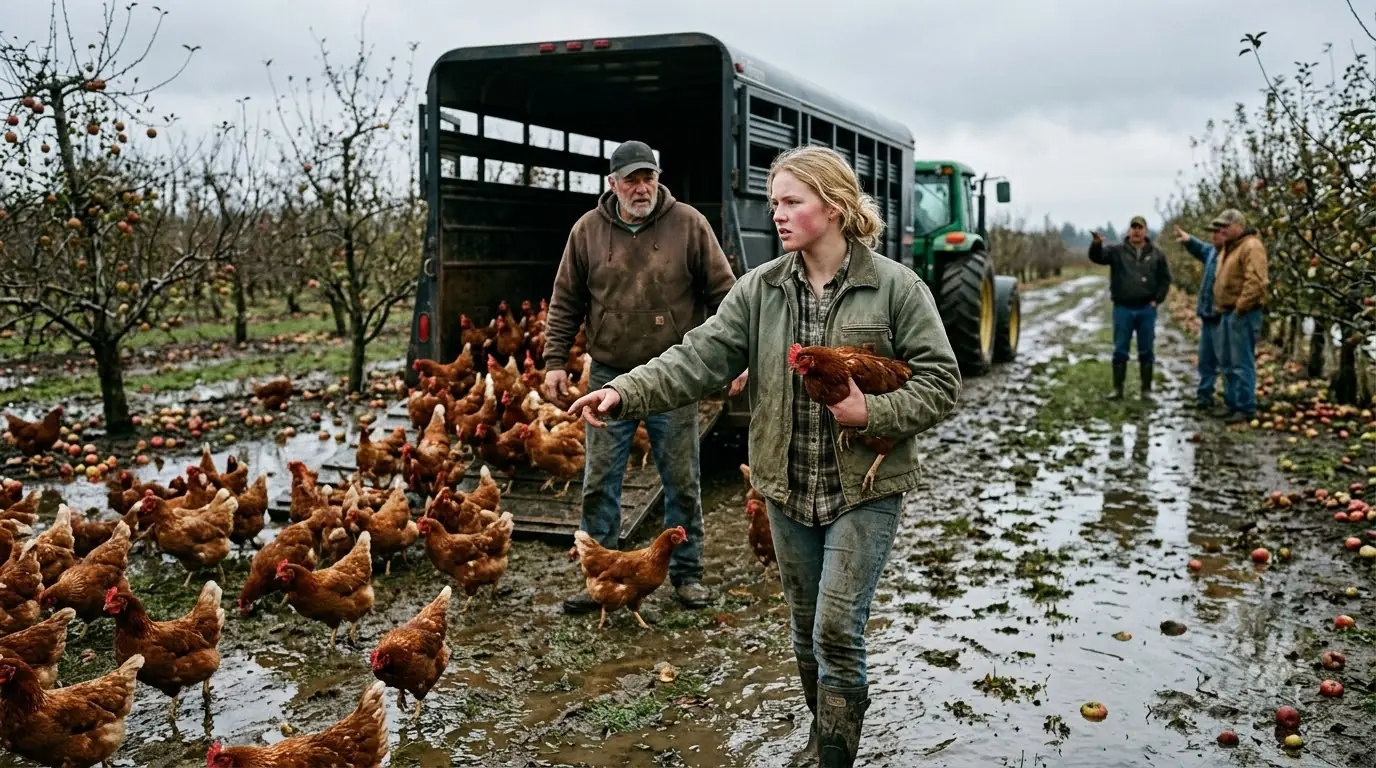
Then five.
Then twenty.
Within thirty seconds, the ramp seemed to pour chickens.
They came squawking, stumbling, hopping over one another, scratching at mud, pecking at fallen apples, darting beneath low branches, and scattering across the flooded orchard like somebody had opened a sack of feathers into the wind.
Avery stood in the middle of it wearing a faded olive work jacket, a red-and-gray plaid shirt, mud-stained jeans, rubber boots, and work gloves that had stopped being waterproof sometime during the previous autumn.
One hen refused to leave her arms.
Avery tucked it against her ribs with one hand while waving the others toward the orchard with the other.
Behind her, Earl Whitaker stared at the scene as if she had just released five hundred raccoons inside a church.
He was sixty-three, lean from forty years of orchard work, with a gray beard and the permanent squint of a man who had spent most of his adult life looking at weather he did not trust.
“Avery.”
She pretended not to hear.
“Avery.”
Another twenty chickens spilled down the ramp.
She turned.
“What?”
Earl pointed toward the birds.
“Tell me you didn’t actually buy all five hundred.”
“Four hundred ninety-eight.”
Earl blinked.
“What happened to the other two?”
“One died before pickup.”
“That is not the comforting distinction you think it is.”
Avery lowered the hen she was carrying.
It hit the ground, shook itself once, and immediately began pecking at a split apple.
Earl looked down at it.
Then across the orchard.
Then back at Avery.
“This is insane.”
“That makes seventeen times you’ve said that.”
“I’m keeping count.”
“So am I.”
She pulled a small notebook from her jacket.
The cover was already warped from moisture.
On the first page she had written the date.
October 18.
Temperature.
Rainfall from the previous week.
Number of birds unloaded.
Feed purchased.
Fuel consumed.
Labor hours.
Earl stared.
“You’re writing down how many times I tell you you’re crazy?”
“Different notebook.”
He almost smiled.
Almost.
Then laughter came from beyond the fence.
Avery looked toward the road.
Three pickup trucks had stopped on the gravel shoulder.
Of course they had.
Nothing traveled faster through Hawthorne County than weather, debt, and somebody else’s bad idea.
Frank Wheeler leaned against the hood of his truck holding a paper coffee cup.
Beside him stood brothers Kyle and Travis Maddox, both wearing insulated farm jackets and expressions that suggested they had driven over specifically for entertainment.
Frank raised his cup.
“Well, I’ll be damned.”
Kyle laughed.
“She really did it.”
Travis shouted across the fence.
“You starting a petting zoo, Avery?”
Avery turned back to the trailer.
More chickens poured out.
Frank came closer.
His boots stopped at the edge of the mud.
He was fifty-eight, heavy through the shoulders, with a red face and the loud confidence of a man who had survived enough farming disasters to believe surviving them made him an authority on every future one.
“What’s the plan?” he called.
Avery checked the trailer.
“Unload chickens.”
“I can see that.”
“Then why’d you ask?”
Kyle laughed.
Frank did not.
He pointed toward the orchard.
“You’re putting five hundred laying hens into thirty acres of flooded apples?”
“Rotating them through fourteen.”
“That’s better.”
Avery nodded.
“Thank you.”
“I was being sarcastic.”
“I wasn’t.”
Frank looked at Earl.
“You letting her do this?”
Earl shoved his hands into his jacket pockets.
“Not my farm.”
“Was your brother’s.”
Avery’s shoulders tightened.
Earl noticed.
Frank had noticed too.
That was why he said it.
Cedar Hollow Orchard had belonged to Avery’s father until nine months earlier.
Technically, it still did.
His name remained on several deeds.
His handwriting covered equipment maintenance logs.
His boots still sat beneath the mudroom bench because Avery had not been able to throw them away.
But Thomas Collins had died in January after a heart attack behind the packing shed.
He was fifty-six.
Young enough that nobody in the family had discussed succession seriously.
Old enough that everyone had assumed there would be time later.
There had not been.
The orchard passed to Avery.
Along with the mortgages.
The equipment loans.
The contracts.
The property taxes.