The older farmer was still laughing when the farm woman emptied the second bucket into the cattle bunk.
He had parked beside the weathered barn with one elbow hanging out the window of his pickup and a paper cup of coffee balanced in his other hand. He had been watching her for nearly five minutes, apparently too entertained to continue wherever he had been going.
The young farm woman ignored him.
At thirty-one, she had stopped believing every insult deserved an answer.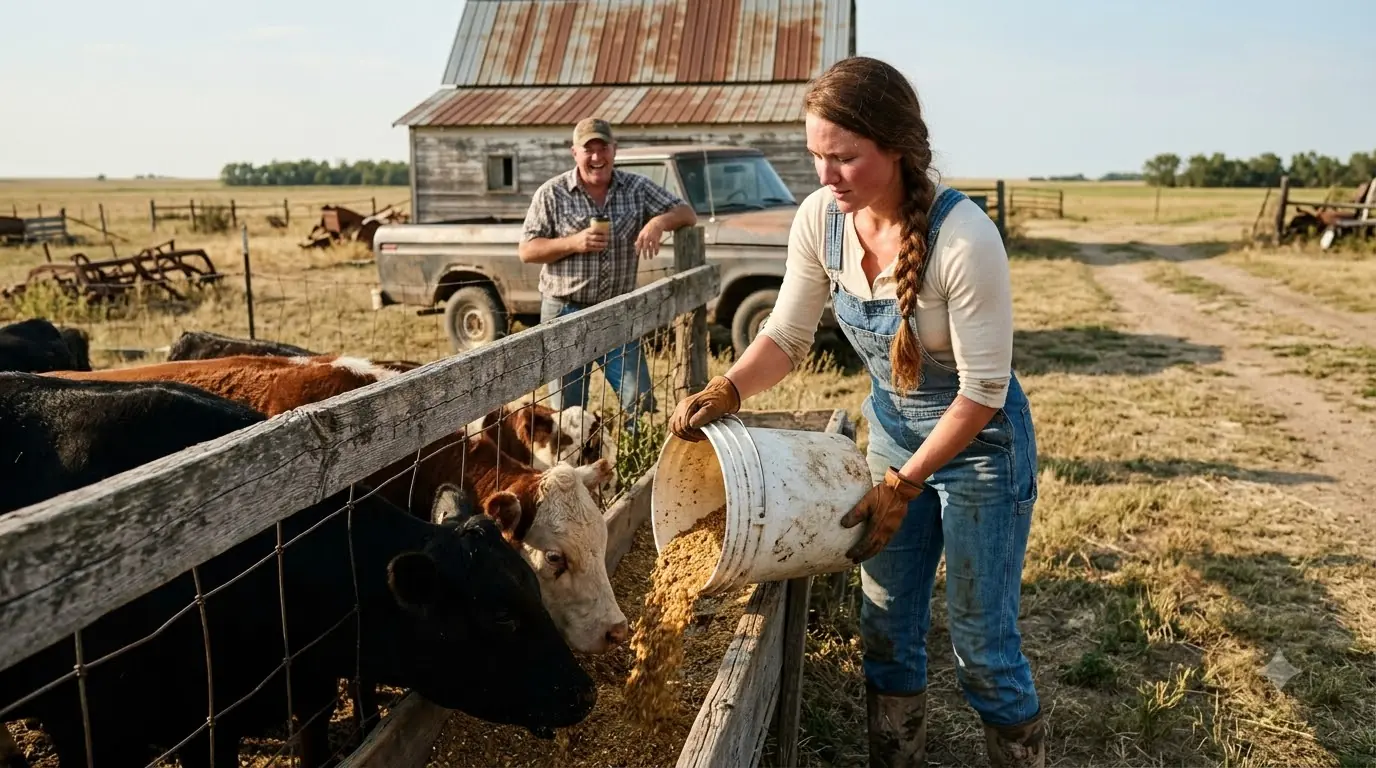
She gripped the handle of the stained white bucket with both gloved hands and tipped it farther.
A heavy mixture of wet golden grain slid over the rim and fell into the wooden feed bunk with a thick slap.
Several Black Angus cows pushed forward immediately.
A Hereford heifer buried her nose into the mixture.
The older farmer laughed again.
“You really are doing it.”
The farm woman straightened.
Her thick chestnut-brown hair had been braided over one shoulder before sunrise, but strands had already escaped around her flushed face. Dust clung to her faded denim overalls. Her cream work shirt was rolled to her elbows, and the muscles in her forearms tightened as she lowered the empty bucket.
She was an attractive woman, though that fact rarely helped repair fences, pay feed bills, or convince a bank to extend a note.
The older farmer lifted his coffee toward the trough.
“Feeding cows whiskey garbage.”
She wiped one glove against the side of her overalls.
“It isn’t whiskey.”
“Smells like it.”
“It’s spent grain.”
He grinned.
“Same difference.”
“No.”
“Give them enough and maybe they’ll start singing.”
She picked up another bucket.
The farmer called after her.
“When they start staggering around drunk, don’t come blaming the rest of us.”
That time she stopped.
She turned.
The older farmer had expected embarrassment.
Instead she walked toward the fence with the empty bucket hanging from one hand.
Her hazel-green eyes were tired.
Not defeated.
Tired was different.
She stopped several feet from him.
“The alcohol is removed during processing.”
The farmer blinked.
She continued.
“The material I’m feeding contains protein, digestible fiber, fat, phosphorus, and moisture. The ration has been balanced with hay, mineral, and the rest of what they need.”
The older farmer smiled again.
“You memorized a brochure.”
“I ran the numbers.”
“Numbers don’t feed cattle.”
“No.”
She looked toward the bunk.
“Feed does.”
The farmer shook his head.
“You’re gambling with your herd.”
The woman’s expression hardened.
“No.”
“I was gambling when I kept buying conventional feed at prices that guaranteed I’d lose the farm.”
That wiped part of the amusement from his face.
Only part.
He leaned against the pickup.
“So this saves you?”
“I’ll know when I have enough data.”
He chuckled.
“Data.”
She reached into the front pocket of her overalls and removed a small spiral notebook.
Mud stained its cover.
She held it up.
“Every load.”
“Every ration.”
“Every group.”
“Consumption.”
“Weight.”
“Condition score.”
“Mineral intake.”
“Manure consistency.”
“Storage temperature.”
“The cattle don’t care about your jokes.”
She tucked the notebook away.
“They care whether I feed them correctly.”
The older farmer watched her.
Then he smiled one more time.
“Still looks like slop.”
The woman picked up the bucket.
“Then it’s fortunate I’m feeding cows instead of you.”
A young hired hand near the barn coughed to hide a laugh.
The older farmer looked toward him.
The hand immediately became interested in a gate hinge.
The farm woman returned to the cattle.
She did not see the older farmer’s smile disappear completely.
She also did not see him look more carefully at the animals before climbing back into his truck.
If she had, she might have noticed the first small crack in the joke.
The cows looked good.
Better than his did.
But nobody was ready to say that yet.
Not even her.
Because six months earlier, she had been sitting at the kitchen table wondering which part of her family’s farm she would have to sell first.
The farm had been in the family for sixty-eight years.
Her grandfather started it with eighty acres, a borrowed tractor, twelve cows, and what her father later described as a terrifying misunderstanding of debt.
By the time she was born, the operation had grown to just under seven hundred acres of owned and leased ground.
The family raised commercial beef cattle.
Some wheat.
Some sorghum.
Hay.
Whatever combination kept the land useful and the bills barely manageable.
Her childhood memories were not romantic.
They were early.
Most began before sunrise.
Frozen water tanks.
Calves arriving during sleet.
Dust blowing through kitchen screens.
Her father cursing machinery.
Her mother keeping an account book at the table after everyone else went to sleep.