The late afternoon sun hung over the parking lot of Westbridge Academy, turning the polished windows of the private school into sheets of gold. Rows of luxury SUVs, expensive sports cars, and gleaming student vehicles filled the asphalt, their paint reflecting the pale autumn sky. Beyond the gates, the school’s immaculate brick buildings stood behind manicured lawns and ornamental trees, a picture of privilege and achievement.
Students streamed out of the main entrance in small, laughing groups. Some headed toward the athletic center, others toward waiting chauffeurs or cars driven by parents. A few lingered beside the fountain, taking photographs beneath the school’s stone crest.
But near the far end of the senior parking area, where the pavement met a row of neatly trimmed hedges, a crowd had begun to gather.
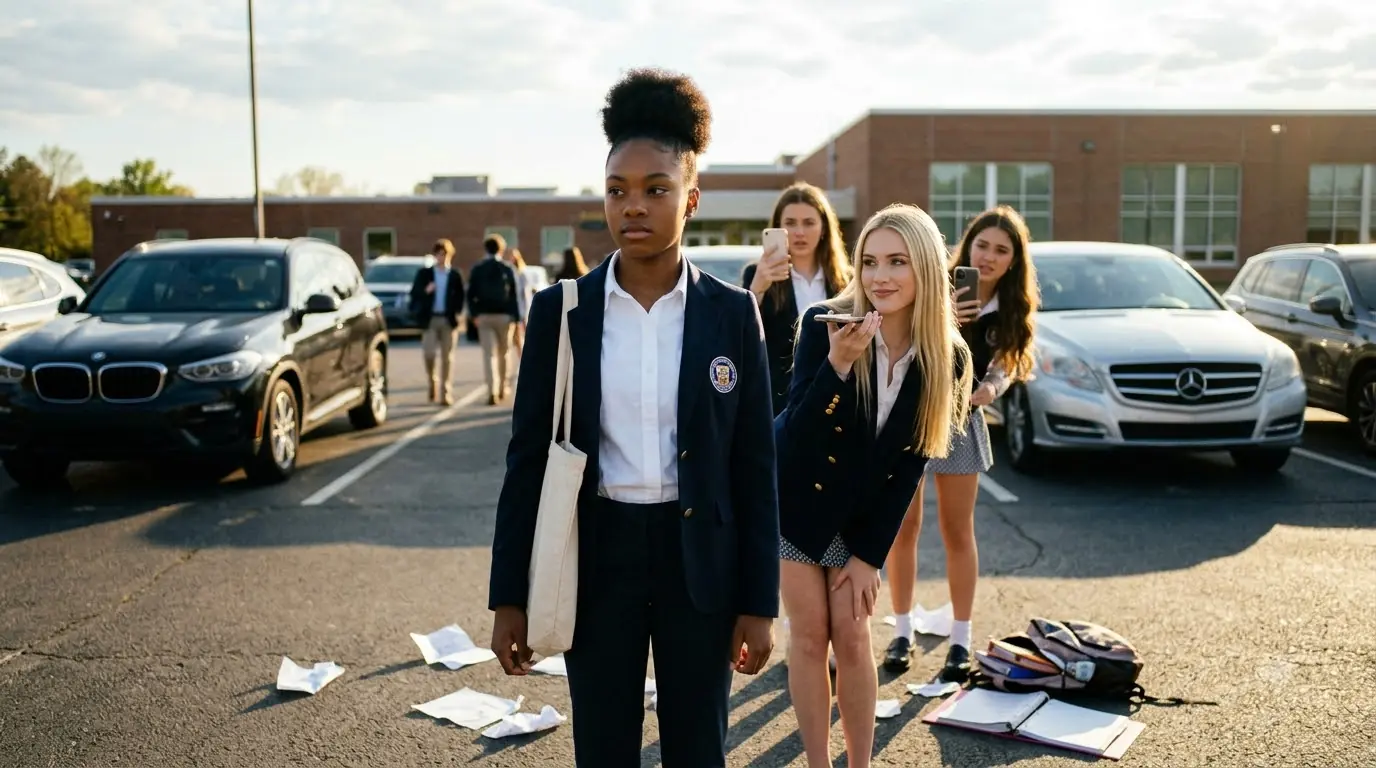
At its center stood sixteen-year-old Amara Johnson.
Her white blouse was still crisp beneath her navy blazer, though one sleeve had been pulled slightly out of place. Her natural hair was gathered into a neat high puff, and a simple canvas tote hung from her shoulder. She wore no designer jewelry, no expensive watch, and no shoes that announced their price with a recognizable logo. Her clothes were clean and carefully pressed, but they were plainly chosen for durability rather than display.
Amara had learned long ago that at Westbridge Academy, people could decide what they thought of you before you ever opened your mouth.
She had also learned not to let their opinions determine what she thought of herself.
Her intelligent brown eyes were fixed on the girl standing directly in front of her.
Madison Whitmore.
Madison was sixteen, blonde, immaculate, and accustomed to being obeyed. Her long, straight hair fell over the shoulders of an expensive navy blazer decorated with gold buttons. Her makeup was flawless, her manicured nails pale pink, and her expression carried the effortless confidence of someone who had rarely encountered a consequence she could not persuade someone else to absorb.
Two girls stood behind her.
The first was Chloe Bennett, whose father owned a chain of luxury car dealerships. The second was Sloane Pierce, whose mother served on the board of several charitable foundations, including Westbridge’s largest private donor organization.
Both had their phones raised.
They were recording.
At Madison’s feet lay the torn remains of a mathematics examination. The pages had been ripped into several pieces, and the fragments were scattered across the asphalt. A few had blown beneath a parked black Mercedes. Amara’s backpack lay open beside them, its contents spilling out: two textbooks, a pencil case, a notebook, a folded lunch bag, and a small photograph of her mother tucked inside a clear plastic sleeve.
Madison held Amara’s phone in one hand.
The device was on speaker.
A voice from the other end of the call had just asked a question.
“Amara? Are you there?”
Madison smiled.
“Oh, she’s here,” she said brightly. “She’s just a little busy explaining why she thinks she deserves special treatment.”
Chloe giggled.
Sloane adjusted her phone to get a better angle.
Amara did not reach for her device.
She did not bend down to collect the scattered papers.
She did not look at the growing crowd.
Instead, she raised her chin slightly and stared at Madison with an expression so calm that the blonde girl’s smile began to falter.
“Give me my phone,” Amara said.
Madison tilted her head.
“Why? Afraid someone might hear the truth?”
“The truth doesn’t need you to hold my phone.”
“Oh, listen to that.” Madison turned toward her friends. “She’s still trying to sound superior.”
A few students laughed uneasily.
Others had stopped walking altogether.
The voice on the phone spoke again.
“Amara, who is that?”
Madison’s eyes flashed with amusement.
“Someone who has a lot of explaining to do.”
Amara’s expression remained unchanged.
“Madison,” she said quietly, “you have about ten seconds to put that phone down.”
Madison laughed.
“Or what?”
Amara glanced toward the phone.
“Or the person listening is going to ask you a question you won’t be able to answer.”
For the first time, Madison’s confidence visibly cracked.
It was only a brief change: a tightening around the eyes, a small shift in the hand holding the phone, a flicker of uncertainty that vanished almost as soon as it appeared.
But Amara saw it.
And so did the voice on the line.
“Madison Whitmore,” the caller said, suddenly firm. “Is that you?”
The parking lot seemed to quiet around them.
Madison swallowed.
“Yes,” she replied, recovering her smile. “And I’m glad you’re listening. Because there’s something you should know about your scholarship student.”
Amara looked at her.
The corners of Madison’s mouth lifted again, but this time the smile seemed forced.
“She cheated,” Madison declared. “She stole answers, and now she’s pretending she’s the victim.”
A murmur spread through the gathering students.