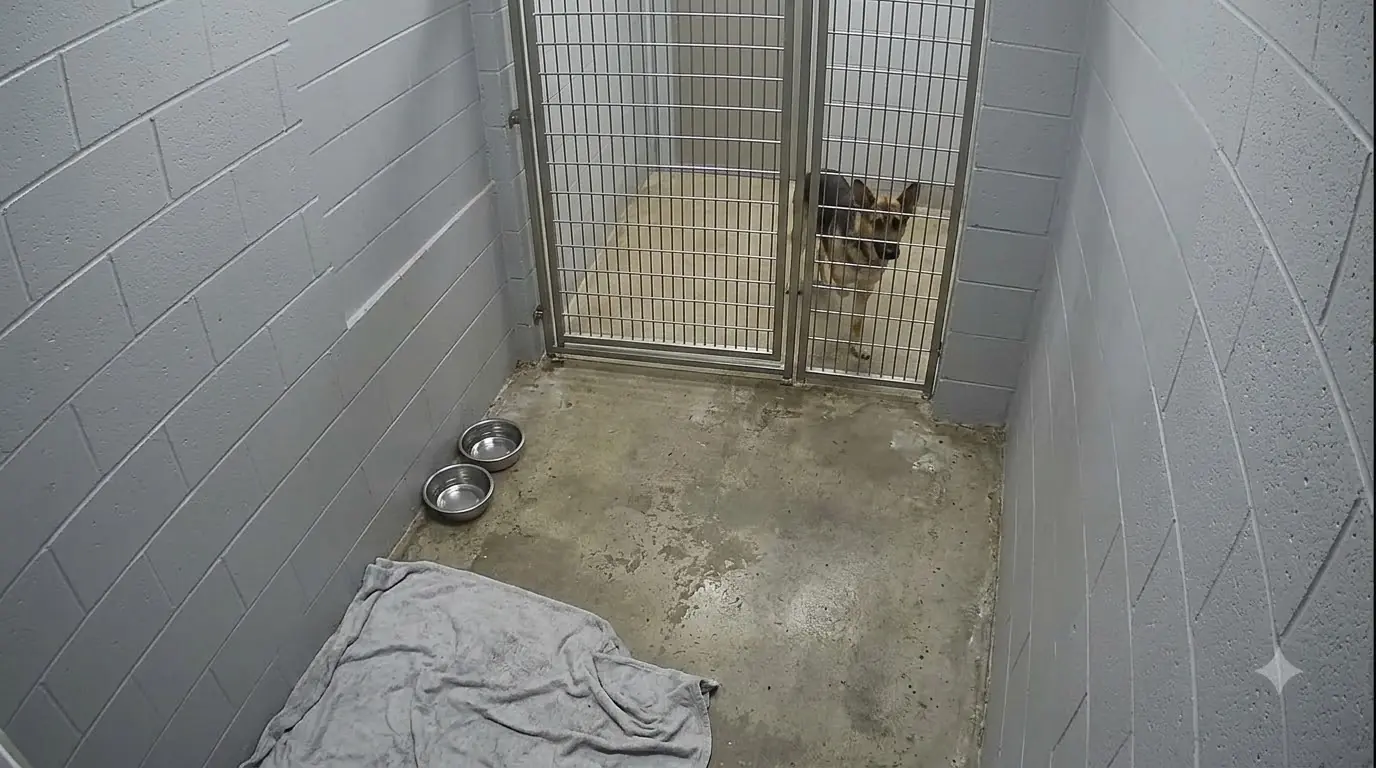
In the Beginning, the Leash Meant He Was Expected to Move
When Cooper first entered rehabilitation after losing one of his front legs, walking was no longer something his body could do automatically.
He was a young German Shepherd mix, mentally alert and physically strong in many ways, but the injury that brought him into veterinary care had been severe enough that saving the damaged front limb was not medically realistic.
The decision to amputate was not made casually.
By the time the surgical team evaluated the full extent of the trauma, the question was no longer whether the leg could be made to look normal.
The question was whether keeping it would leave Cooper with a painful, poorly functional limb and prolong his recovery.
After imaging, surgical consultation, and assessment of tissue damage, amputation became the option most likely to give him a comfortable, functional future.
The surgery solved one problem.
It created another challenge.
Cooper now had to learn how to move through the world on three legs.
Losing a Front Limb Changes Balance More Than Many People Realize
Dogs can adapt remarkably well after limb amputation, but front-leg loss creates particular mechanical demands.
A dog's front limbs normally carry a substantial portion of body weight.
Removing one changes balance immediately.
The remaining front limb must accept more load.
The hindquarters need to contribute differently.
Turning becomes more complicated.
Stopping requires control.
Slippery flooring becomes more significant.
Even standing still can feel unfamiliar.
Cooper's first post-operative days therefore focused on pain control, surgical healing, safe transfers, and preventing falls.
Nobody expected him to walk normally.
Nobody expected him to understand his new balance immediately.
He needed time to learn where his body was now.
The First Time He Stood, He Looked Surprised by His Own Weight
Once Cooper was medically stable enough to begin supported standing, two caregivers assisted him.
A wide support sling was positioned under his body.
His remaining front paw was placed on a nonslip surface.
His hind feet were adjusted so they were beneath him.
Then the support was reduced gradually.
For a moment, Cooper stood.
His body shifted toward the missing side.
He corrected too far in the opposite direction.
The caregiver supported him before he fell.
Cooper tried again.
This time he stayed upright a few seconds longer.
Then he sat down abruptly.
That was enough for the session.
Rehabilitation after an amputation is not about forcing repetition until a dog is exhausted.
Early success may be measured in seconds.
Pain Control Was Part of Mobility Training
Before anyone asked Cooper to move farther, his veterinary team made sure his discomfort was being managed appropriately.
His surgical site was checked regularly for swelling, discharge, excessive redness, bruising, or signs of complications.
Medication was adjusted according to his postoperative needs.
Staff monitored appetite, hydration, urination, stool, and general behavior.
A dog who refuses to move after major surgery may be frightened.
He may also be painful.
Those possibilities cannot responsibly be separated without a medical assessment.
Cooper's reluctance was treated as information, not stubbornness.
The Leash Became the Moment Everything Stopped
Once Cooper was cleared for very short assisted walks, caregivers began using a leash for safety.
That was when a pattern emerged.
Cooper could stand in his recovery area.
He could reposition himself.
He could take several independent steps if he wanted to reach his water or bed.
But when a caregiver clipped on the leash and prepared to walk him, he often froze.
Completely.
He would stand with his three feet planted and look forward.
No pulling backward.
No dramatic panic.
He simply stopped.
The leash had come to predict something difficult.
Movement.
We Did Not Drag Him
Pulling a newly amputated dog forward would have been physically and behaviorally inappropriate.
Cooper was already learning a new gait.
Forcing him off balance could cause a fall or place excessive load on his remaining limbs.
Instead, caregivers changed the exercise.
They clipped the leash on.
Then they waited.
If Cooper shifted his weight forward, that counted.
If he took one step, that counted.
Food rewards were used when they helped, but the team did not lure him into moving faster than he could safely control.
Some sessions ended after only a few steps.
That was not failure.
It was rehabilitation at the pace his body could handle.
His First Gait Was Awkward and Energy-Intensive
When Cooper did move, his stride looked uneven.
His remaining front leg had to land beneath the center of his body more precisely.
His hind legs pushed more strongly.
His head and shoulders moved differently to maintain balance.
At first, every few steps were followed by a pause.
He often leaned slightly.
On turns, he sometimes made a wider arc rather than pivoting tightly.
Those movements were expected.
He was not simply missing a leg.
His nervous system had to update its understanding of where his body was in space.
Muscles that had previously shared work now needed to compensate.
Rehabilitation Focused on Control Before Distance
The team created a simple progression.
First: stand comfortably.
Then: shift weight.
Then: take a few steps on a nonslip surface.
Then: walk a short straight line.
Only after Cooper could do that with reasonable control would the team increase distance or add more complex movement.
There were no long walks.
No stairs for conditioning.
No jumping onto furniture.
No uncontrolled running.
At his age, Cooper had enthusiasm available long before his body was prepared to use it.
That mismatch had to be managed carefully.
His Remaining Front Leg Became a Long-Term Priority
For a three-legged dog missing a front limb, maintaining a healthy body weight is especially important.
Extra weight increases demand on the remaining limbs.
The veterinary team discussed this from the beginning.
Cooper needed enough calories to heal.
He also needed to avoid becoming overweight during a period of restricted activity.
His diet was adjusted based on body condition, healing, and activity level.
His remaining front paw was checked regularly.
Nails were kept appropriately trimmed.
Paw pads were monitored.
The shoulder and elbow of the remaining front limb would need lifelong attention as well.
The goal was not only getting Cooper through rehabilitation.
It was protecting the body he would rely on for years.
The Surgical Site Healed Before His Confidence Did
Physically, Cooper progressed well.
His incision remained clean.
There was no evidence of infection.
Swelling decreased.
Sutures or staples were removed according to the surgical schedule.
His appetite returned fully.
He rested comfortably.
From a medical standpoint, the early postoperative period was moving in the right direction.
But the leash still caused hesitation.
Cooper could walk several steps independently inside his recovery space.
Clip the leash on, and he became slower.
That told the rehabilitation team the barrier was no longer only physical.
Part of it had become learned uncertainty.
We Changed What the Leash Predicted
For several days, caregivers began clipping the leash on without immediately asking Cooper to walk.
Leash attached.
Treat.
Pause.
Leash removed.
Later, the leash stayed attached while Cooper stood and ate a small food reward.
No walking required.
Then a caregiver clipped it on and simply sat nearby.
The goal was to weaken the association between leash and difficult movement.
Gradually, Cooper stopped becoming rigid the moment he heard the clip.
That gave us more room to work.
His First Voluntary Step on Leash Changed the Sessions
One morning, Cooper's caregiver attached the leash and stood beside him.
No forward pressure.
No pulling.
Cooper looked toward the hallway.
He shifted his weight.
Then he stepped.
The caregiver moved with him.
Another step.
Pause.
Another.
The entire walk lasted only a short distance.
But the important part was that Cooper initiated it.
From that point, rehabilitation began looking less like persuasion and more like practice.
He Began Learning the Route to the Training Yard
The medical recovery area connected to a small controlled training yard through a short hallway and door.
At first, Cooper traveled only part of that route.
A few steps out.
Rest.
Turn back.
As he improved, the hallway became a predictable sequence.
Bed.
Kennel threshold.
Nonslip mat.
Hallway.
Door.
Outside.
Dogs learn routines quickly.
Soon Cooper began lifting his head when he saw the leash because the leash no longer meant only difficult work.
It also meant outside.
Grass Was Harder Than Flat Flooring
The training yard created a new challenge.
Grass looks forgiving, but uneven surfaces require more balance than smooth indoor flooring.
Small dips, soft patches, and changes in traction forced Cooper to make constant adjustments.
His first sessions outside remained brief.
He sometimes stopped after only a few yards.
When he lost balance, caregivers supported him without overcorrecting.
The point was to let his body learn.
Not to hold him upright for every step.
Turning Was One of the Hardest Skills
Straight-line walking improved first.
Turning remained awkward.
If Cooper turned toward the side where his front leg was missing, he sometimes shifted his body too quickly and had to catch himself.
Turning toward the remaining front limb created a different balance demand.
The rehabilitation team used wide, gentle curves.
No tight circles.
No rapid direction changes.
Over time, the curves became smaller.
His foot placement became more precise.
His shoulders stopped swaying as much.
There Were Days When He Did Less
Not every rehabilitation session moved forward.
Some mornings Cooper appeared more tired.
On those days, distance was reduced.
If he showed soreness after a session, the veterinary team reassessed him.
Activity was adjusted rather than increased automatically.
One afternoon, Cooper became excited outside and tried to move faster than his body could coordinate.
He stumbled.
He recovered without injury, but the session ended.
The next day, he returned to shorter controlled walking.
Setbacks like that were expected.
They gave the team information about his current limits.
His Personality Started Returning With His Strength
During the first postoperative days, Cooper was quiet.
That changed.
He began watching people walk past.
He started carrying a soft toy from his bed to the front of the recovery area.
He became interested in food puzzles.
When familiar caregivers entered, his ears lifted.
Eventually, he began offering a brief play bow.
The problem was that his body was not ready to follow the invitation.
So play remained controlled.
Low-impact enrichment became important.
Sniffing.
Puzzle feeding.
Training.
Calm interaction.
Cooper needed mental activity while physical activity remained restricted.
The Door Became His Goal
Several weeks into rehabilitation, the training-yard door had become meaningful to Cooper.
He knew what was beyond it.
Fresh air.
Grass.
Smells.
A chance to move.
Caregivers noticed that he began orienting toward the door before they encouraged him.
Sometimes he stood as soon as the leash appeared.
Sometimes he took the first step before the caregiver was fully upright.
That was a major contrast from the dog who once froze when the clip touched his collar.
The Camera Caught the Moment Nobody Had Planned
The rehabilitation area had routine camera coverage.
The footage was not set up to capture a milestone.
It simply documented ordinary movement in the hallway.
One morning, a caregiver clipped Cooper's leash on and opened the recovery area.
Cooper stood.
Then he stepped forward.
The caregiver followed.
Cooper kept going.
His gait was still uneven.
His remaining front leg landed carefully.
His hindquarters pushed him forward in short, deliberate bursts.
But he did not freeze.
He did not wait for encouragement.
He moved toward the training-yard door.
Then He Got Ahead of the Leash
The caregiver briefly slowed to adjust the leash.
Cooper did not notice immediately.
He took another step.
Then another.
The leash tightened gently behind him.
Cooper stopped.
He turned his head.
He looked back toward the caregiver.
The expression itself cannot tell us exactly what he was thinking.
But the physical sequence was unmistakable.
For the first time in rehabilitation, the leash was not waiting for Cooper.
Cooper was waiting for the leash.
That Was the Moment Staff Rewatched
The clip was only a few seconds long.
There was nothing dramatic in the traditional sense.
No sprint.
No jump.
No finish line.
Just a three-legged dog reaching the training-yard door sooner than the person holding his leash expected.
Staff replayed it because it captured a change that had been developing slowly for weeks.
At the beginning, the leash meant Cooper would stand still.
Now he was moving so willingly that the caregiver had to catch up.
We Did Not Turn That Moment Into Permission to Rush
A strong rehabilitation day does not mean restrictions disappear.
Cooper was still recovering.
His muscles were still adapting.
His remaining limbs were still increasing their workload.
The team continued controlled sessions.
Walk duration increased gradually.
Rest remained part of the schedule.
He was not allowed to turn every successful session into a longer one simply because he wanted to continue.
Dogs often feel capable before tissues and conditioning are ready for repeated stress.
The rehabilitation plan stayed conservative.
Strength Training Became More Specific
Once Cooper had reliable basic walking, the team added carefully selected exercises.
Controlled sit-to-stand movements.
Short weight shifts.
Slow walking over slightly varied but safe surfaces.
Gentle changes in direction.
Standing squarely for brief periods.
Everything was designed around balance and core strength.
Exercises were stopped if his form deteriorated.
Quality mattered more than repetition count.
A three-legged dog can compensate poorly if asked to do too much.
Good mechanics were the priority.
His Remaining Shoulder Needed Protection
As Cooper's confidence increased, he began placing more force through his remaining front limb.
That was expected.
It also meant caregivers needed to think long term.
High-impact jumping was discouraged.
Repeated ball chasing was not part of his conditioning plan.
Slippery floors would need management in a future home.
Keeping him lean would remain essential.
Routine veterinary checks would need to include close attention to the remaining front shoulder, elbow, carpus, paw, and spine.
Adaptation does not remove the physical consequences of losing a limb.
It simply allows the dog to function despite them.
He Learned to Stop Without Falling Forward
Starting movement had been the original problem.
Later, stopping became a skill of its own.
When Cooper first gained confidence, he sometimes moved forward faster than he could decelerate.
Caregivers used calm verbal cues and shorter leash distances to help him slow gradually.
Over time, he learned to plant his remaining front paw and shift weight backward more effectively.
His stops became smoother.
His turns became tighter.
He began looking less like a dog surviving each step and more like a dog choosing where to go.
Stairs Were Introduced Only When He Was Ready
A future home could not be guaranteed to have zero elevation changes.
Eventually, Cooper needed to learn safe step navigation.
This did not begin with a flight of stairs.
The rehabilitation team started with a single low step.
Cooper approached.
Paused.
Tested the edge with his remaining front paw.
Then shifted his weight.
Going up required power.
Coming down required even more control.
The first sessions were heavily supervised.
He improved gradually.
A support harness remained available.
His Weight Stayed Lean on Purpose
As Cooper became more active, his appetite increased.
It would have been easy to reward every rehabilitation success with extra food.
Instead, treats used for training were counted as part of his daily intake.
His body condition remained deliberately lean.
That decision mattered.
Every extra pound would be carried by three limbs instead of four.
In a young dog with years of activity ahead, protecting joints now could affect comfort later.
Foster Care Became the Next Real Test
A rehabilitation facility is predictable.
A home is not.
Once Cooper could walk safely for short periods and his surgical site had healed fully, we began planning foster placement.
The foster home was selected with his needs in mind.
Minimal stairs.
Nonslip runners.
No expectation of rough play.
A fenced yard.
Enough structure to continue rehabilitation.
The family understood that Cooper was mobile, not finished.
That distinction was important.
The First Day in Foster Brought Back Some Hesitation
New floor.
New doorway.
New furniture.
New yard.
Cooper's gait became slower again.
That did not surprise anyone.
Physical ability and environmental confidence are not identical.
He walked through the living room cautiously.
He paused at the kitchen threshold.
He investigated floor transitions.
His foster caregiver used the same verbal cues the rehabilitation team had used.
Within a few days, the house began making sense.
He Learned the Route to the Back Door Next
Just as he had learned the training-yard route, Cooper learned the foster home's routine.
Bed.
Hallway.
Kitchen.
Back door.
Yard.
At first, the foster caregiver led.
Then Cooper started anticipating.
He would stand when the leash appeared.
He would move toward the door.
Sometimes he reached it before the leash was fully organized.
The behavior that cameras had captured at the rescue was no longer a single event.
It was becoming normal.
Slippery Floors Remained a Real Problem
One area of the foster home had smooth flooring.
Cooper initially struggled there.
His remaining front paw could lose traction during turns.
The family added runners.
That simple environmental change made an immediate difference.
He moved with more confidence.
Three-legged dogs do not need every challenge solved through training.
Sometimes the correct answer is changing the environment.
Traction can be more valuable than encouragement.
He Had to Learn Not to Launch Himself at Everything
As Cooper felt better, his young-dog energy returned strongly.
He wanted to move faster.
He wanted to investigate.
He occasionally tried to bounce toward toys.
His foster family kept play controlled.
Tug was kept low and gentle.
Food searches allowed him to use his nose without high impact.
Training sessions provided mental fatigue.
Walks remained structured.
The goal was not to suppress his personality.
It was to keep enthusiasm from injuring the body that was still adapting.
The Missing Leg Stopped Being the First Thing His Foster Family Saw
During the first week, every movement drew attention.
Was he balanced?
Was he tired?
Was he sore?
Did he need help?
Weeks later, his family noticed something had changed.
They were not watching every step.
Cooper walked into the room.
He settled.
He got up.
He went outside.
His three-legged gait was still obvious, but it was no longer the only thing defining him.
His personality took up more space than the amputation.
That was a healthy transition for everyone.
Follow-Up Veterinary Exams Stayed Important
Cooper returned for scheduled rechecks.
His surgical site remained fully healed.
The remaining limbs were examined for pain or overuse.
His spine and muscle development were assessed.
The veterinary team watched for compensatory soreness.
His rehabilitation exercises were adjusted based on strength and endurance.
Nothing suggested that the remaining front limb was failing to tolerate its increased workload.
That was encouraging.
It did not mean monitoring could stop.
Adoption Planning Focused on Lifestyle, Not Sympathy
Cooper did not need someone to adopt him because they felt sorry for him.
He needed a family prepared for the practical realities of living with a three-legged dog.
Weight management.
Traction.
Joint protection.
Appropriate exercise.
Routine veterinary monitoring.
Limited repetitive high-impact activity.
Potential changes as he aged.
He was young and energetic.
A home that treated him as fragile forever would not necessarily be a good fit.
Neither would a home that expected him to keep up with intense running or constant jumping.
We wanted balance.
He Met His Future Family in the Training Yard
The family who eventually became serious about adopting Cooper first met him outdoors.
By then, the training yard no longer frightened him.
He walked through the door with his familiar three-legged rhythm.
He sniffed.
He investigated the visitors.
Then he continued moving.
The family did not make a dramatic reaction to his missing limb.
That stood out.
They asked practical questions.
How far could he walk?
What surfaces caused difficulty?
Would stairs be safe?
What long-term joint problems should they watch for?
How should his weight be managed?
What activity was appropriate?
Those were the questions we wanted.
They Saw the Old Video
During the adoption process, staff showed the family the short rehabilitation clip.
Cooper standing in the hallway.
Cooper stepping toward the training-yard door.
The leash briefly falling behind.
Cooper turning back toward the caregiver.
The family watched it twice.
By then, the dog beside them was walking through the room with confidence.
The contrast was substantial.
But the clip was important because it showed how his independence had been built.
Not in one dramatic leap.
Step by awkward step.
His Trial Placement Kept the Same Rules
The family prepared before Cooper arrived.
Runners covered slick sections of floor.
A supportive harness was available.
Stairs were gated initially.
His food was measured.
His bed was placed in an accessible area.
Nobody encouraged him to jump onto furniture.
The first few days were calm.
Cooper explored.
He slept more than expected.
Transitions are tiring even for physically healthy dogs.
Then He Started Beating Them to the Door
Within the first week, Cooper learned what time the morning walk happened.
A leash came off the hook.
Cooper stood.
His adopter turned to put on shoes.
Cooper walked toward the door.
By the time the leash was clipped, he was already facing outside.
On several mornings, he moved so promptly that the person holding the leash had to shorten their own routine and follow.
The behavior that once surprised a rehabilitation caregiver had become part of his personality.
Cooper liked going.
He Still Has Awkward Moments
Three-legged mobility is not perfect.
Cooper occasionally misjudges a turn.
If he gets excited and moves too fast, his body can sway.
Wet grass changes traction.
Uneven ground requires more attention.
After a longer outing, he may need more rest.
His family watches for subtle changes.
Shortened stride.
Reluctance to rise.
Licking at the remaining front paw.
Changes in willingness to walk.
Those signs could indicate overuse or pain and deserve veterinary attention if persistent.
He Does Not Need Help Every Time He Stands Anymore
One of the biggest changes is almost invisible because it became ordinary.
Cooper gets up by himself.
He no longer requires someone to position his feet.
He does not need a sling for normal movement.
He can stand, turn, walk, stop, and lie down independently.
That does not mean the support equipment was unnecessary.
It means it did its job during the stage when he needed it.
His Rehabilitation Was Never About Making Him Look Like a Four-Legged Dog
Cooper will always move differently.
His gait is not symmetrical.
It cannot be.
The objective was never to hide that.
The objective was comfort, stability, endurance, and confidence.
Trying to make a three-legged dog imitate four-legged mechanics would be unrealistic.
Good rehabilitation works with the body that remains.
Cooper learned how to use his.
The Moment at the Door Still Means More Than the Distance
People sometimes ask how far Cooper can walk now.
That is not the milestone staff remember.
The meaningful moment happened weeks earlier.
The leash was attached.
A situation that once made Cooper freeze.
He stepped forward.
One awkward step.
Then another.
Then several more.
He reached the training-yard door.
The caregiver had briefly fallen behind.
Cooper turned back.
For the first time, he was not being asked to catch up.
Someone else had to catch up with him.
The Three-Legged Dog at the Door Is Still the Same Dog
Today, Cooper lives in a permanent home that understands what his body needs.
His weight remains lean.
His exercise is regular but appropriate.
He has traction on slippery floors.
His remaining limbs receive routine veterinary attention.
His family keeps him active without treating every burst of enthusiasm as permission for unlimited impact.
He goes for walks.
He sniffs the yard.
He trains.
He plays.
He rests.
And when someone reaches for the leash, he no longer stands frozen in place.
Most of the time, he is already moving toward the door.
His front leg is still gone.
That part of his story did not reverse.
What changed was everything he learned afterward.
The dog who once stood motionless when the leash clipped on eventually discovered that three legs could still take him somewhere.
Then, little by little, he stopped waiting to be shown the way.