A young Bald Eagle found grounded near Route 17 in Gloucester County, Virginia, was brought to a licensed wildlife rehabilitation center with a wing injury so severe that staff decided the close-up photographs were too graphic to publish on social media.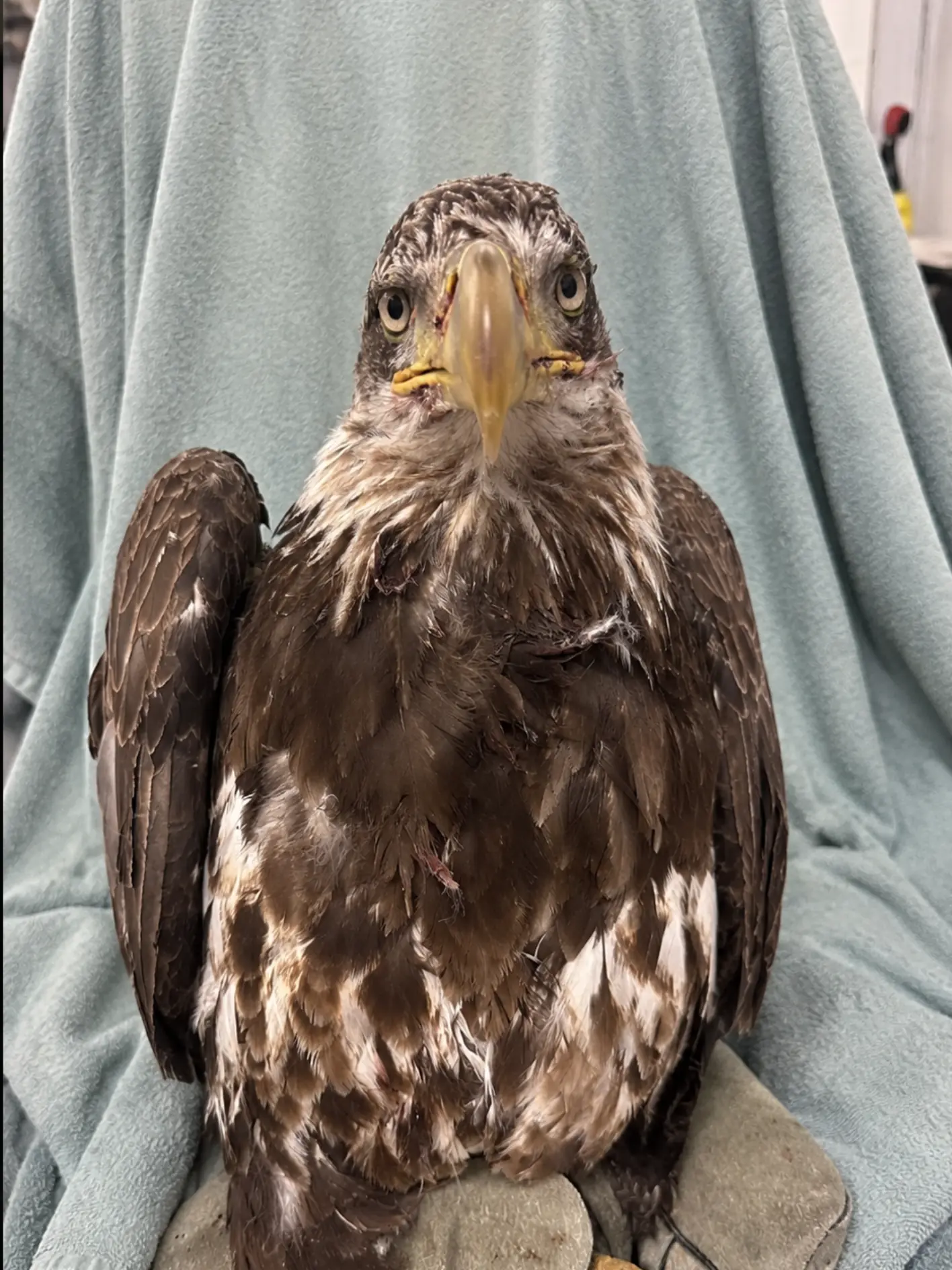
Instead, the medical team shared the radiographs.
Those images showed what the exterior photographs could not be presented publicly without causing distress: catastrophic damage through the distal portion of the wing, including severe disruption of the carpal region — essentially the “wrist” of the wing — and destruction extensive enough that normal mechanical function could never be restored.
Then veterinarians noticed something that changed the entire nature of the case.
The injury did not look like the result of an ordinary collision.
Radiographic evidence was consistent with gunshot trauma.
What staff had feared when they first examined the damaged wing became much more troubling once the images were reviewed.
This eagle had apparently been shot.
By the time it was found, veterinarians believed the injury had likely been present for several days and possibly for more than a week. During that time, the bird had apparently remained outdoors with a severely damaged wing, unable to fly normally and exposed to pain, weather, hunger, predators, and other hazards.
Unfortunately, the extent of the damage left the veterinary team with no realistic surgical path to a functional, pain-free life.
Even if the bird could somehow have survived major reconstructive procedures, the destroyed joint and surrounding tissue would never have allowed the wing to function normally again.
More importantly, clinicians did not believe the eagle could be maintained comfortably in permanent captivity without substantial risk of chronic pain, recurrent tissue problems, and persistent stress.
After reviewing the radiographs, examining the remaining tissue, and considering the long-term welfare implications, the veterinary team made the difficult decision to humanely euthanize the bird.
“We were medically out of options that could give this eagle an acceptable quality of life,” the attending veterinarian said. “Keeping an animal alive is not the same as giving it a life free from chronic pain and distress.”
The rehabilitation center is now sharing the case for two reasons.
First, staff hope that releasing information about where the eagle was found may help investigators identify the person responsible for shooting it.
Second, they believe the case is a reminder of how fragile even a major conservation success can remain.
Only a few decades ago, Bald Eagles were still recovering from severe population declines. Virginia removed the species from its state list of threatened wildlife in 2013 after years of conservation progress.
Population recovery, however, does not make an individual eagle invulnerable.
“This is a species Americans spent decades trying to recover,” the rehabilitation director said. “To see one survive long enough to reach us and then discover that the injury appears to have been deliberately inflicted is extraordinarily difficult.”
The Eagle Was Found Grounded Near Route 17
The young eagle was discovered near Route 17 in Gloucester County after a member of the public noticed that the bird remained on the ground and was unable to leave the area normally.
A healthy Bald Eagle generally maintains significant distance from people.
An injured one may not.
The bird could still remain upright and alert enough to watch activity around it, but its flight ability was severely compromised.
Its plumage indicated that it had not yet completely transitioned into the unmistakable white-headed, white-tailed appearance of a fully mature Bald Eagle.
That made the case particularly difficult for staff.
This was a bird that should have had years of life ahead of it.
Instead, it arrived with an injury that had already eliminated any realistic chance of returning to the wild.
The Visible Injuries Raised Immediate Concern
During the initial examination, staff documented several superficial wounds around the body, including areas near the face and chest.
But the wing was clearly the primary problem.
The external damage was severe enough that the rehabilitation center chose not to publish detailed photographs.
Wildlife organizations frequently use images to explain injuries and educate the public, but there is a line between useful documentation and material that can be unnecessarily graphic.
In this case, staff believed the X-rays could communicate the medical reality without displaying the most distressing aspects of the open wound.
“The photographs of the wing itself are simply not something we believe needs to circulate widely on social media,” a staff member said. “The radiographs tell the story clearly enough.”
The X-Rays Showed Catastrophic Damage
Radiographs revealed extensive disruption in the carpal region of the injured wing.
In birds, the anatomy of the wing differs from the human arm, but the carpal area is broadly comparable to a wrist.
That region plays a critical role in how the wing folds, extends, and maintains the precise geometry required for flight.
The bones were not merely cracked.
The architecture of the joint itself was severely compromised.
There was fragmentation.
Normal alignment had been lost.
The injury also involved extensive damage to the surrounding soft tissues.
For a flying animal, that distinction is crucial.
A simple fracture can sometimes be repaired if the bone can be restored to proper alignment and allowed to heal without permanently altering the mechanics of the wing.
A catastrophically destroyed joint is a different problem.
Flight depends on a highly coordinated sequence of motion through the shoulder, elbow, wrist, digits, feathers, muscles, tendons, and ligaments.
Damage to one critical region can make the entire system nonfunctional.
Then the Team Saw Evidence Consistent With Gunshot Trauma
The radiographs also showed findings that made an accidental collision much less likely as the sole explanation.
Metallic fragments and the pattern of damage were considered consistent with the eagle having been shot.
That conclusion transformed the case from a devastating wildlife injury into a possible wildlife crime.
“Our worst concern became reality when we looked at the radiographs,” the veterinarian said. “The injury pattern was not consistent with a routine impact injury alone. The findings were consistent with gunshot trauma.”
No member of the rehabilitation staff witnessed the shooting.
The center cannot identify who fired the shot or why.
Those questions now belong to wildlife law-enforcement investigators.
What the medical team can document is the injury itself.
The Wound Was Not Fresh
Another disturbing element was the apparent age of the injury.
Veterinarians observed tissue changes suggesting that the eagle had not been shot immediately before it was discovered.
The condition of the wound indicated that it may have been present for several days and potentially for more than a week.
That means the bird likely survived outdoors for an extended period with a catastrophically damaged wing.
A Bald Eagle deprived of normal flight loses far more than mobility.
Flight is how an eagle reaches safe roosts.
It is how the bird escapes threats.
It is how it travels between feeding areas.
It is how it avoids people, vehicles, predators, and territorial competitors.
An eagle stranded on or near the ground is profoundly vulnerable.
Surviving Does Not Mean the Bird Was Recovering
Wild raptors are extraordinarily resilient animals.
That resilience can sometimes create a misleading impression.
A bird that remains alive for days after severe trauma may appear to be “fighting” successfully.
Medically, survival alone tells clinicians very little about whether meaningful recovery is possible.
Wild animals frequently conceal weakness until they can no longer compensate.
An eagle may remain alert despite severe pain.
It may continue to move despite injuries that cannot heal into a functional state.
It may eat opportunistically even while its overall condition deteriorates.
This bird had survived.
It had not been recovering.
More Than a Week With a Destroyed Wing Would Have Changed Everything
If the injury was indeed more than several days old, the delay before rescue also complicated any potential treatment.
Open traumatic injuries become contaminated.
Inflammation increases.
Damaged tissue loses viability.
Infection becomes more likely.
Joints that have been physically destroyed cannot simply be placed back into normal position after prolonged disruption.
The longer a catastrophic injury remains untreated, the fewer reconstructive options remain.
But veterinarians emphasized that even immediate treatment likely would not have guaranteed a different outcome in this case.
The fundamental problem was the extent of the anatomical destruction.
Why Not Simply Repair the Wing?
For many members of the public, the first question is understandable:
Could surgery fix it?
Modern veterinary medicine can repair remarkable injuries.
Wildlife surgeons use pins, plates, external fixation, specialized bandaging, and other techniques to stabilize fractures.
But surgery cannot recreate every destroyed structure.
A functional wing requires far more than two pieces of bone being joined together.
The joint has to move normally.
Tendons need appropriate tension.
Muscles have to work through normal mechanical angles.
Nerves must remain functional.
Feathers must sit correctly.
Pain must be controllable.
And the entire structure has to withstand the enormous forces generated during takeoff and sustained flight.
The damage in this eagle’s wing was too extensive.
Even technically successful stabilization would not have restored normal flight.
Why Not Keep the Eagle in Captivity?
The next question is often:
If the eagle could never fly again, could it simply live in a zoo or education center?
Sometimes, permanently non-releasable raptors can live good lives under professional care.
But non-releasable does not automatically mean suitable for captivity.
Veterinarians must consider welfare.
Can the bird perch comfortably?
Can it move around an enclosure without repeatedly falling?
Can the injured limb remain pain-free?
Can the animal preen normally?
Will the injury develop recurrent infection?
Will abnormal posture create chronic problems elsewhere in the body?
Will repeated treatment be necessary for the remainder of the bird’s life?
And can a highly wild individual tolerate permanent confinement without excessive stress?
In this case, the answer to those questions was not sufficiently favorable.
Why Not Amputate the Wing?
Another potential option would be amputation.
Wing amputation can sometimes be medically appropriate for a non-releasable bird when the remaining animal can live comfortably afterward.
But again, the decision depends on far more than whether surgery is technically possible.
Removing a wing changes balance.
It changes movement.
It affects the way a bird perches and uses its body.
The level of amputation matters.
The bird’s temperament matters.
The condition of the remaining tissues matters.
The likelihood of chronic pain matters.
For this eagle, the veterinary team did not believe amputation or reconstructive surgery would produce a life with acceptable long-term welfare.
That is why the decision ultimately became one of preventing continued suffering rather than extending survival at any cost.
Humane Euthanasia Was a Medical Decision
The word “euthanasia” can be difficult to hear in wildlife rescue stories.
People naturally want every animal to survive.
Veterinary medicine has a different responsibility.
Its obligation is not merely to preserve biological life.
It is to prevent avoidable suffering.
When a wild animal has injuries that cannot be restored to a functional, comfortable state, prolonging treatment can become harmful rather than compassionate.
After examining the wing, reviewing the radiographs, and considering the eagle’s future quality of life, the medical team determined that humane euthanasia was the most responsible option.
“Even if we imagined the best possible surgical outcome, this bird would never have regained a functional wing,” the veterinarian said. “And the level of damage meant we could not reasonably promise a life without chronic pain or repeated medical problems.”
The Hardest Part Was Knowing the Injury Was Preventable
Wildlife rehabilitation centers routinely see tragedy.
Vehicle collisions happen.
Birds strike windows.
Raptors become entangled in fishing line.
Eagles fight other eagles.
Storms damage nests.
Natural predation and disease are part of wildlife biology.
Those cases can be heartbreaking, but they are not necessarily the result of deliberate human action.
A suspected shooting is different.
For the staff who treated this eagle, the realization that someone may have intentionally inflicted the injury made the outcome harder to process.
“This bird survived outside with that injury for days,” the rehabilitation director said. “It endured something that should never have happened.”
Bald Eagles Remain Federally Protected
Bald Eagles continue to receive federal legal protection in the United States.
Their population recovery did not remove those protections.
Wildlife authorities take suspected shootings seriously.
The rehabilitation center documented the injuries and preserved relevant medical information for investigators.
The radiographs themselves may become part of that evidence.
If ballistic material was recovered during examination or postmortem procedures, it may also be relevant to the investigation.
The center is not asking members of the public to identify or confront a suspect themselves.
It is asking anyone with legitimate information to provide it to the appropriate wildlife law-enforcement authorities.
The Location May Help Generate a Lead
The eagle was found near Route 17 in Gloucester County.
Investigators may be interested in anyone who observed unusual activity involving a Bald Eagle in that area during the days before the bird was rescued.
That could include someone who:
- heard gunfire under unusual circumstances,
- saw an injured eagle on the ground,
- observed a bird suddenly disappear from a known perch,
- or witnessed suspicious behavior involving wildlife.
Even small pieces of information can become relevant when investigators are trying to reconstruct an event that happened several days earlier.
The rehabilitation center emphasized that tips should go directly to authorities rather than becoming speculation on social media.
This Is the First Reason the Center Is Sharing the Story
The first reason is accountability.
Someone may know something.
An eagle with a catastrophic gunshot injury did not appear from nowhere.
There was a location.
There was an approximate time period.
There may have been witnesses.
Public attention can sometimes bring forward information that investigators would otherwise never receive.
But the center also has a second reason for speaking publicly.
That reason reaches far beyond this individual bird.
Bald Eagle Recovery Was Not Guaranteed
For many Americans today, seeing a Bald Eagle is no longer an extraordinary event.
That can make it easy to forget how different the situation was several decades ago.
Bald Eagle populations experienced severe declines during the twentieth century.
Habitat loss, persecution, environmental contaminants, and other pressures contributed to their disappearance from many landscapes.
Their recovery required decades of coordinated work.
Federal and state wildlife agencies.
Researchers.
Conservation organizations.
Landowners.
Rehabilitators.
Volunteers.
Members of the public.
Legal protections and broader environmental measures all contributed.
The Bald Eagle eventually became one of the most recognizable conservation recovery stories in the United States.
Virginia’s Recovery Is Relatively Recent
Virginia provides a particularly important perspective.
Only several decades ago, the future of Bald Eagles in the state was still a matter of serious conservation concern.
Following long-term population recovery, Virginia removed the Bald Eagle from its state list of threatened species in 2013.
That milestone represented progress.
It did not mean the work suddenly stopped mattering.
Population recovery is not the same as immunity from future harm.
An individual eagle can still be shot.
A nest can still be disturbed.
A bird can still be poisoned.
A habitat can still be lost.
A successful conservation program can restore numbers, but it cannot prevent every act of human negligence or intentional harm.
Delisting Does Not Mean “No Longer Protected”
This distinction is important.
People sometimes misunderstand conservation-list changes as meaning that a species can now be treated without restriction.
That is not the case with Bald Eagles.
The species continues to receive federal protection.
The recovery of the population means conservation efforts succeeded in moving the species away from its previous level of risk.
It does not mean society has stopped having a responsibility toward it.
One Eagle Still Matters
It may be tempting to argue that losing one Bald Eagle no longer matters because the overall population is healthier than it was decades ago.
Wildlife professionals reject that logic.
Conservation success is built from individuals surviving, reproducing, and contributing to a population over time.
The bird found near Route 17 was young.
It potentially had many reproductive years ahead.
It was part of a generation produced because previous generations of people made the decision that Bald Eagles were worth protecting.
Population-level recovery does not make deliberate harm to individual protected wildlife insignificant.
The National Symbol Adds Emotional Weight — but Biology Is Enough
The Bald Eagle carries unusual cultural significance in the United States.
It is the national bird and a symbol recognized around the world.
That symbolism naturally makes cases like this emotionally powerful.
But wildlife professionals do not argue that Bald Eagles deserve protection only because they are symbols.
They are also living components of functioning ecosystems.
They are predators.
Scavengers.
Competitors.
Breeding animals.
They occupy ecological roles independent of their cultural meaning.
The national symbolism simply makes the contradiction particularly difficult to ignore.
A country can spend decades celebrating the recovery of its national bird and still fail individual animals through preventable human actions.
“We Can Do Better”
The rehabilitation director said that is why the center decided not to quietly treat the case and move on.
“This is exactly the kind of news none of us wants to share,” the director said. “But hiding it does not help the next eagle.”
The center hopes people will see the case not as an argument that conservation has failed, but as evidence that conservation requires continued participation.
“We can do better than this,” the director said. “We have to do better.”
Wildlife Rehabilitation Is Only One Part of Conservation
A rehabilitation hospital works at the end of the chain.
Something has already happened.
The bird has already been hit.
Shot.
Poisoned.
Entangled.
Electrocuted.
Or injured.
Veterinary teams can stabilize patients.
Repair fractures.
Treat infections.
Provide fluids.
Perform surgery.
Recondition birds for flight.
And sometimes return them to the wild.
But they cannot undo every injury.
This eagle demonstrated that limitation clearly.
By the time the bird reached the hospital, the most important damage had already happened.
No amount of commitment from the veterinary team could recreate the destroyed structures of the wing.
The Radiograph Became the Most Important Image
The center may never publish the detailed photographs of the actual wing wound.
It does not need to.
The X-ray communicates the medical reality.
It shows a joint that no longer has the structural integrity required for flight.
It documents the trauma.
And, combined with the other evidence, it raises the deeply troubling conclusion that the injury resulted from gunfire.
For staff, the radiograph represents both medicine and evidence.
It explains why the bird could not be saved.
And it may help investigators understand why the bird needed saving in the first place.
The Eagle’s Last Week Was Likely Defined by Functional Loss
Veterinarians cannot know exactly what the bird experienced between the shooting and rescue.
But they can infer some of the physical consequences.
The eagle could not use the affected wing normally.
It likely could not maintain normal flight.
It would have had difficulty reaching safe elevated roosts.
Food acquisition would have become far more challenging.
Every movement could have disturbed already damaged tissue.
The wound remained exposed to environmental contamination.
The bird also had to cope with normal outdoor conditions while physically compromised.
Based on the extent and apparent age of the injury, clinicians believe substantial pain and functional impairment were likely present during that period.
That Is Why the Decision Was Not Really Between “Life” and “Death”
From the outside, euthanasia can look like choosing death instead of continued life.
The veterinary team saw the decision differently.
The realistic alternatives were:
continued severe disability with chronic pain and medical complications,
or a controlled, humane end to suffering.
There was no hidden third option in which the wing suddenly became functional again.
Understanding that difference is essential in wildlife medicine.
The goal is not to preserve a patient at any cost.
The goal is to restore a life the animal can actually use.
For this eagle, medicine could no longer offer that.
The Investigation Continues Beyond the Hospital
The medical case has ended.
The larger case has not.
Wildlife law enforcement may still be able to determine who shot the eagle.
That will depend on evidence.
Location.
Timing.
Ballistic findings.
Witnesses.
And potentially information that has not yet been reported.
The rehabilitation center hopes that sharing the story will increase the chance that someone who knows something recognizes its significance and comes forward.
The Center Is Asking for Information, Not Speculation
Public involvement can help investigations.
Online accusations usually do not.
The center is asking people to report credible information to authorities.
It is not encouraging confrontation.
It is not asking people to investigate neighbors.
It is not claiming to know who fired the shot.
Those distinctions protect both the integrity of the investigation and innocent members of the community.
Conservation Success Should Make Us More Protective, Not Less
There is a paradox in successful wildlife conservation.
When an animal becomes rare, people notice every loss.
When it becomes more common again, familiarity can gradually reduce urgency.
That is precisely when a recovered species risks becoming taken for granted.
The fact that Bald Eagles are easier to see in Virginia today is evidence that conservation worked.
It should not become an excuse to care less when an individual is deliberately harmed.
“Recovery should make us proud,” the rehabilitation director said. “It should not make us careless.”
This Eagle Will Not Return to the Sky
There will be no release video for this patient.
No carrier opening beside a river.
No first wingbeats over a field.
No moment when staff watch the bird disappear above the trees.
The injury had already taken that possibility away before rescuers reached it.
What remains are the records.
The examination.
The radiographs.
The evidence of a destroyed wing.
And the unanswered question of who pulled the trigger.
Thirty years ago, the sight of Bald Eagles returning to Virginia represented hope that a species pushed dangerously low could recover when people decided to protect it.
That recovery is now visible in rivers, wetlands, forests, and reservoirs across the state.
But the work did not end when the numbers improved.
The responsibility did not disappear when the species was removed from Virginia’s threatened list in 2013.
And federal protection did not become less meaningful because Bald Eagles became easier to see.
This young eagle survived the initial shooting.
It survived days in the wild with an injury that made normal flight impossible.
It survived long enough for someone to find it and bring it to people who wanted desperately to help.
What veterinary medicine could not do was reverse the damage already inflicted.
The most compassionate treatment left was to ensure that the suffering stopped.
That is why the center is telling the story.
To help investigators find whoever may be responsible.
And to remind people what was required to bring Bald Eagles back in the first place.
“We can do better,” the rehabilitation director said. “We need to do better. These birds cannot protect themselves from deliberate human harm. If those of us who share this landscape do not protect what generations worked so hard to restore, who will?”