26 Kids Got on a School Bus, Then the Entire Bus Suddenly Disappeared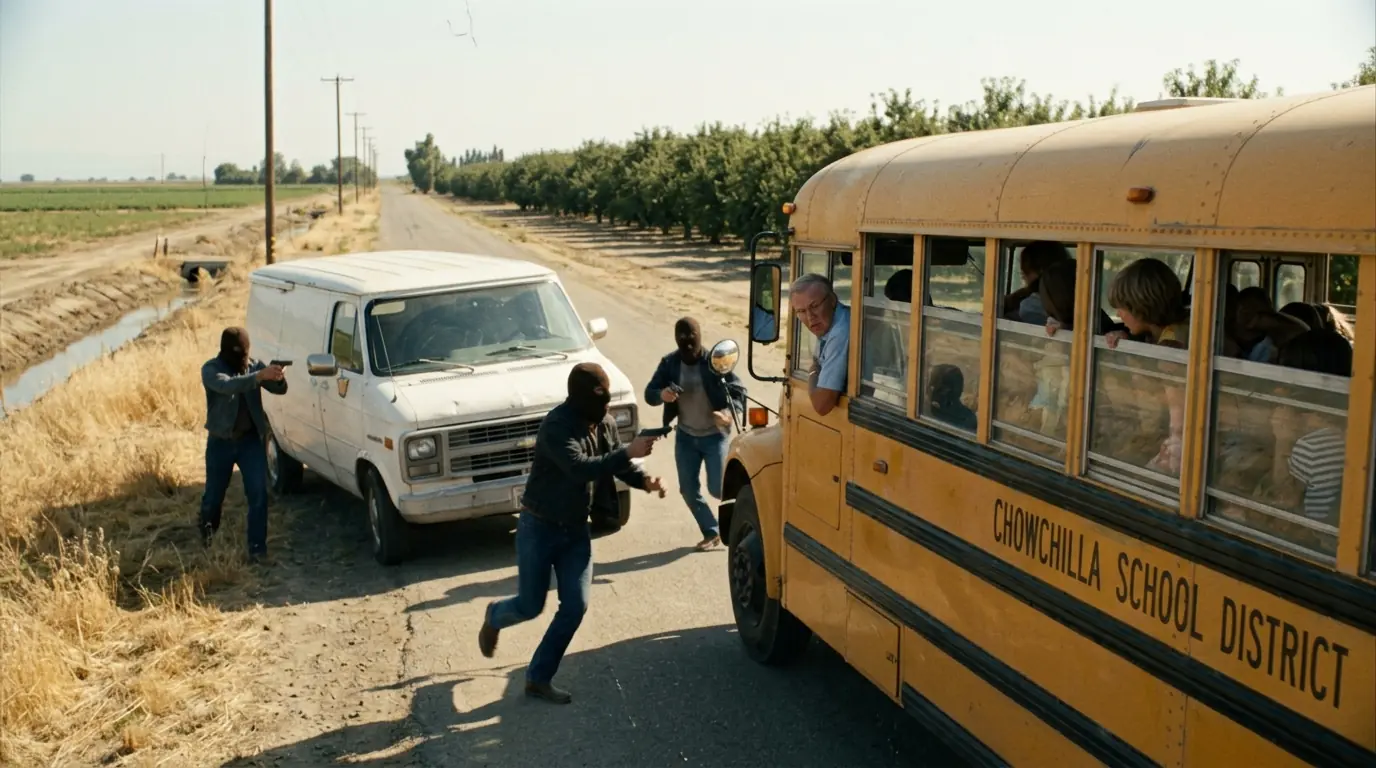
There are crimes that become famous because of how many people were killed.
The Chowchilla kidnapping became famous because nobody died.
And considering what happened, that almost feels impossible.
Twenty-six children.
Some only five years old.
One school bus driver.
Three masked gunmen.
Nearly twelve hours trapped inside dark vans.
Then a ladder descending into the ground.
A buried moving truck.
A steel cover overhead.
Heavy batteries.
Dirt.
Darkness.
And the realization that the men who had kidnapped them were now burying them alive.
By the time the children disappeared on July 15, 1976, their parents had no idea where they were.
Police did not know whether they were still in California.
The abandoned school bus had been found hidden in vegetation miles outside the small town of Chowchilla.
The children were gone.
The driver was gone.
There was no ransom demand.
No telephone call.
No note telling police what to do.
Twenty-seven human beings seemed to have vanished.
Meanwhile, about one hundred miles away, all twenty-seven were underground.
They had been placed inside an old moving van buried roughly twelve feet beneath a rock quarry near Livermore.
Above their only exit were dirt, a heavy cover, wooden construction and weighted material designed to prevent anyone inside from escaping.
They had some food.
Some water.
Minimal ventilation.
No idea where they were.
And no guarantee that the kidnappers were ever coming back.
Hours passed.
The air worsened.
The food disappeared.
The ventilation system began failing.
The roof started bending under the weight above it.
Dust fell into the darkness.
Children cried.
Some believed they were going to die.
Then the adults and older children made a decision.
If they were going to die underground, they would not die waiting.
They would try to dig their way out.
What followed turned one of the most terrifying kidnappings in American history into one of its most extraordinary survival stories.
July 15, 1976
Chowchilla was not the kind of place Americans associated with a massive kidnapping.
It was a small agricultural town in California's San Joaquin Valley.
Farm fields surrounded it.
Families knew one another.
The Dairyland school bus route was not an unfamiliar journey through a dangerous urban area.
It was ordinary.
Predictable.
On July 15, 1976, summer school was almost finished.
It was the next-to-last day.
Bus driver Frank Edward Ray, known as Ed Ray, was taking twenty-six children home.
Ray was deeply connected to the community.
He had been born in the region.
He knew many of the families.
Some of the children on his bus were descendants of people he had known for years.
The passengers ranged from about five to fourteen years old.
The youngest was Monica Ardery.
The oldest included 14-year-old Michael Marshall.
For these children, riding Ray's bus was routine.
Nothing about that afternoon suggested that within hours the entire United States would be asking one question:
Where are the children of Chowchilla?
Ray drove along the rural roads.
Orchards and agricultural land stretched around them.
Then he saw something ahead.
A white van was blocking the road.
To Ray, the situation could have looked like someone having vehicle trouble.
He slowed.
It was exactly what the men waiting ahead wanted him to do.
Three armed men suddenly appeared.
Their faces were concealed with pantyhose.
One carried a sawed-off shotgun.
The children immediately understood that this was not a normal roadside encounter.
Survivor Jodi Heffington, who was ten years old at the time, later remembered the terrifying sight of a man approaching the bus with a stocking over his face and a gun.
Six-year-old Larry Park remembered looking at the masked faces and feeling as though he was looking directly at death.
One of the men ordered Ray to open the door.
The ordinary bus ride was over.
The gunmen took control.
One remained armed around the children.
Another drove.
The white van followed.
Ray did exactly what someone responsible for twenty-six frightened children needed to do.
He tried to keep them calm.
Do what they say.
Stay quiet.
Do not provoke them.
The children noticed something different in his voice.
This was not the relaxed bus driver they knew.
This was a man trying to keep everyone alive.
The kidnappers drove the school bus away from the main road.
Eventually they took it down into a dry waterway or canal area surrounded by vegetation.
Tall growth helped conceal the yellow bus from passing motorists.
Waiting there was another vehicle.
The kidnappers had prepared for this.
They were not planning to continue moving twenty-six children through California in a bright yellow school bus.
The bus was too visible.
Every police officer would recognize it immediately.
So the kidnappers transferred their hostages.
The school bus was positioned beside the vans.
The children were ordered from one vehicle into another.
Some survivors later recalled that the kidnappers positioned the vehicles to minimize footprints on the ground.
The children had to move directly from the school bus into the vans while armed men watched them.
For Jodi Heffington, one moment remained especially vivid.
During the transfer, she found herself standing with a shotgun pressed against her body as the kidnappers repositioned vehicles.
She believed she might be shot.
She had done what they told her.
It did not matter.
The weapon stayed against her.
She waited.
Then eventually she was allowed into the van.
The doors closed.
Darkness.
The vans had been altered.
Windows had been covered or painted.
Wood paneling prevented the children from seeing outside.
The vehicles were effectively mobile jail cells.
No one inside knew where they were going.
The engines started.
And the children of Chowchilla disappeared.
The Empty Bus
Back in town, parents began expecting their children home.
A normal school day has a rhythm.
Parents know approximately when a bus arrives.
Children walk through the door.
They drop their belongings.
They ask for food.
They argue with siblings.
They turn on the television.
That afternoon, those small routines did not happen.
One family waited.
Then another.
Then another.
Twenty-six children failed to arrive home.
At first, there were reasonable explanations.
Maybe the bus had broken down.
Maybe it was delayed.
Maybe there had been some scheduling problem.
But as time passed, concern became fear.
Parents began calling.
People started retracing the bus route.
Where was Ed Ray?
Where were the children?
How does a large yellow school bus carrying twenty-six kids simply disappear?
Police became involved.
Parents helped search rural roads.
Authorities eventually began searching from the air.
Then, shortly before sunset, the missing bus was located around seven miles outside Chowchilla.
It was hidden down in the dry riverbed area among tall vegetation.
The doors were there.
The seats were there.
The bus itself appeared intact.
But nobody was inside.
Twenty-six children.
Gone.
Ed Ray.
Gone.
Investigators examined the ground.
Tire tracks suggested another vehicle had been backed close to the bus.
This did not look like a mechanical failure.
It did not look like the children had wandered away.
Someone had taken them.
Madera County Sheriff Ed Bates realized he was dealing with something almost unimaginable.
An entire school bus had been hijacked.
He called for help.
The FBI became involved.
Dozens of federal agents eventually arrived.
Parents gathered at a fire station that became a command center.
Their children had left for school that morning.
Now law enforcement could not tell them where they were.
There had been no ransom demand.