A Baby Raccoon Was Found Barely Moving Beneath a Backyard Porch — The Swelling Across His Face Made Every Hour Matter
The homeowner first heard the noise shortly after sunrise.
It wasn't loud. Just an occasional scratching sound coming from somewhere beneath the back porch of a suburban home. At first, they assumed a squirrel or another small animal had moved underneath the deck during the night.
Then the sound stopped.
When they checked the area later that morning, they found a baby raccoon lying close to the foundation.
He wasn't hiding.
He wasn't trying to run.
He was stretched partly on his side beneath the porch, with his chin almost touching the dirt. Even from several feet away, something looked seriously wrong with his face.
The entire left side was swollen.
The swelling extended from his cheek toward the muzzle, making one side of his face look dramatically larger than the other. One eye could open only partially. The fur around his neck and shoulder was missing in irregular patches, exposing irritated skin underneath, and several abrasions were visible across the same area.
When he tried to raise his head, he managed only a few seconds before lowering it again.
There was no adult raccoon in sight.
Because raccoons can carry diseases that pose risks to people and other animals, the homeowner wisely avoided handling him directly and sought wildlife assistance. By the time the young raccoon reached our rehabilitation facility, he was still conscious, but his condition was concerning.
Normally, even a young raccoon can be surprisingly defensive when frightened. They may pull away, vocalize, grab with their front paws, or make it very clear that human contact isn't welcome.
This little animal barely reacted.
He remained curled against the transport bedding while we began the initial assessment. His breathing was rapid, his body condition was poor, and he appeared dehydrated. The facial swelling that had been obvious beneath the porch looked even more significant up close.
One side of his muzzle was distorted enough that eating normally would have been difficult.
The damaged area around his neck and shoulder raised another concern.
Something had happened to him, but we didn't know what.
The abrasions and missing fur could have resulted from trauma. The facial swelling could potentially have been associated with an injury, infection, bite, or another medical problem. It was tempting to build a story around the condition in which he had been found, but there had been no witness.
We couldn't say that another animal had attacked him.
We couldn't say that he had fallen.
And we couldn't assume that the swelling itself was the only problem.
What we could say was that this was a very sick or injured young raccoon requiring veterinary evaluation and careful stabilization.
For the first several hours, that became the priority.
The little raccoon was placed in a secure, quiet recovery environment while his condition was assessed more thoroughly. The wounds around the neck and shoulder were examined and managed appropriately, and the facial swelling required particularly careful attention because of its location near the eye, nose, and mouth.
He was weak enough that we didn't want to add unnecessary stress.
Feeding also had to be approached according to his condition rather than simply assuming that a baby animal needed food immediately. Hydration, body temperature, alertness, swallowing ability, and the nature of the facial injury all mattered.
For a while, he simply rested.
One of the caregivers placed a folded towel in the protected portion of his enclosure. The raccoon slowly pushed his nose against it and remained there, almost completely still.
That position became familiar during his first day.
Every time someone checked him, he seemed to have moved only a few inches.
By late afternoon, however, there was one small change.
When the enclosure was opened, his head came up.
Both front paws moved underneath his chest.
For perhaps ten seconds, he held himself upright.
Then he lowered himself again.
Nobody celebrated loudly. He needed quiet far more than encouragement.
But it was the first moment when he looked less like an animal disappearing into the bedding and more like a young raccoon trying to respond to what was happening around him.
During those early checks, someone started calling him Marlow.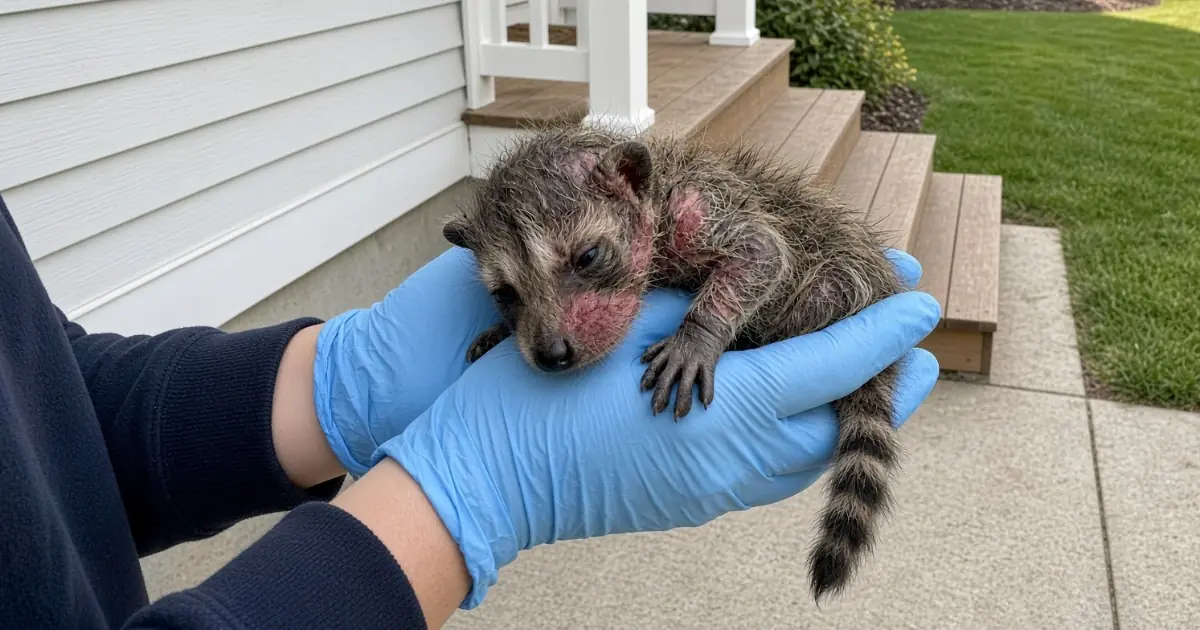
The name wasn't tied to some dramatic feature of his injuries. It was simply a name one caregiver used while recording his observations, and by the next morning it had quietly spread through the team.
Marlow had a name now.
He also had a long way to go.
The first night was difficult.
The swelling didn't suddenly disappear with treatment. His face remained badly distorted, and he continued spending most of his time resting. Because the affected area involved his muzzle, every change in breathing, swallowing, and interest in food was watched carefully.
His eye was monitored too.
With so much swelling around one side of the face, protecting normal function was more important than how dramatic the injury looked from the outside.
The damaged skin around his neck and shoulder also required continued attention. Areas that initially looked like simple abrasions can sometimes reveal deeper problems once swelling, contamination, and matted fur are addressed.
Marlow's injuries had to be allowed to tell their story over time.
By the following morning, he was still weak.
But he was more aware.
When a caregiver approached, Marlow didn't simply lie still.
He pulled himself backward.
It wasn't fast.
It wasn't coordinated.
But he wanted distance.
That was encouraging.
Over the next several days, the rehabilitation room became the setting for dozens of small changes.
Marlow began holding his head upright for longer periods.
He started changing sleeping positions on his own.
His hydration improved.
His interest in appropriate nutrition strengthened as his condition allowed.
Most importantly, the swelling finally began moving in the right direction.
At first, the change was almost impossible to see without comparing photographs.
Then the outline of his muzzle became slightly more symmetrical.
His partially closed eye began opening farther.
The improvement was gradual enough that the caregivers working with him every day sometimes noticed it less than someone who hadn't seen him for 24 hours.
“His face looks smaller.”
That became one of the most welcome observations of the week.
As the swelling decreased, Marlow's behavior changed too.
The almost motionless baby from intake started becoming inconvenient.
During routine care, he began retreating toward the back of the enclosure.
Soon he was using his front paws to pull bedding around himself.
Then he started investigating everything.
Young raccoons are extraordinarily tactile animals. Their sensitive front paws are central to the way they explore their environment, manipulate food, climb, and investigate unfamiliar objects.
Marlow's paws had barely moved during his first hours with us.
Now they seemed to be everywhere.
He touched the edges of his hiding space.
He manipulated bedding.
He investigated appropriate food.
He tested anything new placed into his environment.
Watching those behaviors emerge told us something that a photograph of his face couldn't.
Marlow wasn't merely looking better.
He was beginning to behave better.
The abrasions around his neck and shoulder also continued healing. The missing fur made the area look rough long after the underlying skin had improved, but appearance wasn't our primary measure of success.
We were watching function.
Could he move his head and neck normally?
Could he use both front limbs comfortably?
Could he chew and manipulate appropriate food?
Could he see normally from the previously swollen side?
Could he move through his environment without showing signs that the original trauma was still limiting him?
Those questions became increasingly important as his immediate medical crisis passed.
There was another issue we couldn't ignore.
Marlow was a raccoon.
That matters in wildlife rehabilitation.
Raccoons require careful handling and strict attention to biosecurity because they can carry zoonotic diseases and parasites, and rehabilitation requirements and regulations can vary depending on location. Direct contact was therefore kept limited and appropriate precautions were part of his care.
The goal was also to prevent habituation.
A baby raccoon can become accustomed to humans surprisingly easily when people provide food and comfort over an extended period. That may look endearing in rehabilitation, but a raccoon that actively seeks out people after release can put both itself and the public at risk.
So the healthier Marlow became, the less personal his care needed to feel.
We didn't want him running toward us.
We wanted him disappearing when we arrived.
He began doing exactly that.
As his strength returned, his enclosure evolved to match his developmental needs.
He started climbing.
At first, he was cautious. He would place both front paws onto a low structure, pull himself upward, and pause as though deciding whether the effort was worthwhile.
Within days, the hesitation was disappearing.
He climbed higher.
He became stronger through the shoulders.
His coordination improved.
Soon, Marlow could move around his environment with the kind of confidence that seemed almost impossible when compared with the baby found beneath the porch.
His appetite changed dramatically too.
During the worst of the facial swelling, simply making sure he could receive appropriate nutritional support safely had been a concern.
Now food became something to investigate.
He held pieces between his paws.
He turned them.
He smelled them.
Sometimes he seemed to spend longer examining an item than actually eating it.
That was fine.
Wild raccoons need to explore and forage, not simply wait for a bowl to appear.
As rehabilitation progressed, opportunities for natural problem-solving and foraging became increasingly important. Marlow needed to learn that food could be hidden, scattered, contained, or require manipulation.
Every step moved him farther from being a patient and closer to being a wild juvenile.
His appearance continued catching up.
The facial swelling that had once dominated his entire face decreased dramatically. His eye was fully visible again. The outline of his muzzle looked much more normal.
The fur across his neck and shoulder was slower.
For a while, there remained a noticeable patch where the coat was thin and uneven.
That patch became almost like a record of his arrival.
Everything else about him was changing.
Marlow was climbing.
Exploring.
Eating.
Avoiding people.
But that rough section of coat remained as a reminder of the little raccoon who had been found unable to hold his head up beneath a porch.
We still don't know exactly what caused his injuries.
It's possible that trauma played a major role. It's possible the swelling developed after a wound became inflamed or infected. Several events may have contributed to his condition before he crawled beneath the porch seeking shelter.
Without witnessing what happened, assigning a dramatic cause would only turn speculation into a story.
Wildlife rehabilitation often leaves some questions unanswered.
Marlow doesn't need us to solve that mystery for him.
He only needs us to make sure the consequences no longer prevent him from living normally.
At the time of this update, Marlow remains in rehabilitation while he continues developing and preparing for eventual independence.
The difference from intake is substantial.
He can hold his head normally.
He moves comfortably through his environment.
The severe facial swelling has improved dramatically.
The injured skin has healed well, with coat recovery continuing.
Most importantly, his behavior increasingly resembles that of a healthy young raccoon rather than a debilitated patient.
He wants to explore.
He wants to climb.
He wants to investigate everything with his paws.
And he does not want caregivers standing nearby watching him do it.
Those are good problems to have.
Marlow's case also shows why a visibly compromised raccoon shouldn't be approached as though it were a domestic animal.
A raccoon that appears unusually quiet may be injured or seriously ill, and direct handling can create risks for both the animal and the person. Keeping children and pets away and contacting an appropriate licensed wildlife rehabilitator, animal control agency, or wildlife authority is a much safer response.
The morning Marlow was found, he had chosen—or simply managed to reach—the darkness beneath someone's porch.
He was weak enough that a homeowner could stand several feet away and watch him without seeing any attempt to escape.
One side of his face was so swollen that his eye was barely visible.
His neck and shoulder were scraped and missing fur.
His head kept falling back toward the ground.
Now, when someone approaches his rehabilitation enclosure, getting a clear look at Marlow can be difficult.
There may be a quick movement.
Two dark eyes watching from cover.
A pair of small paws gripping an elevated surface.
Then he's gone again.
We don't know what happened to him before that early-morning scratching drew someone outside.
But if his recovery continues, we know what we want to happen next.
Marlow will eventually have no reason to hide beneath a human porch because he's too weak to go anywhere else.
He'll be able to choose his own shelter, find his own food, climb on his own four feet, and disappear into the kind of wild place where a healthy raccoon should be difficult for us to find at all.