The call came from a driver traveling along a quiet road shortly after sunrise.
She had noticed something lying in the grass near the edge of the pavement. At first, she thought it was a discarded blanket or a bag of trash.
Then she saw one of its legs move.
The driver pulled over safely and walked back. A medium-sized brown-and-white dog was lying on his side several feet from the road. His coat was dirty and matted, and one of his rear legs rested at an unnatural angle.
He was still alive.
When the woman spoke, the dog opened his eyes and attempted to raise his head. He managed to lift it only a few inches before lowering it into the wet grass again.
There was no collar beside him. No vehicle had stopped, and no one nearby appeared to be searching for an injured animal.
The woman called a local rescue organization and remained at a distance while waiting for help. Because she did not know whether the dog had suffered spinal or internal injuries, she avoided moving him.
Cars continued passing only a short distance away.
The dog flinched each time one came close.
A rescue team arrived with a stretcher, blankets and emergency supplies. The dog was conscious, but he was barely responsive. His breathing was shallow, his gums were pale and his body felt cold.
There was dried blood around his nose and on the fur covering his rear legs. Several areas along his shoulder and hip had been scraped raw.
His injuries appeared consistent with being struck or dragged along the pavement, but there were no witnesses.
The team could not yet know what had happened.
They began calling him Parker.
One rescuer stabilized Parker’s head and neck while the others carefully slid a blanket beneath him. He gave a weak cry when they moved his injured rear leg, then became quiet again.
He did not try to bite or escape.
Once Parker was secured to the stretcher, the team carried him to the rescue vehicle and drove directly to its veterinary clinic. Staff were notified that a critically injured dog was on the way.
Parker was placed on a treatment table as soon as he arrived.
An oxygen mask was positioned over his muzzle while the medical team checked his heart rate, blood pressure and temperature. An IV catheter was inserted into his front leg so warmed fluids and medication could be administered.
His blood pressure was dangerously low.
The abrasions visible on his body were painful, but they were not the team’s greatest concern. A dog can appear relatively intact from the outside while bleeding internally or suffering damage to the lungs and abdominal organs.
Parker’s abdomen felt tense during the examination.
His breathing was also more difficult than it should have been, and bruising was beginning to appear across one side of his chest.
X-rays showed a fractured pelvis and a badly broken rear leg. Two ribs were also cracked, although there was no evidence that they had punctured his lungs.
Ultrasound revealed a small amount of fluid inside his abdomen.
The medical team could not immediately determine whether the bleeding was still active. Parker was too unstable for surgery, so staff focused on supporting his circulation, controlling his pain and monitoring him for any change.
His injuries strongly suggested significant blunt-force trauma.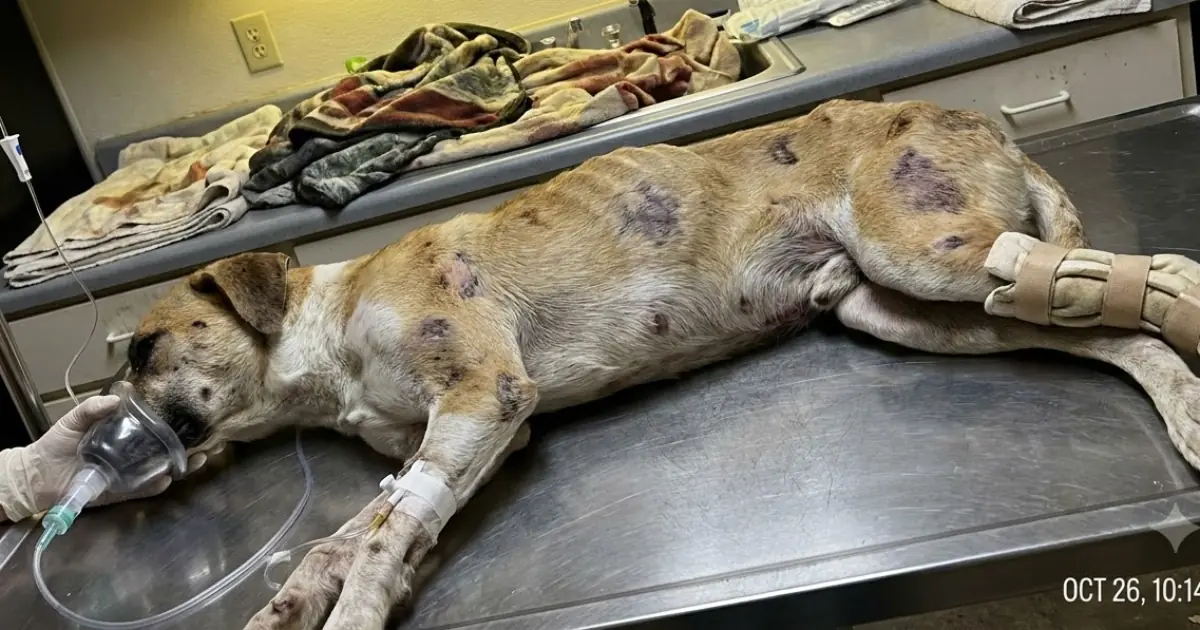
A collision with a vehicle was one possible explanation. The location where he had been found, the damage to his leg and pelvis, and the road rash along his body all supported that suspicion.
Still, without a witness or camera footage, the rescue could not state with certainty that Parker had been hit by a car.
They also could not determine how long he had been lying beside the road.
Some of the blood on his coat had already dried. His body temperature had fallen, and insects had begun gathering around one of his open wounds.
He may have been there for hours.
The thought that a driver could have struck him and continued without stopping was difficult for the team to ignore. Even if the collision had been accidental, Parker had been left injured and unable to move beside an active roadway.
Someone might have seen him.
Someone might have known what happened.
Yet no one had contacted the shelter, animal control or a nearby veterinary clinic to report the incident.
Parker’s first several hours at the clinic were critical.
His blood pressure remained unstable despite fluids. Staff repeatedly checked his abdomen for signs that the bleeding was increasing, while oxygen support helped reduce the effort required for each breath.
The wounds along his hip and shoulder were gently flushed to remove dirt, gravel and fragments of dead tissue.
His broken leg was temporarily supported.
Surgical repair would have to wait until his condition became more stable.
A microchip scan found nothing.
The rescue shared Parker’s photograph with nearby shelters, veterinary offices and local lost-pet groups. No matching report was immediately located.
Because he had no collar and no identification, no one knew where he had lived before he was found.
Parker remained almost completely still throughout the afternoon.
Whenever a technician touched his shoulder, he opened his eyes. He occasionally moved one front paw against the blanket but could not reposition the rest of his body.
Food was not offered immediately because he might require emergency anesthesia.
Instead, staff kept his mouth moist and continued monitoring his blood sugar and hydration through his IV treatment.
As evening approached, repeat imaging brought the first cautious sign of relief.
The fluid inside Parker’s abdomen had not increased significantly. The bleeding appeared to be slowing, although his condition remained serious.
His temperature also began rising toward a safer level.
A technician sat beside the recovery enclosure while checking his breathing. When she spoke to him, Parker moved his eyes toward her voice.
A few minutes later, his tail made one small movement against the blanket.
It was not a dramatic response.
But it was the first time he had reacted to anyone without being touched.
Parker remained under continuous observation overnight.
His blood pressure dropped again shortly before midnight, requiring additional support. The medical team prepared for the possibility that he might need an emergency transfusion or surgery if the internal bleeding worsened.
Fortunately, repeat examinations showed no sudden increase in abdominal fluid.
By early morning, Parker was still weak, but his circulation had begun to stabilize.
He was offered a small amount of soft food from a spoon.
At first, he turned his face away. The technician waited and tried again later, placing only a small amount near his lips.
Parker licked it once.
On the third attempt, he swallowed several bites before resting his head on the blanket.
His appetite was limited, but the fact that he could eat without vomiting gave the team another encouraging sign.
The fractured rear leg still required repair.
Once Parker was considered stable enough for anesthesia, surgeons examined the full extent of the damage. The bone had broken in more than one place, and the surrounding tissue was badly swollen.
His pelvis, although fractured, remained aligned well enough that it could potentially heal with strict rest and pain control. The rear leg was less certain.
The surgeons discussed whether it could be saved.
Damage to the muscles and blood supply around the fracture made the procedure more complicated. If circulation failed or infection developed, amputation might become necessary.
For the moment, the team decided to attempt repair.
The bone was stabilized surgically, and Parker’s leg was placed inside a protective bandage. His wounds were cleaned again while he was anesthetized, and damaged tissue was carefully removed.
The procedure went as planned, but recovery would not be quick.
Parker awoke slowly and remained beneath warm blankets for the rest of the day. He could not stand, and every movement had to be supported so the repaired leg and fractured pelvis would not carry weight.
A padded sling was used during bathroom breaks.
At first, Parker seemed frightened whenever anyone attempted to move him. His body became rigid, and his eyes widened as the sling was positioned beneath his abdomen.
Staff kept each interaction slow and predictable.
They spoke before touching him, supported his injured side and returned him to his bedding as soon as possible.
Despite his fear, Parker never showed aggression.
He seemed exhausted more than anything else.
During the following days, his appetite gradually improved. He began lifting his head when food entered the room and could eat from a shallow bowl without assistance.
The swelling around his injuries slowly decreased.
His dressings still required frequent changes, and the deepest abrasion near his hip remained at risk of infection. Antibiotics and pain medication continued while veterinarians monitored the repaired bone.
Investigators returned to the road where Parker had been found.
They searched for nearby security cameras and asked residents whether anyone had heard or seen an accident. A business farther down the road had exterior footage, but the camera did not clearly cover the location where Parker was discovered.
One recording showed headlights slowing briefly during the night.
The vehicle was too far away to identify, and the footage did not show whether a collision occurred.
No one came forward to report hitting a dog.
It remained possible that Parker had been injured somewhere else before reaching the roadside. However, his fractured pelvis, broken leg and extensive abrasions continued to make vehicle trauma the most likely explanation.
The rescue avoided presenting that suspicion as proven fact.
What could be confirmed was that Parker had been left beside the road in critical condition, unable to stand or reach help on his own.
A week after arriving, Parker attempted to rise.
He planted both front paws on the bedding and lifted his chest. His hindquarters remained supported by the sling, and his body trembled from the effort.
He stood for only a few seconds.
Then he looked toward the open clinic door as if he wanted to move forward.
The technician encouraged him to take one careful step with his front legs before helping him lie down again.
That small movement became the beginning of his rehabilitation.
Parker’s recovery plan included strict rest followed by carefully controlled exercises. At first, rehabilitation focused on preventing stiffness and protecting the muscles around his injuries.
Staff gently moved his joints through a safe range while watching for pain.
As the fractures began healing, Parker practiced standing with support. He slowly learned to balance on his uninjured legs while keeping weight away from the repaired limb.
Some days were harder than others.
After one bandage change, Parker refused food for several hours and kept his head turned toward the back of the enclosure. On another morning, he surprised everyone by standing before the sling had been fully adjusted.
Recovery from severe trauma rarely follows a straight line.
Progress came through small changes: finishing a meal, sitting upright without assistance, allowing a caregiver to touch his injured side and remaining on his feet for several seconds longer than the day before.
No owner contacted the rescue.
Parker’s photograph was widely shared, but none of the responses led to a verified family. It was unclear whether he had been lost, abandoned or living as a stray before the incident.
The shelter may never know where he came from.
It may also never know who was driving on the road when he was injured—or whether that person understood the damage that had been done.
Several weeks after surgery, new imaging showed that Parker’s leg was beginning to heal. His pelvis was also becoming more stable.
The possibility of amputation had not disappeared completely, but circulation in the repaired limb remained adequate and no deep infection had developed.
Parker could now take a few supported steps.
He moved slowly, placing most of his weight through his front legs while the sling steadied his hindquarters. After each short session, he returned to his bed and slept from the effort.
His tail had also begun moving more often.
It wagged when his regular caregiver entered with food and again when she lowered the sling beside his bed.
Parker is still undergoing treatment and rehabilitation.
He needs continued wound care, follow-up imaging and weeks of restricted movement before veterinarians can fully evaluate his long-term mobility. Arthritis may develop in the injured areas as he grows older, and the repaired leg may never function exactly as it once did.
But the dog who arrived unable to lift his body from the treatment table can now stand with assistance.
No one can say with certainty what happened on that road.
The evidence suggests Parker may have been struck by a vehicle and left behind, but the unanswered details remain with whoever was there that night.
What is certain is that he was injured, frightened and completely helpless when a stranger finally noticed him in the grass.
Someone had passed him by.
Then someone else chose to stop.