A Badly Injured Squirrel Was Found Beneath a Backyard Tree — His Wounds Suggested He May Have Been Dropped From Above
When the squirrel arrived at our wildlife rehabilitation center, the first thing we noticed was that he wasn't trying to escape.
For an adult eastern gray squirrel, that alone was concerning.
He lay curled inside the small transport box with his head low against the towel beneath him. His breathing was shallow and rapid, and although his eyes were open, he made only a weak attempt to move when the box was opened for assessment.
One side of his body was visibly injured.
There were several puncture-like wounds through the fur around his back and shoulder, along with abrasions on his side. One rear leg rested at an unnatural angle when he tried to reposition himself, and dried blood was visible around a damaged patch of fur near his flank.
But the injuries didn't immediately tell us exactly what had happened.
The people who found him had discovered him beneath a large tree at the back of their property earlier that morning. They hadn't witnessed the incident itself. They had simply heard an unusual commotion outside—several loud bird calls followed by movement in the branches—and later noticed the squirrel lying in the grass.
There was another detail that made the situation unusual.
A neighbor reported seeing a large bird leave the area around the same time.
That didn't prove anything, and in wildlife rehabilitation we have to be careful about turning assumptions into facts. But the combination of puncture wounds, trauma, the squirrel's location, and the reported bird activity made one possibility worth considering: he may have been caught by a bird of prey and then dropped.
Hawks and other raptors naturally prey on small mammals, including squirrels. Sometimes prey can be lost during an attempted capture or while being carried. If this squirrel had fallen from a significant height after already being injured by talons, it could explain why we were seeing signs of both puncture trauma and a potentially serious impact injury.
Whatever had happened, by the time he reached us, determining the exact sequence was less important than keeping him alive.
He needed veterinary assessment and stabilization.
Handling was kept as limited as possible while we evaluated his breathing, responsiveness, wounds, mobility, and overall condition. With significant trauma, the injuries visible on the outside aren't always the only concern. A fall can potentially cause fractures, internal injury, head trauma, or damage that isn't immediately obvious beneath thick fur.
The punctures themselves also mattered. Wounds caused by another animal can introduce contamination deep into tissue even when the openings at the skin look relatively small.
The squirrel was clearly painful and stressed, and the abnormal rear leg raised immediate concern.
He was placed in a quiet, controlled environment while supportive care was initiated and the veterinary team evaluated the extent of his injuries.
During that first examination, we found no obvious reason to believe the leg was completely nonfunctional, but he wasn't bearing weight on it normally. The tissues around the hip and upper leg were tender, and his reluctance to move made it difficult to know how much of the problem was related to pain, swelling, or a deeper injury.
The wounds across his back and shoulder were carefully evaluated and cleaned as appropriate. Several were consistent with punctures rather than simple scrapes from hitting the ground.
That strengthened our suspicion that another animal had been involved.
Still, we couldn't say with certainty that a hawk had carried him.
So on his intake record, the cause remained what it often has to remain in wildlife medicine: suspected trauma, mechanism unknown.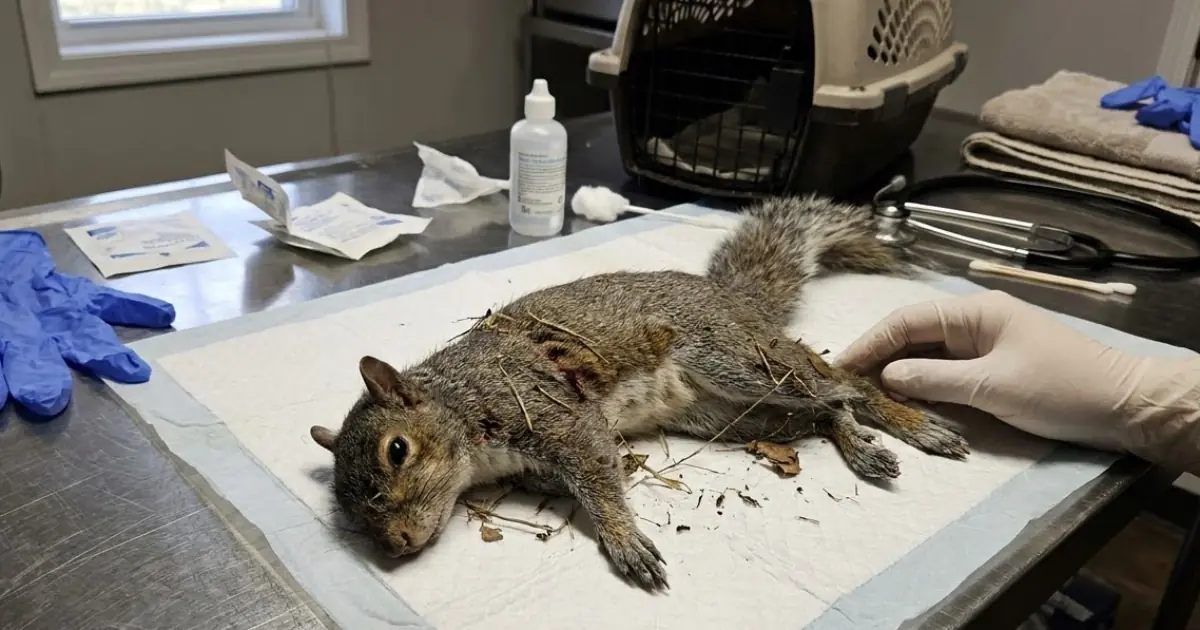
By the end of that first day, one of our caregivers had begun calling him Tumble.
The name came from the story that had accompanied him through the door—the possibility that somewhere above that backyard, he had lost his captor's grip and fallen back to the ground.
We couldn't prove that was what happened.
But the name stayed.
For the first night, Tumble didn't do much that looked encouraging from the outside.
He remained tucked into a protected section of his recovery enclosure and barely changed position. Food was available when appropriate, but eating wasn't his priority.
Rest was.
The enclosure was deliberately simple. He wasn't given branches to climb or elevated places to explore. If he had sustained an impact injury, the last thing we wanted was for a frightened squirrel to attempt a climb and fall again.
Instead, his environment was kept low and secure while we watched for changes.
His breathing was monitored.
So was his responsiveness.
We watched for neurological abnormalities that could suggest significant head trauma. We checked the injured areas and paid particular attention to the rear leg.
The next morning, Tumble was still in roughly the same part of the enclosure.
But something had changed.
When the door opened, his head came up immediately.
His eyes followed the caregiver.
Then, for the first time since intake, he tried to retreat.
He didn't get far. His injured leg still prevented normal movement, and after several awkward steps he stopped.
But the instinct was there.
He wanted distance from us.
For a wild squirrel, that was a good sign.
Over the following days, his recovery became a matter of watching small changes rather than expecting one dramatic transformation.
The swelling around the injured areas gradually began to improve. The puncture wounds required continued monitoring because the surface appearance of a wound doesn't always reveal what is happening underneath.
His appetite improved too.
At first, he ate only modest amounts. Then staff began finding more evidence each morning that he had been active when the room was quiet.
Tumble was also becoming less cooperative.
That may sound like a problem, but it was exactly what we wanted.
A seriously compromised squirrel may tolerate human presence simply because he doesn't have the strength to react. As Tumble recovered, he became increasingly alert when caregivers approached. He began retreating to the far side of the enclosure and watching us closely.
The rear leg remained the biggest question.
For several days, he continued to protect it.
Then we noticed him placing the foot down.
Not consistently.
Not with full weight.
But it touched the floor.
Over the next several days, those brief moments became more frequent. He began using the limb during slow movement instead of holding it away from the ground.
That was encouraging, but we still weren't ready to let him climb.
A squirrel can compensate surprisingly well for weakness in a controlled environment. Outside, the standards are much higher.
An eastern gray squirrel doesn't simply need to walk.
He needs explosive movement.
He needs to race vertically up bark, wrap his toes securely around branches, leap across gaps, land accurately, change direction almost instantly, and maintain balance while moving through a canopy.
If Tumble had truly survived an encounter with a raptor, there was another requirement that mattered just as much: he needed to be capable of escaping the next one.
So we waited until his recovery had progressed enough before gradually giving him opportunities for more movement.
The first time he was provided with a low climbing structure, he approached it cautiously.
He placed both front feet against it and pulled upward.
One rear foot followed.
Then the injured one.
For several seconds he remained there, gripping the surface with all four limbs.
It was a small climb, but compared with the squirrel who had arrived lying almost motionless inside a cardboard box, it was a major change.
From that point, Tumble seemed determined to make our job more difficult.
As his enclosure became more complex, he started using every part of it.
He climbed higher.
He moved faster.
He began jumping between short, safe distances.
The damaged areas of fur were still visible, and healing wounds made his coat look uneven across one side of his body, but his movement increasingly resembled that of a healthy squirrel.
His personality returned with his mobility.
Soon, opening the enclosure required careful planning because Tumble no longer sat quietly while someone checked him.
He disappeared.
Sometimes the only view we got was a gray tail vanishing behind a branch.
That was one of the most reassuring developments of his entire rehabilitation.
The animal that had once been too injured to flee from a person now wanted absolutely nothing to do with us.
As his condition improved, the focus shifted away from simply healing wounds and toward determining whether he could function normally.
We watched his balance when he climbed.
We watched how he landed.
We compared the use of both rear legs.
We looked for hesitation before jumping or signs that pain appeared after activity.
We also monitored his ability to grip and maneuver because even subtle weakness can matter enormously for an arboreal animal.
Tumble continued improving.
Eventually, the rear leg that had looked so concerning at intake was participating normally in most of his movement. His wounds closed without the kind of complication we had feared during those first days, and the damaged areas of his coat began gradually recovering.
The difference was striking.
At intake, we had been concerned about whether he would remain stable through the first night.
Now we were trying to determine whether he was fast enough to go back to the trees.
At the time of this update, Tumble remains in rehabilitation while his final physical condition and release readiness are evaluated. He is alert, active, eating independently, climbing, jumping, and maintaining the strong avoidance of humans that we want to see in a wild squirrel.
There are still no guarantees.
Wildlife rehabilitation isn't complete simply because wounds have closed. Before release, we need confidence that the animal can perform the behaviors necessary to survive without human support.
For Tumble, his story also offers a glimpse into something that can be difficult for people to witness: predation is a normal part of the natural world.
If a raptor was responsible for his injuries, the bird wasn't being cruel. Hawks and other predators have to eat, and squirrels are part of the food web they inhabit.
Our role isn't to judge what may have happened.
Our role began when an injured wild animal was found alive and brought into care.
We may never know precisely what happened in the branches above that backyard.
Perhaps a hawk caught Tumble and lost its grip.
Perhaps he escaped during the struggle and fell.
Perhaps some part of the story was entirely different from what the injuries initially suggested.
Tumble can't tell us.
His body was the only evidence that arrived with him.
The punctures told us something had grabbed him.
The trauma told us something significant had happened.
And the way he lay almost motionless inside that transport box told us how much the experience had taken out of him.
Today, when a caregiver approaches, Tumble doesn't lie still.
He climbs away.
Fast.
If his recovery continues and he ultimately meets every requirement for release, there may eventually be another tree waiting for him.
This time, we hope the only thing carrying Tumble into its branches will be his own four feet.