The first thing Officer Derek Rollins said to me that Sunday morning was not good morning.
It was, “Step away from the mailbox.”
I had lived in that house for nine years.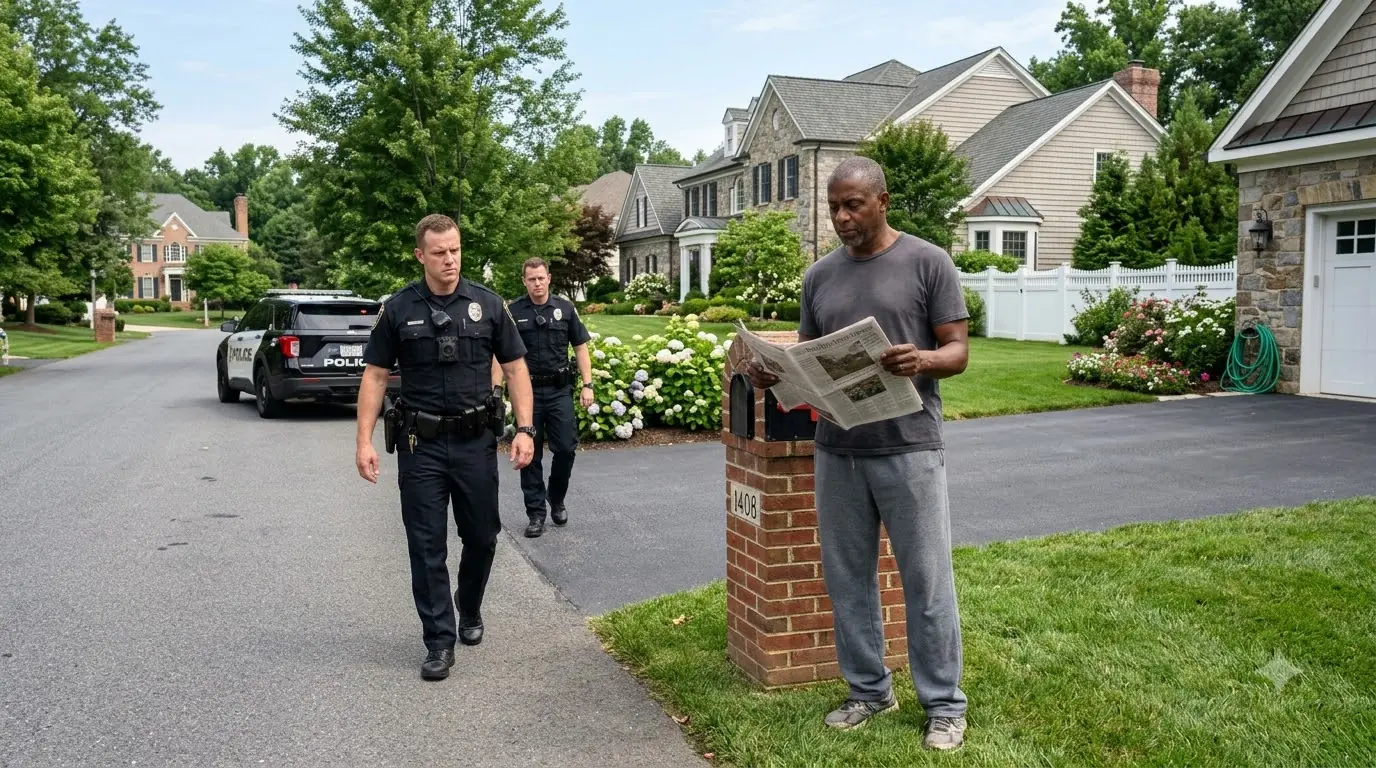
The brick mailbox had been repaired twice during that time, once after a delivery truck backed into it and once after a snowplow clipped the stone edging. I had planted the hydrangeas beside the driveway with my wife, Margaret, during the first spring after we bought the property.
There were probably few places in America where I had a clearer legal right to stand.
But Officer Rollins had already decided that the ordinary explanation was the least believable one.
I folded the Washington Sunday paper beneath my arm and looked at him.
“Good morning.”
“Step away.”
His hand rested near the front of his duty belt.
Not on his firearm.
Not yet.
But close enough to announce that our conversation had already been placed inside a category I had not chosen.
Behind him, a marked Bethesda-area patrol cruiser sat half along the curb, morning sunlight reflecting off the windshield.
His partner remained in the passenger seat for another moment.
The neighborhood was quiet.
Sprinklers clicked across a lawn two houses down.
A jogger moved along the opposite sidewalk.
Somewhere behind my house, the garden hose continued spilling water beside the hydrangeas because I had forgotten to close the nozzle before walking toward the mailbox.
It should have been an ordinary Sunday.
That was the point.
Sunday mornings were the only part of my life I guarded with any real stubbornness.
Monday through Saturday belonged to other people.
Intelligence briefings.
Threat assessments.
Meetings with senior officials.
Calls with field offices.
Oversight demands.
Emergency conferences.
Decisions that would appear later in newspapers written by people who had no idea how many hours had gone into making them.
Sunday morning belonged to coffee.
The newspaper.
My garden.
And the memory of my wife.
Margaret had died three years earlier.
Cancer.
Eight months from diagnosis to funeral.
Even after three decades of federal service, I discovered there were emergencies no training could make you useful against.
I could coordinate multi-state operations involving hundreds of agents.
I could sit through classified briefings on threats most Americans would never know existed.
I could testify before hostile committees without raising my voice.
But when Margaret became too weak to walk to the kitchen alone, I could do nothing except hold her hand and pretend not to look frightened.
After she died, the house became too quiet.
So I built routines.
Sunday coffee at seven.
Garden at seven ten.
Newspaper at seven fifteen.
Breakfast around eight.
Call my daughter before nine.
Ordinary things.
I was wearing a faded gray Georgetown T-shirt that morning, loose sweatpants, and worn running shoes.
No suit.
No security detail.
No lapel pin.
No indication that I held one of the most scrutinized law-enforcement positions in the country.
I preferred it that way.
Arthur Pendleton was allowed to exist before Director Pendleton took over the day.
Officer Derek Rollins saw only Arthur.
More precisely, he saw a fifty-eight-year-old Black man in inexpensive clothes standing in front of a six-million-dollar home.
Apparently that was enough.
“What are you doing here?” he asked.
“Getting my newspaper.”
“Here?”
I looked at the paper.
Then at the mailbox.
“Yes.”
His partner opened the passenger door.
Officer Greg Miller stepped out holding a coffee cup.
Miller was older than Rollins by perhaps five years, with a heavier build and an expression that immediately told me he was already uncomfortable.
Rollins looked toward the house.
“This yours?”
“Yes.”
“Name.”
“Arthur Pendleton.”
His eyes narrowed.
“Homeowner’s name.”
“Arthur Pendleton.”
A small smile appeared.
Not friendly.
The kind of smile someone gives when they believe the lie has become too obvious to take seriously.
“Sure.”
Miller glanced at him.
“Derek.”
Rollins ignored his partner.
“Identification.”
“My wallet is inside.”
“How convenient.”
“You can confirm the property registration.”
“No.”
“You can run the plates on the SUV in the garage.”
“No.”
“You can call dispatch and verify the address.”
His face changed.
There are people who interpret helpful information as cooperation.
There are others who interpret it as a challenge to their authority.
Rollins belonged to the second category.
“I don’t need you telling me how to do my job.”