The first thing I noticed was that his body camera was dark.
Not the gun.
Not the way his feet were planted halfway up my front walk.
Not even the fact that the barrel was pointed directly at my chest while I sat in a wooden chair on my own porch with a Sunday newspaper folded across my lap.
The camera.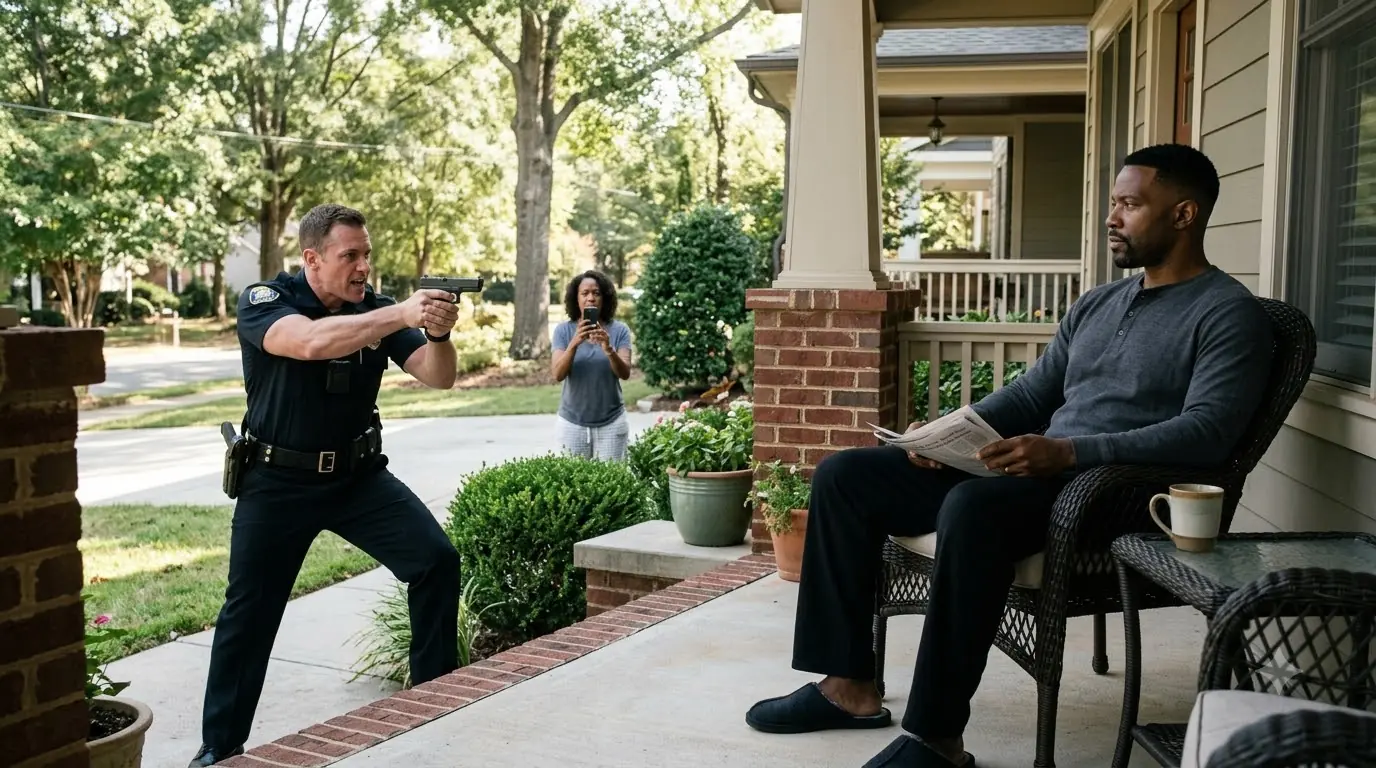
A small rectangular device sat at the center of the officer’s black uniform, positioned exactly where department policy required it to be.
But the indicator light wasn’t glowing.
That mattered.
It mattered more than the officer knew.
“PUT DOWN WHAT YOU’RE HOLDING!”
His voice struck the quiet street so hard that a woman walking two houses away stopped in the middle of the sidewalk.
For a second, I didn’t move.
Not because I intended to challenge him.
Because I genuinely couldn’t understand what he believed I was holding.
The newspaper?
My coffee?
The reading glasses balanced low on my nose?
I looked at the pages in my hands.
Then back at him.
“It’s a newspaper.”
“I SAID PUT IT DOWN!”
I lowered it slowly.
The paper settled beside the ceramic mug on the little table near my chair.
My hands remained visible.
Palms open.
Fingers spread.
The officer did not lower his pistol.
Across the street, the woman who had stopped walking pulled out her phone.
She raised it vertically.
Recording.
Good.
Another front door opened.
An older man stepped outside and stared toward my house.
The neighborhood had been almost silent thirty seconds earlier.
Sunday morning.
Warm sunlight filtering through mature trees.
Sprinklers clicking somewhere down the block.
A lawn mower several streets away.
The smell of somebody’s breakfast drifting from an open kitchen window.
Normal.
Now a police officer was aiming a gun at a Black man sitting in his own porch chair.
Me.
“KEEP YOUR HANDS WHERE I CAN SEE THEM!”
“They are where you can see them.”
“Don’t argue.”
“I’m not arguing.”
His jaw tightened.
I recognized the reaction immediately.
Not because I knew him personally.
Not yet.
Because I had spent years studying what happened when authority began interpreting ordinary clarification as resistance.
I had reviewed hundreds of complaints involving law enforcement.
Some had been credible.
Some had not.
Some officers had been vindicated completely by video.
Others had written reports that looked reasonable until surveillance footage showed the event unfolding differently.
Most cases were complicated.
People remembered stress imperfectly.
Witnesses contradicted one another.
Officers made split-second decisions.
Citizens made bad decisions too.
My work had taught me to distrust easy conclusions.
A complaint was not proof.
A badge was not proof either.
Evidence mattered.
Sequence mattered.
What someone knew at the moment mattered.