Cold rain had been hammering downtown Atlanta since before sunrise when Judge Josephine Caldwell stepped out of the parking garage and crossed toward the federal courthouse carrying a black leather briefcase in one hand and a burgundy handbag in the other.
Ordinarily, she would have entered through the secure judicial garage beneath the east wing, taken the private elevator directly to chambers, changed into her black robe, and appeared in court without ever passing through the public corridor.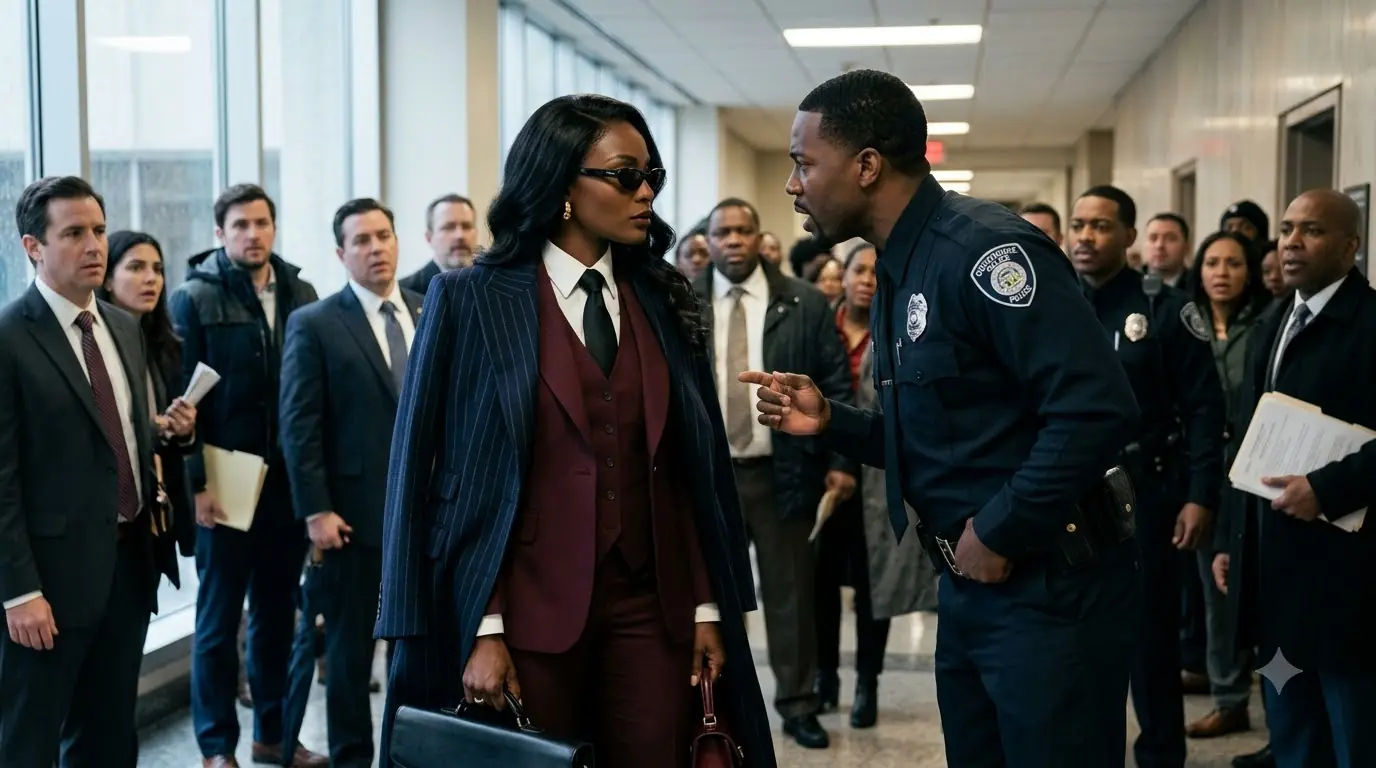
That morning, nothing was ordinary.
A transformer failure caused by the overnight storm had knocked the private judicial elevator offline. Maintenance crews were still working belowground, and the only functioning route to the fourth floor was through the public lobby.
Josephine did not particularly mind.
She had spent twelve years on the federal bench and seven years before that as a trial attorney. She had entered courthouses through every kind of door imaginable. A twenty-minute inconvenience was hardly worth complaining about.
She was thirty-nine, tall and poised, with deep brown skin, sharply defined features, dark almond-shaped eyes, and long black hair falling in polished waves behind her shoulders. Narrow black sunglasses protected her eyes from the wind-driven rain.
Her outfit was unusually striking for a court day, though nobody looking at her would have mistaken it for casual clothing.
She wore a tailored three-piece burgundy suit over a crisp white shirt and narrow black tie, white pointed heels, gold earrings, and a long navy pinstripe coat draped elegantly across her shoulders. Her judicial robe was already hanging inside chambers.
To anybody who knew fashion, she looked expensive.
To anybody who knew Washington or federal court culture, she looked like what she was: someone accustomed to serious rooms.
To Officer Marcus Hale, she looked like someone who did not belong where she was going.
That misunderstanding began four minutes after Josephine entered the courthouse.
The public lobby was crowded because the rain had delayed transportation all across Fulton County. Attorneys shook water from umbrellas. Families clustered near security. Defendants checked paperwork against digital courtroom boards. Clerks hurried between elevators carrying file boxes.
Josephine placed her handbag and briefcase on the conveyor belt, removed her sunglasses, passed through security, then waited while the officer at the screening station returned her belongings.
One of the older security officers recognized her.
“Morning, Judge.”
Josephine smiled.
“Morning, Frank.”
Marcus Hale was not close enough to hear.
He had spent the previous half hour in an argument with his supervisor.
Hale was thirty-four, tall, athletic, and physically imposing in the fitted dark uniform of the courthouse police division. He had joined law enforcement eleven years earlier and transferred into courthouse security three years ago after a disciplinary dispute with his previous department.
He did not describe it that way.
He told people he had left because patrol command had become “too political.”
His record told a different story.
Two excessive-force complaints.
One allegation involving an unlawful detention.
Several complaints about aggressive language.
None had resulted in termination.
Most had resulted in counseling, additional training, or no finding at all.
The most recent complaint was different.
It had triggered the emergency hearing scheduled for that morning.
Hale knew a hearing was happening.
He did not know Josephine Caldwell was the judge assigned to preside over it.
His supervisor had deliberately withheld that detail after internal investigators learned Hale had attempted to contact one of the complainants.
Captain Evelyn Brooks had called him into her office shortly after seven.
“You will stay away from Courtroom 4A today.”
Hale had frowned.
“I’m assigned to fourth-floor security.”
“Not today.”
“Why?”
“You know why.”
Hale leaned back.
“That woman lied.”
Captain Brooks closed the file in front of her.
“That determination is not yours anymore.”
“She shoved me.”
“The footage doesn’t show that.”
“The footage cuts out.”
“That’s one of the problems.”
Hale’s jaw tightened.
“My camera malfunctioned.”
“Again.”
He stared.
Brooks continued.
“Marcus, listen carefully. There is a federal preservation order now. No talking to witnesses. No accessing archived video. No discussing the complaint with anybody except your attorney or internal affairs.”
“You’re treating me like a criminal.”
“I’m treating you like an officer under investigation.”
“That’s the same thing around here now.”
Brooks sighed.
“Go work the public corridor. Stay professional.”
Professional.
Hale hated that word when supervisors used it.
It usually meant somebody wanted him to tolerate disrespect.
He left Brooks’s office angry.
By ten fifteen, he had already corrected two defendants for standing beyond a security line, confiscated a phone from a teenager who ignored courtroom rules, and threatened to remove a man who kept asking why his wife’s hearing had been delayed.
Then Hale received a message over his radio.
“Fourth-floor personnel, be advised. Defendant Maya Turner may attempt to enter restricted chambers corridor. Failure to appear in 4B earlier. Twenty-three-year-old Black female, approximately five-four, braids, gray sweatshirt, blue jeans.”
The information was clear.
Hale repeated it.
“Copy. Maya Turner.”
Three minutes later, Josephine Caldwell stepped out of the elevator.
She was nearly six feet tall in heels.
Thirty-nine.
Long wavy hair.
Burgundy tailored suit.
Navy coat.
Leather briefcase.
Nothing about her matched the description except gender and skin color.
Hale saw her glance toward the sign marked JUDICIAL CHAMBERS.
Then walk in that direction.
He moved before thinking.
“Hey.”
Josephine kept walking.
Not because she ignored him.
Because the courthouse hallway was full of people and she had no reason to assume a shouted “Hey” was directed at her.
Hale increased his pace.