A Critically Weak Baby Squirrel Arrived Barely Able to Lift His Head — The First Night Was About Getting Him Through the Next Hour
The baby eastern gray squirrel was still breathing when he reached our wildlife rehabilitation center, but almost everything else about him was frighteningly still.
He lay on his side inside a small transport box, his cheek pressed against the towel beneath him. His eyes were only partially open, his developing tail was thin and unkempt, and the fur across his belly and legs was dirty and matted. His body looked noticeably thin beneath the coat, particularly around the hips and shoulders.
When the box moved, he didn't try to crawl away.
When a gloved hand came close, he barely reacted.
Every few seconds, his chest rose in a shallow breath.
Then it fell again.
The finder had discovered him earlier that day near a row of mature trees behind a residential property. He wasn't directly beneath an obvious nest. There were no siblings nearby, and no one had seen him fall.
They initially watched from a distance in case an adult squirrel returned, but the baby's condition quickly made it clear that this wasn't simply a healthy youngster temporarily separated from his mother.
He couldn't sit upright.
At one point he attempted to crawl, managed only a few inches, and collapsed again.
By the time help was sought, he was becoming progressively less responsive.
We didn't know how long he had been alone.
That uncertainty mattered. A young squirrel still dependent on maternal care can deteriorate rapidly when several problems occur together. Lack of nutrition, dehydration, exposure, an underlying injury, or illness can leave a small animal with very little reserve.
At intake, we found no single dramatic wound that explained everything.
Instead, there were multiple concerns.
He was cold.
He appeared dehydrated.
His body condition was poor.
Several areas of fur were dirty and sparse, and his abdomen and hindquarters needed closer examination. Most concerning was his profound weakness. Even when stimulated during the assessment, he couldn't maintain a normal upright posture for long.
This wasn't a baby we could simply feed and expect to perk up.
He needed stabilization first.
We transferred him onto clean, soft material and provided carefully controlled supplemental warmth. The room around him remained quiet, and handling was limited to what was necessary for assessment and supportive care.
There was another reason not to rush.
A severely compromised baby squirrel should not automatically be given a large syringe of formula simply because he looks hungry. Body temperature, hydration, swallowing ability, and overall condition all affect how feeding can be approached safely. In a patient this weak, trying to push nutrition too quickly can create additional problems.
So we worked in stages.
Warmth.
Assessment.
Support.
Observation.
Then reassessment.
For a while, the baby remained almost completely motionless.
One caregiver began checking his chest before doing anything else because the movement was so subtle beneath his fur.
Still breathing.
That became the first measure of progress.
During one of those checks, he finally moved a front paw and tucked it closer beneath his chest.
Later, he lifted his head.
It lasted only a few seconds before his chin dropped back onto the pad, but it was more purposeful movement than we'd seen when he arrived.
Someone on the evening shift quietly started calling him Moss. There wasn't a dramatic story behind it. His disheveled gray-brown coat and the bits of dried plant material that had been tangled through it when he arrived simply made the name seem appropriate.
By midnight, everyone was using it.
Moss was still critical.
Veterinary evaluation remained important because severe weakness in wildlife can have many causes, and we couldn't assume that separation from his mother was the entire explanation. His hydration, body condition, neurological responses, breathing, abdomen, limbs, and skin all had to be considered while we watched for signs that might point toward trauma or illness.
The first night became less about making Moss better and more about preventing him from becoming worse.
He spent most of it sleeping.
There was no dramatic moment when he suddenly sat up and looked healthy.
Instead, there were tiny changes.
His body temperature became more appropriate.
His responses became slightly stronger.
When repositioned, he began trying to correct himself rather than simply remaining on his side.
Once his condition allowed nutritional support to be introduced appropriately, everything had to be done cautiously.
Moss didn't initially respond like the vigorous orphaned squirrels we sometimes receive.
A healthy hungry baby may actively search, push forward, and eagerly latch during feeding.
Moss barely did any of that.
He took a small amount.
Stopped.
Rested.
Then tried again.
The pace was frustratingly slow, but the goal wasn't to make him consume as much as possible. It was to support a fragile animal without overwhelming him.
By morning, Moss had made it through the night.
That was our first victory.
He still looked extremely weak. His coat remained rough, his body was thin, and he spent most of his time tucked into the warmest part of his nest.
But when a caregiver checked him, Moss lifted his head without assistance.
Later that morning, he attempted to pull himself forward.
He didn't get far.
His front legs moved first, while the hindquarters seemed to lag behind. After several inches, he stopped and rested with his head down.
We continued monitoring that weakness closely.
Over the next two days, Moss remained one of the patients we checked most carefully.
His weight was tracked.
His hydration was reassessed.
His feeding response was monitored rather than assumed.
His bedding was kept clean and dry, and we watched his elimination as another indicator of how his body was functioning.
Progress wasn't perfectly linear.
One feeding might go well.
At the next, he might be sleepier and less interested.
One morning he looked noticeably brighter.
Several hours later, he seemed exhausted again.
That is one of the difficult realities of rehabilitating severely compromised young wildlife. Improvement doesn't always happen in a smooth upward line.
But slowly, Moss began accumulating more good moments than bad ones.
His feeding response strengthened first.
Instead of waiting passively, he began moving his head when it was time to eat.
Then came the paws.
During one feeding, Moss reached forward and wrapped both tiny front feet around the feeding syringe.
The same squirrel who had barely reacted to touch at intake was now trying to hold onto his food.
Within several days, he could maintain a more normal resting posture instead of constantly collapsing onto his side.
His eyes looked brighter.
His movements became deliberate.
And his weight finally began trending upward.
The change was easiest to see when comparing him with the animal in his intake photographs.
Moss still looked like a young squirrel in recovery, but he no longer looked flattened.
There was shape returning to his body.
His coat gradually became cleaner and softer as his overall condition improved. The prominent outline around his hips became less obvious. Even his developing tail began looking fuller.
Then Moss started doing something that created an entirely new problem.
He tried to leave the nest.
At first, he would crawl to the edge of the bedding and stop.
A few days later, he was climbing over it.
Soon we were adjusting his setup because the critically weak baby who once couldn't lift his head had begun developing opinions about where he wanted to go.
That was when rehabilitation started changing.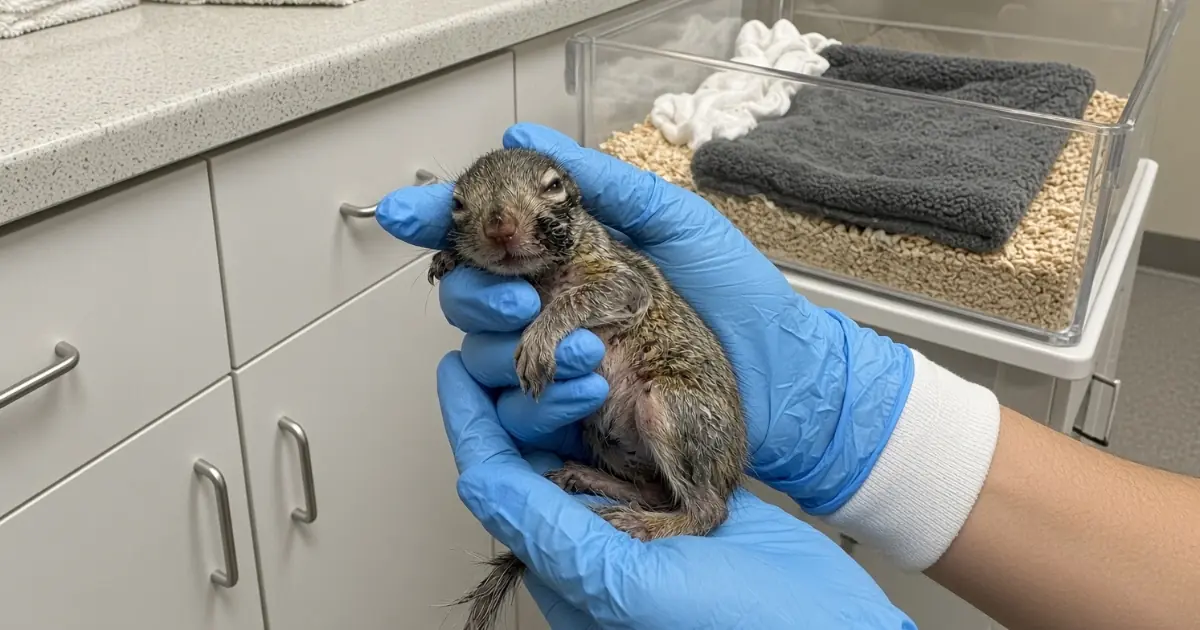
Keeping Moss alive was no longer the only goal.
Now we had to help him grow up correctly.
As his developmental stage advanced, his enclosure changed with him. Appropriate opportunities for movement and exploration were introduced. His nutritional plan evolved as he became ready for the gradual transition toward independent feeding.
Human contact also had to begin decreasing.
It can be easy to become emotionally attached to a baby that required such intensive care, especially one whose survival initially seemed uncertain.
But Moss wasn't being raised to remain with us.
The better he became, the less central we needed to be.
He began exploring rather than waiting.
He learned to grip surfaces with his claws.
He started manipulating appropriate food with his paws.
The weak crawling movements from his first days turned into climbing.
And eventually, Moss discovered speed.
Once that happened, routine checks became considerably more interesting.
He no longer remained politely on a pad while someone examined him. When a person approached, Moss increasingly chose distance.
That change mattered just as much as his physical recovery.
A wild squirrel needs an appropriate wariness of people. A youngster that becomes excessively habituated during rehabilitation may face additional challenges after release.
Our objective was therefore never to make Moss love his caregivers.
Our objective was to make sure he eventually didn't need them.
At the time of this update, Moss is in a dramatically different condition from the baby who arrived barely responsive.
He is eating appropriately, maintaining his body temperature, gaining strength, moving independently, and progressing through the developmental stages expected of a young squirrel. His body condition has improved substantially, and the profound weakness that defined his first hours is no longer what we see when we look at him.
He still isn't automatically ready for release.
Surviving a medical crisis is only the beginning for a young orphan.
Before Moss can return to the wild, he needs to continue developing the strength, coordination, climbing ability, foraging behavior, appropriate coat condition, and avoidance responses required for independent life. Whenever appropriate, opportunities for development around compatible squirrels of a similar age can also help keep the social environment closer to what a young squirrel would naturally experience.
There is another lesson in Moss's case.
A baby squirrel found alone doesn't always need to be removed immediately. In some circumstances, a healthy displaced youngster may still be reunited with its mother with guidance from a wildlife professional.
But Moss wasn't a healthy baby waiting quietly for his mother.
He couldn't sit up.
He couldn't maintain normal warmth.
He was dehydrated, thin, and becoming less responsive.
Those details matter.
Anyone finding a baby wild animal in that condition should contact a licensed wildlife rehabilitator or appropriate wildlife professional rather than attempting to raise it at home or immediately forcing food or liquid into its mouth.
Moss needed more than milk.
He needed someone to recognize that his body wasn't ready for a normal feeding yet.
He needed controlled warmth.
He needed assessment.
He needed supportive care.
Most of all, he needed time.
During his first evening here, nobody knew what the morning would look like.
We weren't talking about climbing or release.
We were watching his chest.
One breath.
Then another.
That was enough.
Weeks later, the same squirrel has very little interest in lying quietly while we watch him.
He wants to move.
He wants to climb.
And increasingly, he wants us to stay away.
For Moss, those may be the clearest signs of recovery we could have hoped to see.
The first night was about keeping a critically weak baby alive until morning.
Everything we're doing now is about preparing a young wild squirrel for the day when he can leave us behind completely.