A Dog Arrived Barely Breathing With Wire Around His Abdomen—His Swollen Hind Legs Had Almost No Response
Rusty did not lift his head when he was placed on the shelter’s treatment table.
His body remained stretched across a padded towel, with his front legs folded weakly beneath his chest. A thin length of wire was embedded around his abdomen just ahead of his hips.
Everything behind it was severely swollen.
Both hind legs appeared abnormally enlarged, and the paws felt cooler than the front half of his body. When a technician touched his toes, Rusty showed almost no response.
His breathing was shallow.
Each breath moved his chest only slightly before fading into a long pause.
No one yet knew how long he had been trapped.
Rusty had been found earlier that morning beside the remains of an abandoned fence on a vacant rural property. A utility worker inspecting nearby power lines noticed what appeared to be a motionless dog lying among the weeds.
When the worker approached, Rusty opened his eyes.
He attempted to drag himself forward with his front paws, but his lower body remained against the ground. The movement tightened the wire around his abdomen and caused him to release a faint cry.
The worker stopped immediately.
A loose section of fencing had collapsed near Rusty’s body. One strand of old wire appeared to have looped around him before twisting against a damaged fence post.
The more Rusty had struggled, the tighter it had become.
His coat was tangled with dry grass, mud and rust-colored debris. The skin around the wire was hidden beneath compressed fur and swelling.
The worker called animal control and stayed nearby without attempting to remove it.
Cutting the wire at the scene could have been dangerous. If it had compressed major blood vessels, suddenly releasing it without medical support might trigger a rapid change in circulation.
Rusty needed to be stabilized first.
When rescuers arrived, he was no longer trying to move.
They supported his spine and carefully cut the section still connecting him to the fence, leaving the wire around his body in place. Rusty was lifted onto a rigid stretcher so nothing would pull or twist during transport.
He did not resist.
Only his eyes moved as the stretcher was carried toward the vehicle.
The team began calling him Rusty after the reddish-brown marks left across his dirty coat by the deteriorating fence.
At the shelter clinic, staff immediately provided oxygen and established IV access in one front leg. His blood pressure was dangerously low, and his gums were nearly white.
Rusty was in shock.
The wire had constricted his abdomen strongly enough to interfere with circulation to the lower half of his body. Blood and fluid had continued entering some of the tissues but could not drain normally, contributing to the extreme swelling.
The medical team also worried about his internal organs.
The wire crossed an area containing the intestines, urinary tract and major blood vessels supplying the hindquarters. Pressure there could cause far more damage than what was visible from the outside.
Rusty received pain medication and carefully controlled fluids while the veterinarian examined the wire.
It had cut deeply through the coat and into the skin. In some areas, swollen tissue had risen around it, making portions nearly impossible to see.
Removing it required more than a pair of ordinary cutters.
Rusty was too unstable for full anesthesia, but leaving the wire in place would continue damaging his body. The team used light sedation while monitoring his breathing and heart rhythm.
A technician slid a protective metal guide between the wire and Rusty’s skin wherever space remained. Small sections were clipped one at a time.
The first cut did not release it.
The wire had twisted beneath his body and crossed over itself near one hip. Staff gently rolled Rusty only far enough to expose the knot, supporting his swollen hindquarters throughout the movement.
His breathing weakened during the repositioning.
Everyone stopped until it steadied.
The final section was clipped several minutes later.
The wire opened.
No one pulled it away immediately.
The team eased it from the surrounding tissue millimeter by millimeter, checking for active bleeding and changes in Rusty’s heart rate.
When the last portion separated, a deep circular wound remained around his abdomen.
The pressure was gone.
But the danger was not.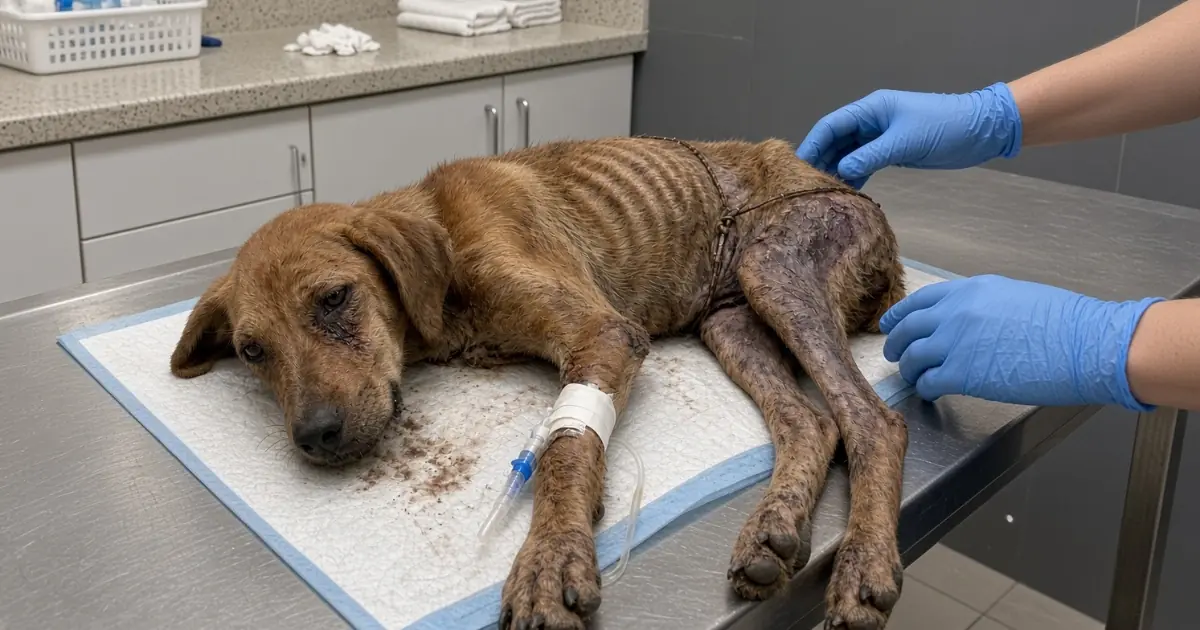
Restoring circulation to severely compressed tissue can release accumulated substances into the bloodstream. Those changes may affect the heart and kidneys, particularly in an animal already in shock.
Rusty’s fluids and medications were adjusted while staff monitored his bloodwork and heart rhythm.
His lower body remained swollen.
Both hind legs lay motionless on the pad.
The veterinarian pinched one toe gently.
Rusty did not pull away.
A stronger stimulus produced only a faint movement in the left leg. The right showed no visible reaction.
That finding raised several possibilities.
The wire may have compressed the nerves that controlled his hind legs. Swelling could also be preventing normal movement, or Rusty might have injured his spine or pelvis while struggling against the fence.
The team could not yet determine whether the paralysis was temporary.
X-rays showed no obvious spinal fracture. His pelvis was also intact, although one hip was badly bruised.
Ultrasound revealed swelling around the abdominal wall but no immediate evidence of a ruptured bladder or major internal bleeding.
Those results provided cautious relief.
However, blood tests showed extensive muscle damage, dehydration and strain on his kidneys. Rusty’s red blood cell count was low, and his body temperature continued falling despite warm blankets.
He remained in critical condition.
The circular wound was flushed to remove dirt, rust and pieces of damaged fur. Several areas contained tissue that no longer appeared healthy, but the full extent of the injury would not be clear immediately.
Pressure injuries can continue evolving even after the constricting object has been removed.
Some tissue that initially looks viable may deteriorate later because its blood supply was interrupted for too long.
Sterile dressings were placed around Rusty’s abdomen.
The wounds could not simply be stitched closed. Closing contaminated, swollen tissue might trap infection beneath the skin.
For the moment, the area needed drainage, protection and repeated evaluation.
Rusty was transferred into a heated recovery kennel with oxygen support. His hind legs were positioned on thick padding and elevated slightly to help manage the swelling.
He remained on his side.
A shallow dish of water was held near his mouth, but he did not drink. Food would have to wait until his circulation became more stable and the possibility of emergency surgery had decreased.
During the first several hours, Rusty showed almost no awareness of the room around him.
His eyes opened when someone touched his shoulder, but he could not hold up his head. The muscles in his neck trembled with each attempt.
Near sunset, his blood pressure dropped again.
The veterinary team increased circulatory support and prepared for a transfusion. Repeat bloodwork showed that his anemia had worsened, although there was still no large collection of blood inside his abdomen.
Small vessels damaged by the wire and prolonged pressure may have been leaking into the swollen tissue.
Rusty received the transfusion that evening.
For much of the night, his condition remained uncertain.
His heart rhythm became irregular twice as circulation returned to the damaged muscles. Medication and electrolyte adjustments helped stabilize it, but staff continued monitoring him continuously.
Shortly after midnight, Rusty moved one front paw.
He attempted to pull it beneath his chest before becoming still again.
His hind legs did not move.
By morning, Rusty was still breathing without a ventilator.
His blood pressure had improved, and his gums held slightly more color. The swelling behind the abdominal wound remained severe but had not increased.
A technician offered a small amount of soft food from her fingers.
Rusty smelled it.
His tongue moved slowly against his lips, and he swallowed one bite. After resting, he accepted another.
The team stopped before he became exhausted.
Those few bites were the first voluntary action he had taken since arriving.
Animal control returned to the property where Rusty had been discovered. The site appeared to have been vacant for years.
Sections of old wire fencing had collapsed into tall grass, creating loose loops and sharp ends at ground level. There were no houses close enough for anyone to have heard Rusty struggling.
Tracks in the dirt suggested that he may have entered through a gap while searching for shelter or food.
Investigators found disturbed soil around the damaged post and flattened weeds extending several feet in every direction.
Rusty had tried repeatedly to escape.
The markings showed that he had moved in circles as the wire tightened. Eventually, his hind legs likely became too swollen and weak to support him.
No collar or identification was found.
A microchip scan at the shelter produced no result, and no nearby lost-dog report matched his description.
The team could not know whether Rusty had wandered onto the property alone or had been abandoned somewhere nearby.
They could only estimate how long he had been trapped.
The severe swelling, dehydration and muscle damage suggested many hours—possibly longer than a full day.
Rusty’s second day brought another complication.
The skin along part of the abdominal wound began darkening. That area had lost too much circulation and would not heal on its own.
The veterinarian removed the unhealthy tissue while preserving as much viable skin as possible. The wound remained open beneath specialized dressings that would need frequent replacement.
Rusty tolerated the procedure.
His body was still too fragile for extensive surgery.
The priority remained stabilizing his organs and determining whether function would return to his hind legs.
Neurological checks were repeated throughout the day.
The left rear paw began showing a slightly stronger response to pressure. One toe flexed when the veterinarian touched between the pads.
The right leg remained nearly motionless.
Staff could not tell whether the nerve damage was permanent.
Swelling alone can suppress nerve function, and recovery may take days or weeks. But if the wire had interrupted circulation for too long, some damage might never reverse.
Rusty was repositioned regularly to protect his skin. A urinary catheter was placed because he could not rise or fully empty his bladder.
He also needed help keeping his hindquarters clean and dry.
Through every procedure, his eyes followed the same few caregivers.
He did not growl or attempt to bite. When frightened, he became completely still and pressed his chin against the bedding.
On his third morning, Rusty lifted his head.
He held it above the blanket for only a few seconds, looking toward a technician carrying his measured meal.
Then his neck weakened, and his chin lowered again.
The food was placed close enough for him to eat without standing.
Rusty finished the portion.
Later that afternoon, the tip of his left hind paw moved against the towel.
The technician initially believed she had shifted the bedding accidentally. She waited and touched his toes again.
The paw flexed a second time.
It was not enough to show that Rusty would walk, but it confirmed that the leg was not completely without function.
Rehabilitation began cautiously.
At first, treatment consisted only of gentle positioning and supported movement of the joints. The therapist moved each hind leg through a limited range to prevent stiffness and encourage circulation.
Rusty watched every motion.
The right leg remained limp, while the left offered faint resistance.
Any exercise that increased pain or placed tension on the abdominal wound stopped immediately.
The wound itself required daily care.
Dressings were removed slowly after being moistened so they would not pull on new tissue. The area was cleaned and examined for infection before fresh material was applied.
Rusty trembled during the first changes.
By the end of the week, he began resting his head against the towel while the familiar technician worked.
His kidney values gradually improved with fluids and monitoring. The muscle-damage markers also began falling, suggesting that his body was clearing the effects of prolonged compression.
The immediate danger to his heart had decreased.
The future of his hind legs was still uncertain.
One week after the wire was removed, the swelling had reduced enough for the true shape of Rusty’s body to become visible again.
His back legs were thin beneath the remaining inflammation. The right side showed more muscle loss, and the paw sometimes curled under when staff repositioned it.
Rusty could now move the left leg voluntarily.
When a caregiver touched the blanket near his paw, he drew the limb a short distance toward his body.
The right leg produced only a small twitch near the hip.
A neurologist reviewed his examinations and imaging. There was no single injury that could be repaired surgically.
The most likely explanation was a combination of nerve compression, loss of circulation and soft-tissue damage caused by the wire.
Only time and rehabilitation would show how much function could return.
Rusty made his first attempt to sit upright on the ninth day.
He pushed against the bedding with his front paws while a caregiver supported his chest. His hindquarters remained on the mattress, but he raised the front half of his body.
The movement stretched the healing abdomen, and he quickly lowered himself again.
For several seconds, however, Rusty had held up his own head and chest.
The next day, he tried before anyone touched him.
His front legs slid once, then found traction on the mat. He remained upright long enough to eat several bites from a bowl.
The change revealed more of his personality.
Rusty began watching the hallway whenever he heard the food cart. He lifted his ears when his name was spoken and nudged a caregiver’s hand if she paused while scratching his chest.
His tail remained too weak and painful to wag normally.
But the tip moved once when the same caregiver entered after a night away.
Standing required a padded sling.
The first attempt involved three people—one supporting Rusty’s chest, one holding the sling beneath his pelvis and another positioning his paws.
Rusty straightened both front legs.
His left hind paw touched the mat.
The right folded underneath.
The therapist corrected it gently, but Rusty could not hold the position. His body leaned heavily into the sling, and his breathing became faster.
The session ended after only a few seconds.
No one considered it a failure.
For a dog who had arrived barely breathing, simply bearing weight through his front legs was progress.
During later attempts, the left hind leg began pushing against the floor. The right remained weak but started producing small, deliberate movements from the hip.
Rusty could not walk.
He could, however, help support part of his own body.
The abandoned property was eventually secured, and the dangerous sections of fencing were removed. No evidence identified an owner or explained how Rusty reached the site.
His story began, as far as the shelter knew, beside that collapsed fence.
But his physical condition suggested that his difficulties had started earlier.
Rusty was underweight beneath the swelling, his coat was dull and his nails were overgrown. He may have been wandering without consistent care before the wire trapped him.
No one came forward to claim him.
Three weeks after his rescue, the wound around Rusty’s abdomen was producing healthy new tissue. It had not yet closed completely, but the threat of serious infection had decreased.
He no longer required oxygen or continuous IV support.
His left hind leg continued regaining function. He could pull it beneath his body and press the paw against the ground during supported standing.
The right leg recovered more slowly.
Sensation had returned to the paw, but coordinating it remained difficult. Sometimes Rusty dragged the toes; at other times, the leg crossed beneath him.
A protective boot prevented new abrasions during therapy.
Rusty was transferred to a medical rehabilitation foster home where his wound care and exercises could continue in a quieter environment.
He rested on an orthopedic bed with traction mats extending toward the yard. A low cart supported his hindquarters during short mobility sessions.
On his first day there, Rusty remained near the open crate.
When the sling was brought out, he lowered his head as though expecting another painful procedure.
Instead, it was positioned gently beneath him.
Rusty pushed through his front legs.
The left hind paw followed.
The right leg moved forward after a long pause.
With most of his weight supported, he completed one uneven step.
Then another.
No one knows whether Rusty will ever walk normally. His right hind leg may retain permanent weakness, and the constriction injury could affect his mobility for the rest of his life.
But both legs remain alive.
Both respond to touch.
And both now produce some voluntary movement.
When Rusty arrived at the shelter, the swollen lower half of his body seemed almost disconnected from the dog lying above it. He could not lift his head, and each breath appeared weaker than the last.
The wire had taken his circulation, damaged his skin and nearly silenced the nerves controlling his hind legs.
It did not take away his willingness to keep trying.
Rusty now raises his chest whenever the sling is placed beneath him. His legs still tremble, and the right paw does not always land correctly.
But he looks toward the mat ahead, presses his front paws down and attempts the next step.