A critically injured dog found barely breathing beside the road has just been rushed to our rescue clinic, with severe wounds across his legs and too little strength to lift his head. While treating him, our veterinary team discovered signs that he may have been suffering long before he finally collapsed.
The emergency call came from a driver who noticed a motionless dog lying beside a rural road.
Cars had been passing only a few feet from his body. From a distance, the driver believed the dog was already dead, but after stopping safely and walking back, she saw his chest rise slightly.
He was still breathing.
The medium-sized brown-and-white dog was lying on his side near the edge of the pavement. His coat was dirty, several areas of skin were scraped raw, and blood had dried around his lower legs.
He attempted to raise his head when the woman approached but immediately lowered it again.
She contacted a local rescue organization and remained nearby to prevent another vehicle from striking him. Because she did not know whether his spine or internal organs had been injured, she avoided moving him unnecessarily.
A rescue team arrived with a stretcher several minutes later.
The dog was conscious but barely responsive. His breathing was shallow, his gums were pale, and his body felt unusually cold despite the mild temperature outside.
Rescuers began calling him Cody.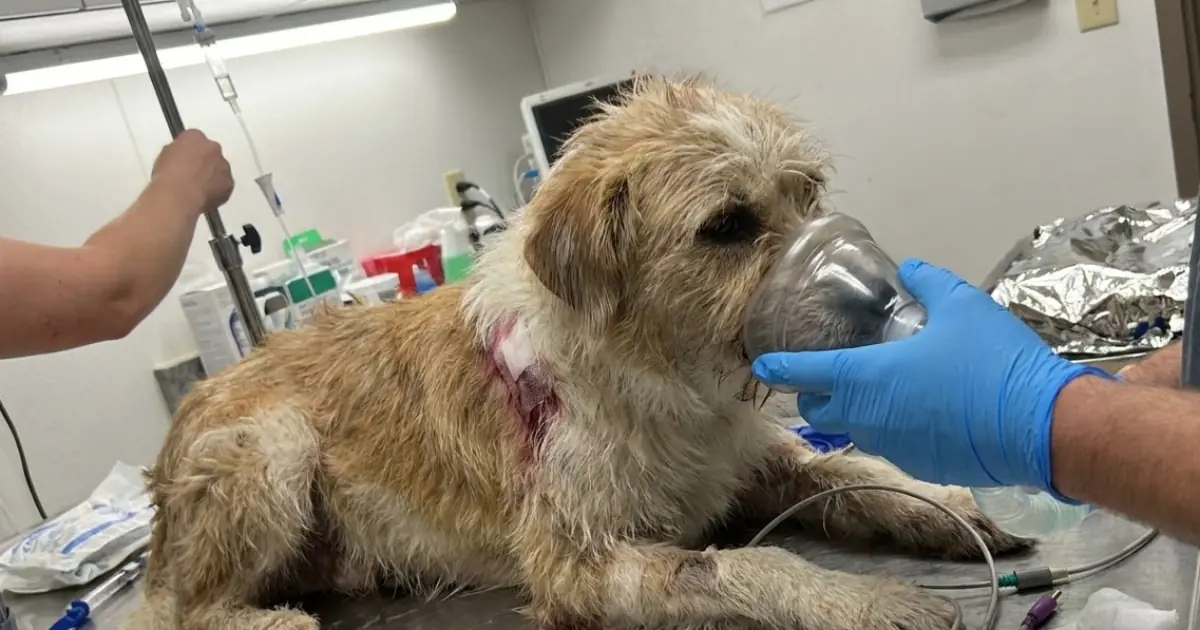
They carefully slid a blanket beneath him and lifted him onto the stretcher. Cody did not cry or struggle. One of his front paws moved weakly against the fabric before his body became still again.
The team drove directly to its veterinary clinic, alerting the medical staff that a critical patient was on the way.
Cody was placed on an examination table as soon as he arrived.
A veterinary technician held an oxygen mask over his muzzle while the rest of the team checked his heart rate, temperature and blood pressure. Intravenous access was established, and warmed fluids were started cautiously.
The wounds on Cody’s legs initially suggested that he might have been struck by a vehicle.
Several paw pads were badly worn, and the skin around his front legs had been scraped away in places. There was bruising across his chest and abdomen, but no obvious open fracture.
X-rays showed that Cody had two cracked ribs and a fracture in one rear leg. Fortunately, his spine appeared intact, and there was no evidence that his lungs had been punctured.
However, the imaging revealed another serious concern.
Cody’s stomach was almost completely empty, and his body carried very little protective fat. His muscles had wasted significantly, particularly around his hips and shoulders.
These changes could not have developed from a single night beside the road.
Cody had been deteriorating for weeks.
Blood tests confirmed severe dehydration and anemia. His protein and blood-sugar levels were dangerously low, and a heavy parasite burden had placed additional strain on his weakened body.
The accident may have caused his final collapse, but it was not the beginning of his suffering.
Veterinarians believed Cody had already been starving and wandering for a considerable period when he entered the roadway. In his debilitated condition, he may not have been able to move quickly enough to avoid an approaching vehicle.
The next several hours were critical.
His pain had to be controlled without lowering his blood pressure further. Fluids were administered carefully, oxygen support continued, and the medical team repeatedly examined him for signs of internal bleeding.
Cody was too unstable for immediate surgery on his fractured leg.
The limb was temporarily supported while staff focused on keeping him alive. His open wounds were flushed to remove dirt and fragments of road debris, then covered with clean dressings.
Food also had to wait.
Because Cody appeared to have gone without adequate nutrition for an extended period, allowing him to consume a large meal immediately could have created dangerous complications. The team planned to introduce small, measured portions only after his circulation and body temperature had improved.
For much of the afternoon, Cody remained on his side beneath warm blankets.
He opened his eyes when someone touched him but could not hold his head up. His breathing occasionally became irregular, forcing the team to increase his oxygen support and watch him continuously.
No microchip was detected.
Cody wore no collar, and there was no identification among the few items found near him. His photograph was shared with nearby shelters, veterinary offices and local lost-pet groups, but no matching report was immediately located.
As evening approached, Cody’s temperature began rising toward a safer level.
A technician offered a small amount of soft food from a spoon. Cody smelled it but did not eat.
She waited before trying again.
During the second attempt, he licked the food once and swallowed. The technician offered another tiny amount, then stopped so his exhausted body could rest.
Those few bites were the first encouraging sign since his arrival.
Cody remained in critical care overnight.
His blood pressure fell twice, and additional medication was needed to support him. Staff continued checking for internal bleeding while monitoring the color of his gums and the effort required for each breath.
Shortly after midnight, Cody lifted his head away from the oxygen mask.
He could hold it up for only a few seconds, but he turned toward the dish of food resting beside him.
A technician supported his head while he ate several small bites.
By morning, Cody was still alive.
His condition remained serious, but his blood pressure had stabilized and no new evidence of internal bleeding had appeared. Repeat testing showed that his anemia was no longer worsening.
Over the next two days, Cody received multiple small meals, antibiotics, pain medication and continued wound care. His dressings had to be changed frequently because of the depth of the abrasions on his legs.
The fractured rear leg still required surgery.
Once Cody was strong enough to tolerate anesthesia, the veterinary team repaired the fracture and placed the limb in a protective bandage. He would need weeks of restricted activity followed by gradual rehabilitation.
Recovery was not immediate.
Cody remained too weak to stand after surgery. During bathroom breaks, two caregivers supported him with a padded sling so he would not place weight on the injured leg.
He initially showed little interest in the people around him.
He did not wag his tail or seek physical contact. He simply watched each movement while lying quietly on his bedding, conserving what little energy he had.
That response was consistent with a traumatized, exhausted dog—not an animal who had given up.
Staff kept every interaction slow and predictable. They announced themselves before touching him and avoided unnecessary handling between treatments.
On the fourth morning, Cody ate an entire small meal.
Later that afternoon, he raised his chest from the bedding without assistance. His front legs shook, and he lowered himself again within seconds, but it was the first time he had attempted to reposition his own body.
Each day brought another small improvement.
The swelling around his wounds began to decrease. His gums developed more color, and he remained alert for longer periods. When his regular technician approached with food, Cody started lifting his head before the enclosure opened.
One week after arriving, he stood with assistance.
He could not yet walk normally, but he placed weight through his uninjured legs while the sling protected the repaired limb. After several hesitant steps, he stopped and leaned against the technician beside him.
Cody has now been transferred from emergency care to a medical recovery area.
He is no longer dependent on oxygen, and his appetite continues to improve. His wounds still require daily treatment, and his repaired leg must remain protected while the bone heals.
The anemia and malnutrition will also take time to correct.
Meals are being increased gradually, and his bloodwork is monitored to ensure his organs are responding safely to nutrition and treatment. He remains significantly underweight, but the first small gains have already been recorded.
No owner has come forward.
The rescue may never know where Cody lived before he appeared beside the road or how long he survived while injured, hungry and alone.
What the medical team knows is that the collision was only part of his condition. By the time he was struck, his body had already been weakened by prolonged neglect, parasites and a lack of food.
Cody is not yet ready for adoption, and his long-term mobility cannot be fully evaluated until the fracture has healed.
But he survived the hours when his breathing was failing.
The dog who arrived unable to lift his head now watches the clinic door at mealtime. When his caregiver enters, Cody slowly pushes himself upright and waits for the bowl to be placed beside him.
His recovery has only begun, but he is no longer lying unseen beside the road—and he is no longer fighting for his life alone.