A Dog Was Found Tied Beside a Busy Highway—With His Empty Carrier Abandoned Behind Him
Dozens of vehicles passed the black-and-white dog before anyone stopped.
He was curled beneath a metal guardrail on the shoulder of a rural highway. A faded red leash was wrapped around one of the support posts, leaving him only enough room to lie in a small patch of gravel.
Several feet behind him sat an empty plastic pet carrier.
From the road, the scene looked temporary.
Drivers assumed someone had pulled over because of a flat tire or another problem. They thought the dog’s owner must be nearby and would soon return.
But the hours passed.
The sun rose higher, and the pavement became hot. Cars and trucks continued rushing past only a few feet from the dog’s body.
He remained beneath the guardrail.
A delivery driver who had noticed him earlier traveled along the same highway on his return route. When he saw the dog in the exact same place, he slowed down.
There was still no vehicle nearby.
No person was walking along the shoulder.
The dog had not moved from the patch of shade.
The driver pulled over at a safe distance and contacted highway patrol. He remained inside his vehicle while waiting because traffic made it dangerous to approach on foot.
When an officer arrived, she positioned her vehicle between the dog and the nearest traffic lane. Only then did she walk toward him.
The dog lifted his head.
His fur was dirty and tangled with dry grass. His eyes followed the officer, but he did not stand or bark.
The red leash tightened when he tried to shift away.
It had been secured firmly around the guardrail.
The officer spoke quietly and placed a bowl of water within reach. The dog hesitated until she stepped back, then lowered his head and drank.
He emptied the bowl.
The officer refilled it with a smaller amount and examined the carrier behind him. The door was open, and an old towel lay crumpled inside.
There was no food, paperwork or identification.
A water dish had not been left with him.
The carrier was large enough for the dog, and scratches around its doorway suggested he had recently been transported inside it. Investigators could not immediately prove how he arrived, but the arrangement was difficult to misunderstand.
Someone appeared to have taken him from the carrier, tied him beneath the guardrail and driven away.
The officer began calling him Scout.
She cut the leash from the metal post rather than attempting to untie the tight knot. When Scout realized he was no longer secured, he did not try to escape.
He remained pressed against the gravel.
A rescue worker arrived with another vehicle and a padded stretcher. Scout appeared capable of moving his front legs, but he avoided standing on his right rear leg.
The team did not know whether he had been injured before being left or struck after entering the roadside.
They carefully transferred him to the stretcher.
As he was lifted, Scout looked toward the highway and watched each passing vehicle.
He offered no resistance when he was placed inside the rescue van.
The empty carrier and the remaining leash were collected as evidence.
Scout was taken directly to a veterinary clinic.
His body temperature was elevated from the heat, and he was moderately dehydrated. His paw pads were scraped, his coat was filled with burrs and the skin beneath his collar was irritated.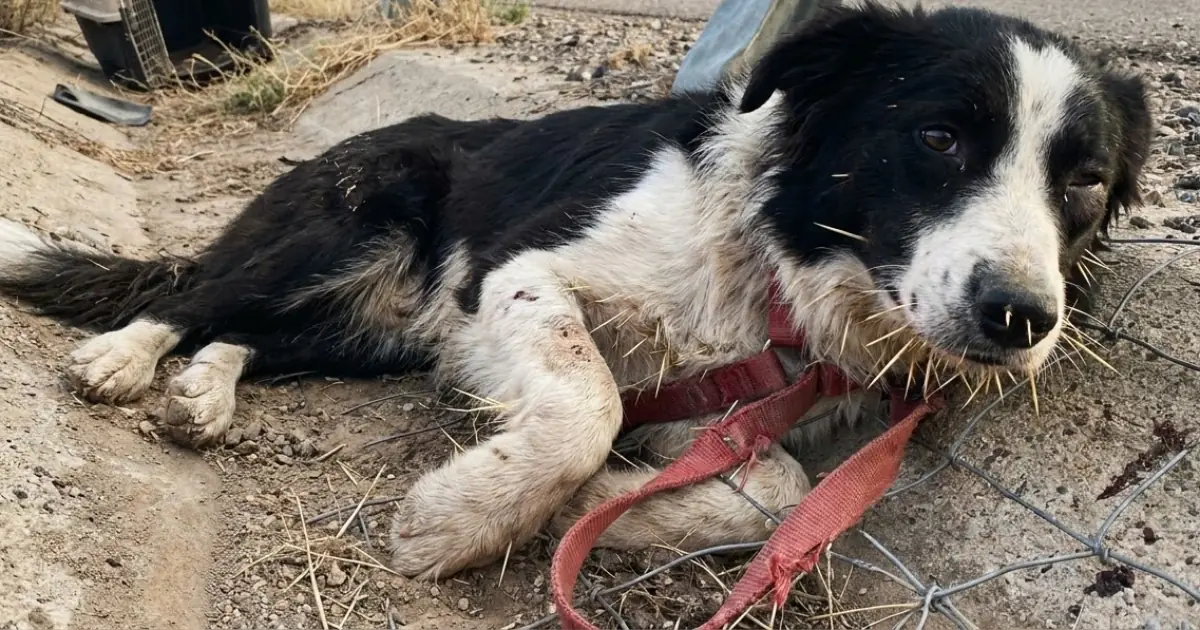
The greatest concern was his rear leg.
X-rays showed an older fracture near the hip that had healed poorly without treatment. The joint was inflamed, and the surrounding muscles had weakened because Scout had been avoiding weight on that side.
The injury had not happened that morning.
It had been affecting him for weeks, possibly longer.
Additional testing found a tick-borne infection and mild anemia. Scout was also underweight beneath his thick coat.
None of his conditions made him beyond help.
They did mean that his care would require time, medication and possibly surgery.
The veterinary team could not know whether those needs contributed to his abandonment. But the possibility weighed heavily on everyone involved.
Scout was scanned for a microchip.
A chip was found.
For a brief moment, the team believed they might have an explanation.
The registration led to a family who had owned Scout several years earlier. They told investigators that they had rehomed him after moving into an apartment that did not allow large dogs.
They provided the name of the person who had taken him.
That phone number was disconnected.
The address belonged to an empty rental property.
The trail ended there.
Scout was placed in a quiet medical kennel while the investigation continued. He received fluids, pain medication and treatment for the tick-borne infection.
His coat was brushed carefully to remove burrs and compacted dirt. Staff had to work slowly around his painful hip.
A shallow bowl of food was placed beside his bed.
Scout smelled it but did not eat while anyone remained in the room. When the caregiver stepped into the hallway, he approached the bowl and finished everything.
Then he returned to the rear corner of the kennel.
Every time an engine sounded outside, Scout raised his head.
The shelter was located near a busy road, and vehicles entered the parking lot throughout the day. Scout listened to each one.
If a car door closed, he stood despite the pain in his hip and looked toward the entrance.
He seemed to expect a familiar person to appear.
No one did.
During his first night, Scout refused to sleep on the bed. He curled on the floor beside the kennel gate with the cut section of red leash still attached to his collar.
A caregiver removed it gently and replaced the worn collar with a soft temporary one.
Scout watched her hands but did not pull away.
When she placed the red leash outside the kennel, his eyes followed it.
The following morning, staff took him outside using a harness. Scout walked slowly, keeping most of his weight away from the damaged rear leg.
As soon as he heard traffic, he stopped.
His body lowered, and he looked toward the sound.
The caregiver waited without pulling him forward. After several minutes, Scout turned back toward the shelter and followed her inside.
Veterinarians reviewed his imaging and determined that surgery might improve his comfort. Because the fracture had already healed incorrectly, the procedure would be more complicated than treating a recent injury.
Another option was long-term pain management and controlled rehabilitation.
The rescue arranged an orthopedic consultation.
Until then, Scout began gentle therapy to strengthen the muscles supporting his hip. Sessions lasted only a few minutes, and staff allowed him to rest whenever he showed discomfort.
He remained withdrawn around strangers.
He did not growl or bark. Instead, he lowered his body and avoided eye contact when someone entered.
With familiar caregivers, small pieces of his personality began to appear.
Scout enjoyed having his chest scratched. When a technician stopped, he carefully moved one front paw onto her shoe.
He also carried his blanket toward the kennel door each evening.
Staff initially believed he wanted to sleep closer to the hallway. Then they noticed that he positioned himself where he could see the building’s main entrance.
He continued waiting.
Highway patrol requested footage from businesses and traffic cameras near the location where Scout had been found. One distant camera showed a light-colored pickup stopping on the shoulder late the previous evening.
The vehicle remained there for several minutes.
A person appeared to remove something from the truck bed or rear compartment. Because of the distance and poor lighting, neither the license plate nor the individual could be identified.
The pickup then drove away.
The footage did not clearly show Scout being tied to the guardrail, but the timing matched the likely period of his abandonment.
No one contacted authorities to accept responsibility.
The shelter shared Scout’s photograph in hopes of locating anyone who recognized him. Some people remembered seeing a similar dog around a rural property, but none of the reports could be confirmed.
His former registered family did not know who might have owned him most recently.
Scout’s history had been passed from person to person until no one claimed responsibility for him.
The orthopedic specialist later confirmed that his hip injury could be treated.
Surgery would not make the joint completely normal, but it could reduce pain and allow him to use the leg more comfortably.
Scout underwent the procedure after his dehydration and infection had improved.
When he woke, the hair around his hip had been shaved, and a long incision was covered by a clean dressing. An IV remained in his front leg while staff monitored his recovery.
He appeared frightened when he first attempted to move.
A technician steadied him and prevented him from twisting toward the surgical area. Scout eventually settled beneath a blanket.
That night, he accepted food from her hand.
The next several days were difficult.
Scout needed assistance during bathroom breaks, and the repaired leg could not yet support normal weight. He became tired after only a few steps with the rehabilitation sling.
But he continued trying.
During one session, a truck passed loudly outside. Scout froze and turned toward the sound.
For a moment, he appeared ready to lower himself to the ground.
Then he looked at the caregiver holding his sling and took another step toward the shelter door.
It was a small decision, but it marked a change.
He had heard a vehicle and chosen to follow the person beside him instead of watching the road.
His recovery continued gradually.
The swelling around his hip decreased, and Scout began placing the toes of his injured leg against the ground. His appetite improved, and follow-up blood tests showed that the anemia was resolving.
He also stopped sleeping directly against the kennel gate.
One morning, staff found him stretched across the center of his bed with his head resting on the blanket.
The entrance remained visible from where he lay.
But he was no longer pressed against the door.
The red leash and empty carrier stayed with investigators. They were reminders of the way Scout had been found, but they offered few answers about the person who left him.
Perhaps someone believed tying him beneath the guardrail was safer than allowing him to wander.
Perhaps they assumed another driver would stop.
Whatever the reasoning, Scout had been placed beside fast-moving traffic without food, water or a way to reach safety.
His old injury made the situation even more dangerous.
If the leash had loosened, Scout could have entered the highway. If no one had stopped, dehydration and heat exposure would have continued worsening.
He survived because one driver remembered seeing him and paid attention when he was still there hours later.
Several weeks after surgery, Scout could walk short distances without the sling.
He still limped, and his muscles would require continued rehabilitation. Long walks and running remained out of reach.
But he could cross the recovery yard independently.
He began stopping beside the same caregiver each morning and leaning gently against her legs. When she walked away, Scout followed rather than remaining behind.
No one has been able to confirm who tied him beside the highway.
The old microchip revealed part of his history, but not the final person responsible for him. The pickup captured on distant footage has not been identified.
Scout cannot explain what happened before he was left beneath the guardrail.
He cannot say whether the person who abandoned him had once treated him kindly or whether his untreated injury had made him unwanted.
The clearest evidence was left at the roadside: a red leash tied tightly around a steel post and an empty carrier discarded in the weeds.
Scout had not wandered there by himself.
Someone transported him to that isolated stretch of highway, removed him from the carrier and ensured that he could not follow when they drove away.
For hours, he lay beneath the guardrail listening to cars pass.
He watched every vehicle as though one might bring his person back.
None did.
The vehicle that finally stopped belonged to a stranger—the first person that day who looked closely enough to realize Scout had been left behind.