A Dog Was Found Tied to a Park Bench—and No One Knew if His Owner Was Coming Back
The small brown dog was first noticed shortly after sunset in a neighborhood park.
He was lying beneath a concrete bench with a leash tied tightly around one of its supports. His body was curled into a small ball, and his head remained lowered between his front paws.
A woman walking home through the park stopped when she saw him.
She waited nearby for several minutes, expecting someone to return. The dog wore a collar, and nothing about the situation immediately suggested that he had been abandoned.
The woman assumed his owner might be using the restroom, speaking with someone nearby or briefly retrieving something from a vehicle.
When she approached the bench, the dog pressed himself closer to the ground.
He did not bark or pull toward her. He simply watched her from beneath the seat with his ears lowered and his body trembling.
Believing the owner would soon return, the woman continued home.
But the following morning, she passed through the park again.
The dog was still there.
He remained tied to the same support, lying in almost the same position beneath the bench. His leash had become twisted around one leg, leaving him only enough room to stand and turn in a small circle.
There was no food or water beside him.
The woman asked several people in the park whether they knew who owned the dog. No one recognized him, although another resident remembered seeing him beneath the bench late the previous afternoon.
That meant he may have spent the entire night alone.
The temperature had dropped after sunset, and a brief rain had passed through the area before dawn. The pavement beneath the bench was still damp, and the dog’s coat felt cold when the woman carefully touched his back.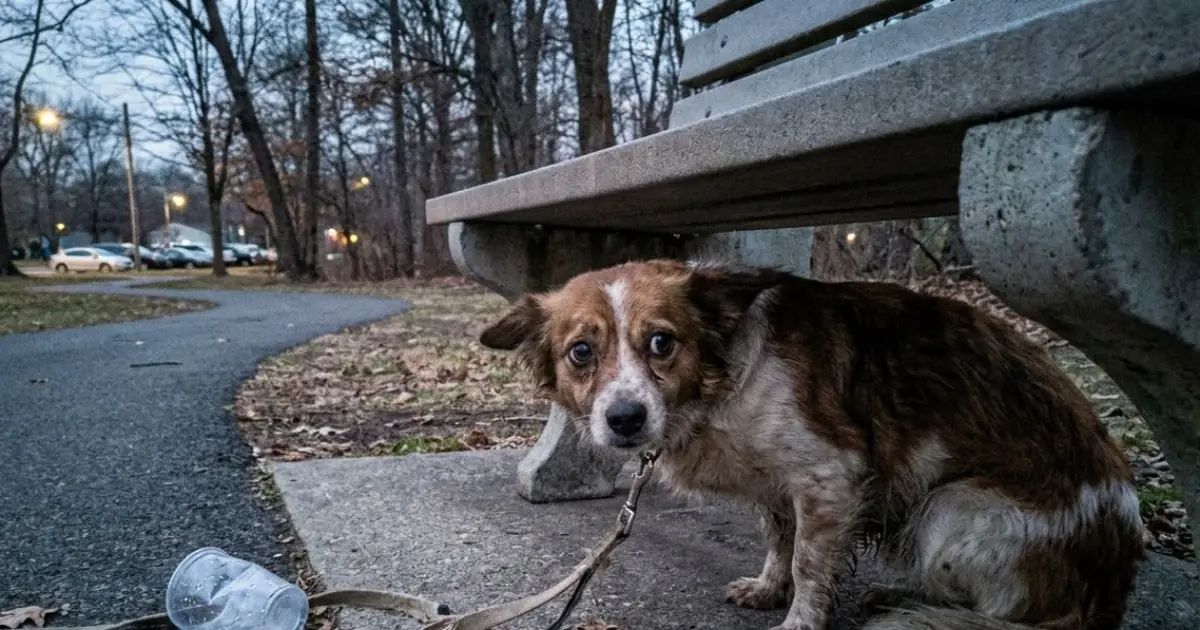
She placed a bowl of water within his reach.
At first, he was too frightened to approach it. He watched the woman step away, then slowly crawled forward and began drinking.
He emptied the bowl.
The woman contacted animal control and remained nearby until an officer arrived.
The dog retreated beneath the bench when he saw the uniformed stranger approaching. He made no attempt to bite, but his entire body tightened whenever anyone touched the leash.
The knot around the bench had been pulled extremely tight.
Rather than tugging on the dog’s collar, the officer cut the leash near the concrete support. The dog was finally free, but he did not attempt to leave.
He remained pressed against the ground as though he was still tied there.
The officer began calling him Benny.
When she gently lifted him, Benny tucked his legs against his body and became completely still. He was carried to the animal-control vehicle and taken to a local rescue clinic for evaluation.
Benny was dehydrated and mildly underweight.
His paw pads were worn, and the skin beneath his collar was red from pressure and repeated pulling. He also had several older scratches across his legs, but no serious external injuries were found.
Blood tests showed no immediate organ failure or severe infection.
The greatest concern was how long Benny might have gone without reliable food or water before he was discovered.
Although he had likely spent at least one night at the park, his thin body suggested that his neglect may have begun earlier. Staff could not determine whether he had been abandoned directly from a home or had already been passed between different people before being tied to the bench.
Benny was scanned for a microchip.
A chip was found, giving the team hope that his family could be contacted quickly. However, the phone number connected to the registration had been disconnected, and the listed address belonged to someone who had moved away several years earlier.
The rescue attempted to contact the registered owner through every available record.
No one responded.
Benny was offered a small meal at the clinic. He approached the bowl only after the staff member left the room, then ate rapidly enough that the food had to be divided into smaller portions.
After finishing, he returned to the rear corner of his enclosure.
Whenever footsteps passed outside, Benny raised his head and stared toward the door. If someone entered, he lowered himself again and avoided eye contact.
He did not appear aggressive.
He appeared uncertain about what would happen each time a person came near him.
During his first night at the rescue, Benny refused to sleep on the bed provided for him. Instead, he curled against the kennel door with the cut section of his old leash still attached to his collar.
A caregiver removed the remaining leash and replaced the tight collar with a soft temporary one. Benny trembled during the process but allowed her to finish.
The next morning, staff took him outside on a new leash.
Benny walked cautiously until he saw a concrete bench near the clinic entrance. He immediately stopped.
He lowered his body and attempted to move beneath it.
The caregiver did not pull him forward. She waited until Benny looked away from the bench, then guided him slowly back toward the building.
Over the following days, his physical condition improved.
Regular meals corrected his dehydration, and the irritated skin beneath his collar began healing. Benny also started accepting treats from the same caregiver who brought his food each morning.
His behavior remained guarded.
He startled when someone reached toward his collar and froze whenever a leash became wrapped around an object. Staff began using a lightweight harness so there would be no pressure around his neck.
They also kept his daily routine predictable.
Benny was taken outside at the same times, fed in the same location and handled by a small group of familiar caregivers. No one forced him to greet visitors or pulled him from his bed when he chose to hide.
Gradually, he began approaching the front of the kennel on his own.
Meanwhile, the rescue continued trying to determine how he ended up in the park.
A public appeal was posted asking anyone who recognized Benny to contact animal control. Several people shared the post, but no verified owner came forward.
One person reported seeing an unfamiliar vehicle stop near the park on the afternoon Benny first appeared. However, there was not enough information to confirm whether the vehicle was connected to him.
The park did not have a camera positioned directly toward the bench.
Without clear footage or a reliable witness, authorities could not establish who tied Benny there or whether that person ever intended to return.
What they could establish was that Benny had been left without accessible food, water or shelter for many hours.
A leash tied to a bench does not make an animal safe.
A dog left that way can become dehydrated, entangled, injured by another animal or exposed to dangerous temperatures. Benny had no way to search for water, escape the rain or protect himself if someone approached with harmful intentions.
Two weeks after his rescue, Benny began showing small but meaningful changes.
He started eating while his caregiver remained in the room. He accepted gentle touch along his shoulders and occasionally rested near the front of his kennel rather than hiding at the back.
The bench remained difficult for him.
During a quiet walk, his caregiver stopped several feet from the same bench outside the clinic. Benny hesitated but did not drop to the ground.
After watching it for several seconds, he turned toward her and accepted a treat.
Benny is now living in a temporary foster home while the required stray-hold and ownership process is completed.
His foster caregiver reports that he sleeps in a covered bed and follows a predictable routine well. He remains nervous when anyone picks up a leash, but he has begun walking toward the door rather than retreating beneath furniture.
No confirmed owner has contacted the rescue.
The team may never know whether the person who tied Benny to the park bench planned to return or simply walked away believing someone else would eventually take responsibility.
Benny waited there through sunset, darkness and rain.
He could not understand why the leash never loosened or why familiar footsteps did not return. By morning, he had stopped pulling and curled beneath the bench to conserve his strength.
The dog whom people initially assumed was only waiting for his owner had actually been left alone all night.
Today, Benny still watches closely whenever someone walks away from him. But in his foster home, those footsteps now return—and the leash attached to his harness is never tied to an empty bench.