By the third week of August, the goats had stopped fighting over shade.
That frightened Clara Whitmore more than the cracks opening across her pasture.
Forty-three animals stood beneath the narrow shadow cast by the western wall of the barn, their heads lowered, ears hanging loosely in the Nebraska heat. A few still moved toward the fence when they saw Clara carrying a bucket. Most simply watched her.
Three months earlier, they would have shoved one another aside.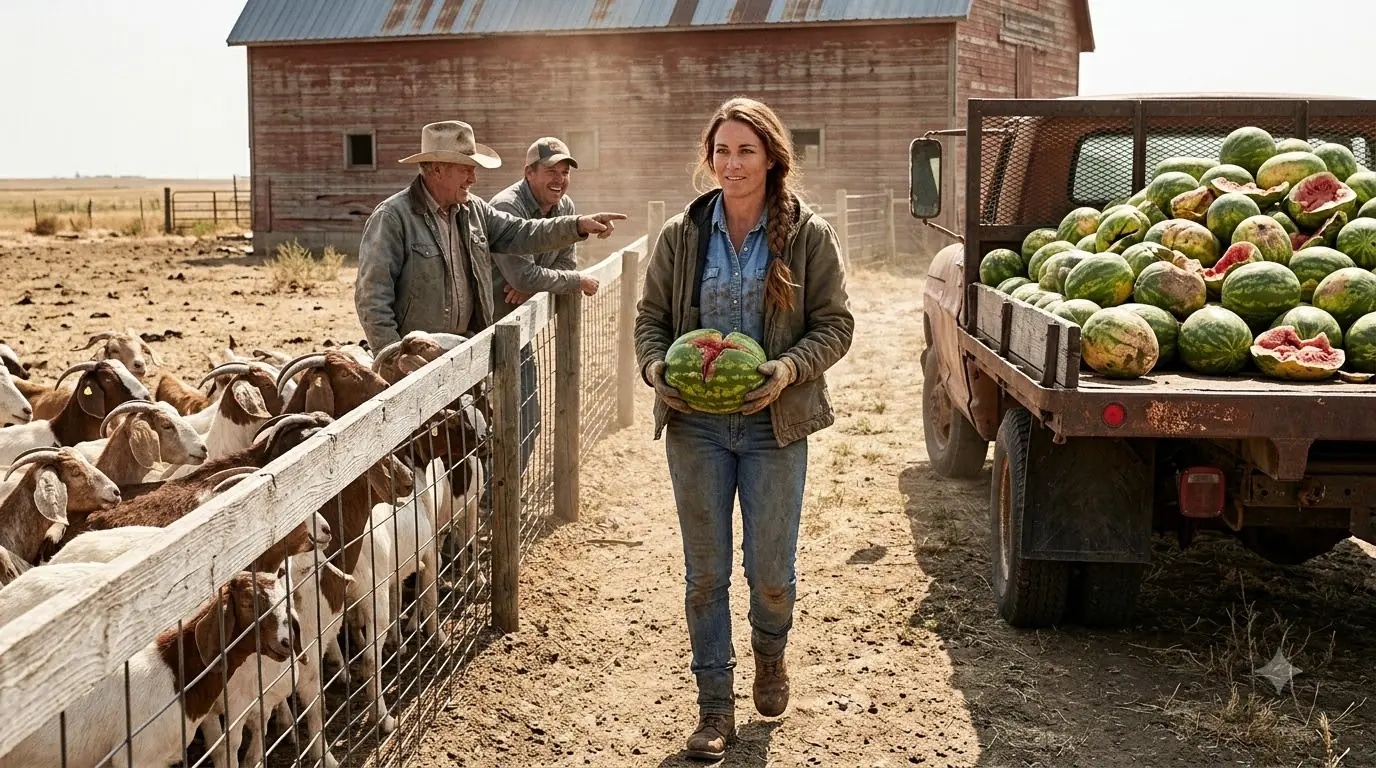
Now they were conserving energy.
Clara lowered the bucket beside the trough and looked across Whitmore Ridge Ranch.
The land appeared exhausted.
One hundred and sixty acres rolled toward the Sandhills beneath a bleached blue sky. What should have been late-summer pasture had faded into gray-brown stubble. The stock pond had shrunk until a ring of cracked mud surrounded a shallow center no larger than a swimming pool. Dust rose behind every vehicle on the county road and remained suspended long after the engine disappeared.
The drought had begun as an inconvenience in May.
By June, neighboring ranchers were selling cattle.
By July, hay prices had doubled.
Now August had become something else entirely.
A countdown.
Clara was thirty-one, widowed for three years, and more accustomed to physical work than most people who met her expected. She had a striking face browned lightly by the sun, green eyes, thick auburn hair usually tied into a loose braid, and the strong, balanced build of a woman who lifted feed sacks, repaired fencing, hauled buckets, and climbed onto tractors because there was nobody else around to do it.
That morning she wore faded jeans, muddy boots, a denim work shirt, and the old olive canvas jacket she had inherited from her husband.
Luke had worn it until the sleeves frayed.
Clara had mended them twice.
She still sometimes put her hands into the pockets expecting to find one of his folded receipts or the peppermint candies he used to keep there.
Today she found only dust.
She opened the ranch notebook balanced against the fence.
Forty-three goats.
Three hundred and twenty pounds of usable hay remaining.
One hundred ninety gallons in the upper storage tank.
Bank balance: $1,184.63.
She stared at the number.
The September mortgage payment would take $1,063.
That left almost nothing.
A proper hay delivery sufficient to carry the herd through the next several weeks would cost more than six thousand dollars, assuming she could even find it.
Clara closed the notebook.
“Don’t look at me like that,” she told the goats.
A white doe named Pepper blinked.
“You’re not helping.”
Pepper continued staring.
Clara sighed.
The well pump started behind the barn.
Its motor groaned.
Water coughed through the pipe.
Stopped.
Then resumed weakly.
Clara turned.
That sound had become her alarm clock.
Every morning the pump took longer to build pressure.
She had lowered the intake twelve feet in July.
There was nowhere left to lower it without drilling deeper, and the drilling company wanted a deposit larger than Clara’s entire bank balance just to bring a rig onto the property.
Her phone vibrated.
A message from First Prairie Bank.
Reminder: loan review scheduled September 2. Please provide updated livestock inventory and operating projections.
Clara locked the screen without answering.
She already knew what the projection would look like.
Bad.
Her goats were the last part of the ranch producing meaningful income. She raised Boer-Kiko crosses for breeding stock and meat. The herd had survived two hard winters, an outbreak of parasites, and the year Luke died.
Clara had promised herself she would never sell the breeding does simply because she became frightened.
Fear made expensive decisions.
Luke used to say that.
Her mother used to say something similar.
But dead people had the luxury of giving advice without paying invoices.
Clara looked toward the road.
A plume of dust appeared in the distance.
At first she assumed it was another neighbor.
Then she saw the shape of a flatbed truck.
Large.
Slow.
Overloaded.
The truck turned through her gate.
Clara’s stomach tightened.
She had made the purchase two days earlier.
Until this moment it had existed only as a number on a phone call.
Seeing five hundred rejected watermelons stacked across a truck made the decision look considerably more insane.
The driver stopped beside the barn.
Watermelons filled wooden produce bins across the flatbed.
Green.
Striped.
Bruised.
Split.
Some soft enough that red juice had stained the boards beneath them.
The driver climbed down.
He was young, sunburned, and visibly confused.
“You Clara Whitmore?”
“Yes.”
He looked at the truck.
Then at her goats.
Then back at Clara.
“Ma’am, you really ordered all of these?”
“Every usable one.”
He scratched beneath his cap.
“We separated anything obviously fermented.”
“Good.”
“Warehouse manager said you knew these aren’t fit for retail.”
“I know.”
“Some won’t last forty-eight hours.”
“I know.”