A German Shepherd Lost His Leg in an Accident—Then His Family Abandoned Him for Being “Useless”
Rex had spent the first six years of his life believing he belonged to a family.
He guarded their yard, followed them from room to room and waited near the front door whenever they left. Neighbors often saw him walking beside his owner in the evenings, alert but well behaved.
Then one accident changed everything.
Rex escaped through a gate that had not been properly latched and ran into the road. A passing vehicle struck him before he could reach the other side.
The driver stopped and called for help.
Rex was taken to an emergency veterinary hospital with severe injuries to his left rear leg. The bones were shattered in several places, much of the surrounding tissue was damaged and circulation to the lower limb had been nearly lost.
Veterinarians initially tried to stabilize him.
But the damage was too extensive.
Keeping the leg would have placed Rex at risk of uncontrollable infection, chronic pain and tissue death. After discussing the available options, the veterinary team determined that amputation offered him the best chance of surviving and eventually moving comfortably again.
The operation removed his entire left rear leg.
Rex awoke beneath warm blankets with an IV catheter in one front leg and a long surgical incision along his hip. Medication kept his pain controlled, but he appeared frightened and disoriented whenever he tried to reposition himself.
His family was told that recovery would require time.
He would need help standing, short supervised bathroom breaks and several weeks of restricted activity while the surgical area healed. Later, rehabilitation could help strengthen his remaining legs and teach him how to balance on three limbs.
Many dogs adapt remarkably well after an amputation.
Rex’s family, however, did not want to manage the recovery.
At first, they said they were worried about the cost. A local rescue offered to help with part of the medical bill and provide basic rehabilitation guidance.
Then the explanation changed.
According to the surrender information later provided to the shelter, the family said Rex would no longer be useful as a guard dog. They believed a German Shepherd missing a rear leg would be too weak, too difficult to handle and unable to protect their property.
One person reportedly described him as “useless now.”
The word followed Rex to the shelter.
Only days after surgery, he was placed inside a vehicle and driven away from the home he had known for years. He arrived at the municipal shelter wearing an inflatable recovery collar with a folded blanket beneath his body.
His family completed the surrender paperwork.
Then they left.
Rex watched them walk through the lobby and disappear beyond the front doors.
He attempted to follow.
When he pushed himself upright, his remaining rear leg slipped beneath him. His body twisted toward the missing limb as though he still expected a paw to touch the floor.
A shelter employee caught him before he fell.
Rex stared at the closed doors while the employee supported his abdomen with a towel. He remained focused on the entrance long after his family’s vehicle had driven away.
The staff moved him to the shelter’s medical area.
His surgical incision was still fresh, and the skin around it was swollen. Fortunately, the wound appeared clean, with no immediate signs of infection.
Physically, Rex was stable.
Emotionally, he seemed lost.
He refused the first meal offered to him. He did not bark, growl or seek attention. He lay facing the kennel door with his head resting between his front paws.
Whenever footsteps entered the hallway, his ears lifted.
If someone approached his kennel, Rex raised his head and looked past them toward the main entrance.
The employees began to understand what he was waiting for.
Rex did not know that he had been surrendered.
He only knew that his family had walked away while he was unable to follow them.
That first evening, a caregiver helped Rex outside using a padded rehabilitation sling. He placed his two front paws on the floor but hesitated to move the remaining rear leg.
When encouraged forward, he shifted his weight toward the side where his leg used to be.
His body tilted sharply.
The sling prevented him from falling, but Rex immediately lowered himself to the ground. His breathing quickened, and he refused to try again.
The employee sat beside him without pulling on the leash.
After several minutes, Rex lifted his head and looked toward the building. He seemed tired, confused and embarrassed by a body he no longer understood.
The loss of a limb requires more than healing an incision.
A dog must relearn balance, turning, sitting, standing and navigating different surfaces. The remaining limbs carry additional weight, while muscles along the back and abdomen must compensate for the missing support.
Rex was also a large dog.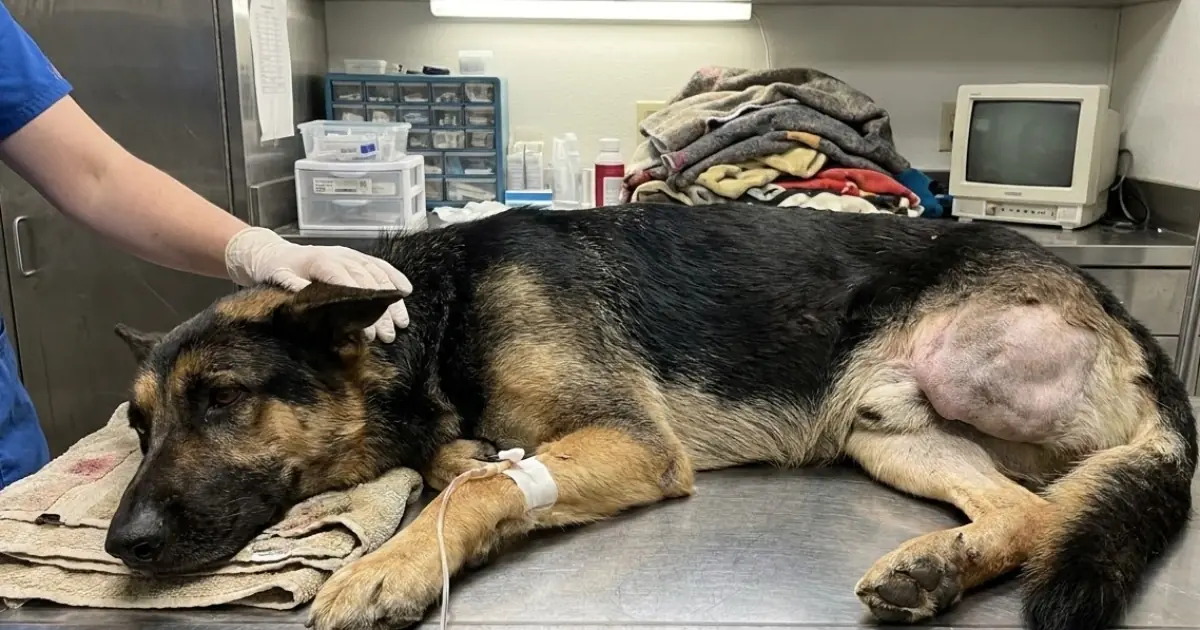
His size made the first stage of recovery more challenging because his remaining rear leg had to support much of his weight whenever he stood.
Shelter staff created a rehabilitation plan with veterinary guidance.
The first goal was simply to help him rise without panicking.
His bedding was placed on a nonslip surface. Food and water were kept within easy reach, and a sling was used for every bathroom break.
The team avoided forcing him to walk farther than necessary.
During his second day at the shelter, Rex finally ate.
A caregiver warmed his food and sat quietly outside the kennel. Rex initially ignored the bowl, but after several minutes, he lifted his head and smelled it.
He ate only half.
Then he returned to watching the door.
His incision was checked twice daily.
The swelling gradually decreased, but Rex remained reluctant to look toward or allow anyone to touch his left side. When a caregiver adjusted the blanket near his hip, his body tightened.
He was not aggressive.
He appeared afraid that the pain would return.
The shelter kept his routine predictable. The same few employees handled his medical care, announced themselves before touching him and supported his body in the same way during every trip outside.
On the fourth morning, Rex stood with the sling.
His front legs straightened first. After several seconds, he placed his remaining rear paw firmly on the floor and raised his body.
He swayed but did not fall.
The caregiver allowed him to remain still until his breathing settled. Then she moved one step forward.
Rex followed with his front paws.
His rear leg hopped forward awkwardly behind them.
He stopped immediately and looked down.
The caregiver praised him quietly but did not ask for another step. Rex had remained upright, and for that day, it was enough.
Each attempt became slightly easier.
At first, he could take only two or three steps before lowering himself. A week later, he crossed the short medical hallway with support.
His movements were still uneven. He occasionally searched for the missing leg and lost his balance during turns.
But he was learning.
The shelter also discovered that Rex responded strongly to a tennis ball.
One afternoon, a volunteer rolled a ball slowly across the floor outside his kennel. Rex raised his ears and followed it with his eyes.
When the ball stopped near his bed, he reached forward and picked it up.
It was the first object he had shown any interest in since arriving.
From then on, the ball accompanied him during rehabilitation. A caregiver held it several feet ahead while Rex practiced moving toward it.
He did not always follow.
But on his stronger days, he took several careful hops, reached the ball and carried it back to his bed.
His incision continued healing.
After the sutures were removed, the rehabilitation work expanded. Gentle exercises helped strengthen his remaining rear leg and core muscles.
Staff encouraged him to shift his weight gradually and stand for slightly longer periods. Thick rugs and rubber mats gave him secure footing.
Slippery floors remained frightening.
The first time Rex stepped onto smooth tile, his rear paw slid. He dropped his body immediately and refused to move.
No one dragged him forward.
The team covered the path with mats and allowed him to try again at his own pace.
A few days later, he crossed the same area without lying down.
His physical progress became visible, but his attention still returned to the shelter entrance.
Whenever a vehicle stopped outside, Rex lifted his head.
Whenever someone resembling his former owner entered the lobby, he attempted to stand.
No one came back for him.
Shelter staff contacted the family once to ask for additional medical history and information about his behavior. They confirmed that Rex had lived with them for years but said they did not want him returned.
Their decision was final.
The dog they had once depended upon was no longer considered worth the work his recovery required.
Rex could not understand any of that.
He did not know that people had judged his value by the number of legs beneath him. He did not know why the home he had protected was no longer his home.
He only knew the familiar voices were gone.
During his third week at the shelter, Rex stopped waiting upright whenever the hallway door opened.
Instead, he began responding to the caregivers who were actually present.
When his regular rehabilitation worker entered, his tail moved against the bed. When she picked up the sling, Rex pushed himself into a sitting position before she reached him.
He was still cautious, but he was beginning to participate.
One morning, the caregiver opened his kennel and positioned the sling beneath him.
Rex stood before she lifted its handles.
He balanced for several seconds, then hopped toward the tennis ball resting in the hallway.
The sling remained loose.
For the first time since the accident, he had moved without someone carrying part of his weight.
The shelter team watched him take five independent steps.
His body leaned slightly to one side, and each hop required visible effort. Yet he remained upright until he reached the ball.
Rex picked it up and turned carefully.
Then he carried it back to his bed.
From that day, his confidence grew more quickly.
He began walking short distances without the sling, although a caregiver remained close in case he lost balance. He learned to make wider turns and pause before changing direction.
Stairs were avoided while his strength developed.
Veterinarians continued monitoring his remaining joints. Large three-legged dogs can place extra strain on their shoulders, spine and surviving rear limb, making healthy weight and controlled exercise especially important.
Rex would need lifelong attention to those areas.
But he was not helpless.
He could stand, walk, eat and play. He could move around the rehabilitation yard and relieve himself without being carried.
He could still hear unfamiliar sounds before anyone else in the room. His ears rose sharply whenever someone approached the building, and his deep bark remained as powerful as ever.
Losing a leg had not removed the qualities that made him a German Shepherd.
It had not erased his intelligence, loyalty or desire to remain close to people.
More importantly, his worth had never depended on whether he could guard someone’s property.
Several weeks after his surrender, Rex was moved from the medical kennel into a quieter rehabilitation space. His bed was positioned beside a low window where sunlight reached the floor during the afternoon.
He often rested there with the tennis ball between his front paws.
His gait would never look exactly as it had before the accident. He tired more quickly, and some surfaces still required caution.
But the dog who once collapsed while trying to follow his family out of the shelter could now cross the room independently.
Rex’s medical recovery continues.
The shelter is monitoring his weight, protecting his remaining joints and helping him build endurance gradually. His amputation site has healed, but his emotional adjustment may take longer.
He occasionally turns toward the lobby when the front doors open.
He no longer waits there for hours.
The word “useless” described nothing about Rex.
It described only the way someone had chosen to see him after he became injured.
Rex lost a leg in the accident.
Then he lost the only family he had ever known.
But beneath the fear, the surgical scar and the unsteady first steps, he remained the same loyal dog who had spent years trusting the people around him.
They decided he no longer had value.
Rex is slowly learning that they were wrong.