A Neglected Dog Arrived Hidden Beneath Pounds of Matted Fur—And Removing It Revealed the Damage Underneath
At first glance, rescuers could barely tell where the dog’s body ended and the tangled fur began.
His coat had formed thick, rope-like mats that covered his back, legs and underside. Dirt, dried leaves and small pieces of debris were trapped deep inside them.
Several mats hung heavily from his body whenever he tried to move.
He had been discovered beside a row of dumpsters behind a closed business. A delivery driver initially mistook him for a pile of dirty fabric.
Then the dog lifted his head.
He took one hesitant step before lowering himself to the pavement again. His legs seemed unable to move normally beneath the weight of his coat.
The driver placed a bowl of water nearby and contacted animal control.
The dog watched from behind the hair covering much of his face. He appeared frightened but too exhausted to run.
When an officer arrived, she approached slowly with a slip lead.
The dog did not bark or growl. He simply remained crouched beside the dumpster, trembling as the lead was placed around his neck.
The team began calling him Murphy.
Lifting Murphy required care.
The mats had pulled his legs into unnatural positions, and rescuers could not tell whether he had fractures or open wounds hidden beneath the fur. Some sections were so tight against his skin that touching them caused his entire body to tense.
Murphy was wrapped loosely in a blanket and transported directly to a veterinary clinic.
On the treatment table, the seriousness of his condition became clearer.
His coat had not simply become dirty or overgrown. It had hardened into a heavy shell around much of his body.
The mats on his back were several inches thick. Those around his legs had twisted together, limiting the movement of his joints. Urine and feces had collected in the fur beneath his tail, creating a strong odor and constant contact with the skin.
One front leg was red and swollen below a tight band of hair.
Murphy tried to shift his position, but the matting pulled painfully against his skin. He stopped moving and looked toward the people surrounding the table.
A veterinary technician prepared clippers.
This would not be an ordinary grooming appointment.
The team could not simply brush the tangles away. The fur was packed too tightly, and attempting to separate it would have caused unnecessary pain.
Every section had to be clipped carefully from the skin.
Murphy was dehydrated and underweight, but the extent of that weight loss could not yet be measured accurately. Too much of what appeared to be his body was actually compacted fur, dirt and debris.
His temperature was low, and his bloodwork showed anemia.
Because prolonged grooming would be painful and stressful, the veterinarian administered light sedation while monitoring his breathing and heart rate.
The first cut was made along Murphy’s shoulder.
The clippers could not move through the outer layer. A technician used blunt-tipped scissors to open a small gap in the mat, keeping one finger between the blade and Murphy’s skin.
Beneath the tangled coat, the skin was pink and inflamed.
The team slowly widened the opening.
Large sections of fur came away together like pieces of a heavy blanket. Dirt fell across the treatment pad, along with leaves, twigs and material that could no longer be identified.
Murphy’s body beneath the coat was much smaller than anyone expected.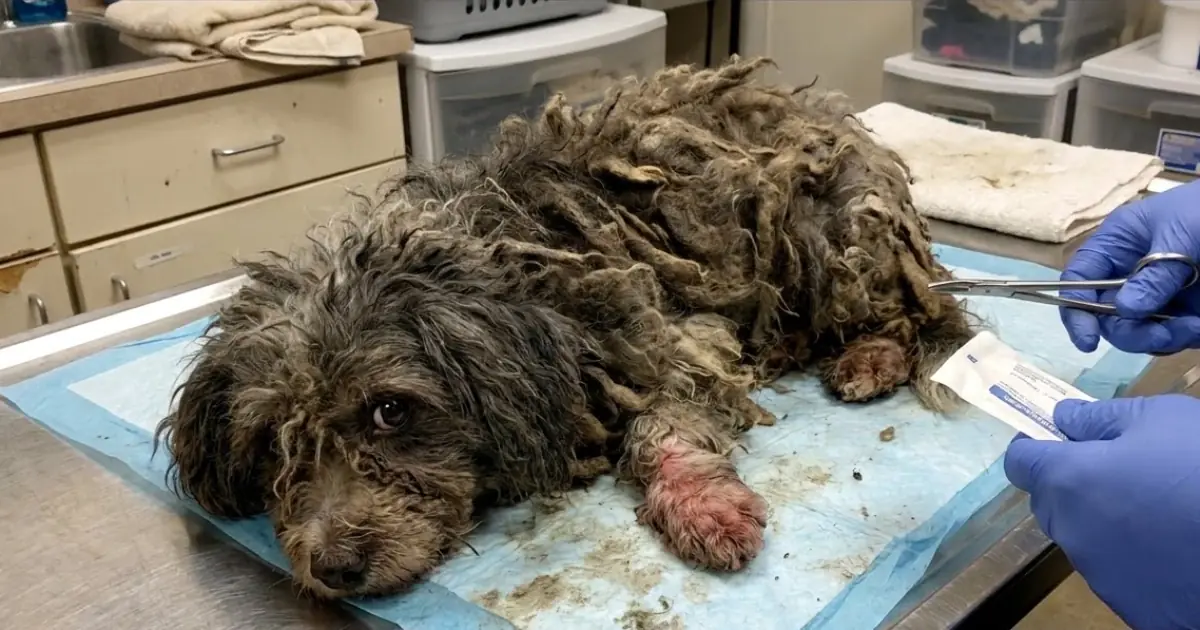
His ribs were visible.
His spine formed a sharp line beneath thin skin, and much of the muscle around his hips had disappeared.
The mats had concealed severe weight loss.
As the team continued, they found wounds along his legs and abdomen. Some were pressure sores caused by constant pulling and restricted movement. Others had formed where moisture and waste remained trapped against the skin.
Several areas were infected.
The swollen front leg presented the greatest concern.
A thick ring of matted fur had tightened around it like a cord. Circulation below the constriction had been reduced, causing inflammation and irritation around the paw.
When the team cut through the ring, Murphy’s skin underneath was raw.
The nails on that paw had curled toward the pads. One had already broken through the skin, leaving a painful puncture wound.
His other paws were in similar condition, though less severe.
Murphy had likely been struggling to walk for a long time.
The team could not determine exactly how many months his coat had been neglected. But mats this extensive do not appear overnight.
His condition reflected a prolonged absence of basic grooming, sanitation and medical attention.
Someone should have noticed long before he reached this point.
The hair around Murphy’s face was removed next.
A heavy section had pulled continuously at the skin beneath his left eye. Once it was lifted away, staff found dried discharge and irritation around the eyelid.
Murphy blinked repeatedly as his face became exposed.
For the first time, the team could clearly see both of his eyes.
He looked around the room, appearing confused by the movement and light.
The technicians continued working in small sections. Whenever his temperature dropped, they paused to cover the areas that had already been shaved with warm towels.
Without the massive coat, Murphy had almost no protection from the cool clinic air.
The entire process took hours.
By the time the final pieces were removed, the discarded mats filled several bags. Staff weighed them separately and found that they had accounted for a significant portion of what rescuers initially believed was Murphy’s body weight.
Murphy lay on the table with most of his coat gone.
His skin was covered in sores, redness and darkened areas caused by chronic irritation. His legs appeared unusually thin, and the damaged front paw remained swollen.
Yet for the first time in a very long while, nothing was pulling against him.
The team cleaned his skin gently with warm antiseptic solution. A full bath would have been too stressful, so they treated one area at a time.
Medication was started for pain and infection.
His embedded nail was trimmed and the wound in his paw was flushed. Bandages protected the rawest sections of skin.
X-rays found no broken bones.
Murphy’s stiffness and unusual gait appeared to be caused mainly by muscle loss, painful skin and months of restricted movement beneath the mats.
That was encouraging, but it did not mean recovery would be easy.
His blood tests showed dehydration, anemia and low protein levels. A stool sample revealed intestinal parasites, which may have contributed to his thin condition.
Food had to be introduced in measured portions.
Murphy smelled the first bowl immediately.
He lifted his head but did not stand. When a technician moved the bowl closer, he ate quickly until the portion was gone.
He searched the empty dish afterward.
Staff resisted the urge to refill it. His weakened body needed several small meals rather than one large serving.
Murphy was transferred to a warm recovery kennel with thick bedding.
Without the weight of the mats, he attempted to reposition himself. He moved one front paw, then the other, appearing uncertain about how far his legs could now reach.
When he tried to stand, his limbs trembled.
He remained upright for only a moment before lowering himself onto the blanket.
It was the first time the shelter team had seen the actual shape of the dog they were treating.
Murphy was a small mixed breed, likely around eight years old. His gray-brown coat would eventually grow back, but some scarred areas might remain thin or bare.
No microchip was found.
Animal control searched the neighborhood around the dumpsters and shared his photograph with local shelters and veterinary clinics.
No one reported him missing.
A nearby employee remembered seeing a similar dog wandering behind the businesses several days earlier. Another person believed Murphy had been living beneath a vacant structure farther down the road.
No one knew where he had come from.
It was possible that he had been roaming alone for some time. However, his coat suggested that the neglect had begun well before he appeared beside the dumpsters.
A dog this severely matted would have struggled to travel far.
The shelter could not determine whether Murphy had escaped, been abandoned or spent years without proper care inside a home.
During his first night, Murphy slept for several hours without changing position.
A caregiver checked him regularly, ensuring that his temperature remained stable and that the bandages on his legs stayed dry.
Near midnight, Murphy awakened and began licking the empty food bowl.
The caregiver brought his next measured meal.
This time, Murphy stood.
His legs shook, but he took two small steps toward the bowl and ate without assistance.
Afterward, he remained standing for several seconds, as if surprised that his body could move.
Over the next few days, Murphy’s personality slowly began to emerge.
He remained cautious when anyone approached with clippers or medical supplies. The sound of the grooming equipment made him flatten himself against the bed.
Staff avoided using the clippers near him unless necessary.
Ordinary touch was also unfamiliar.
When a caregiver stroked his shoulder, Murphy initially pulled away. She stopped and allowed him to decide whether to come closer.
Several minutes later, he leaned his shaved side gently against her hand.
His skin treatments continued daily.
Some sores began closing, while others required antibiotics and protective dressings. The swelling in his front paw gradually decreased after the constricting mat was removed.
Murphy also received careful exercise.
During his first walks, he lifted each paw unusually high. His body had adapted to moving beneath heavy, tangled fur, and he seemed unsure where his legs were without it.
He tired after only a few steps.
A padded harness supported him while staff helped rebuild his strength. The floor was covered with nonslip mats so his weak legs would not slide.
Every day, he walked slightly farther.
By the end of the first week, Murphy could cross the medical room and return to his bed without assistance.
His tail remained tucked most of the time.
But when his regular caregiver entered with breakfast, the tip began making small movements.
The shelter posted photographs documenting his condition.
The images were difficult to look at. Many people could not understand how a dog could become so severely matted without anyone intervening.
The staff explained that extreme matting is not merely cosmetic.
Tangled fur can pull constantly on the skin, restrict circulation and trap moisture, waste and parasites. It can hide wounds, infections and weight loss while making ordinary movement painful.
Murphy had been carrying all of those problems at once.
His appearance had hidden how sick he was.
It had also hidden the dog underneath.
Two weeks after his rescue, soft new fur began emerging across some of the shaved areas. His skin remained uneven and scarred, but the redness had faded.
He had also gained a small amount of weight.
Murphy now approached the front of his recovery kennel when familiar people entered. He accepted treats carefully and occasionally placed one paw against the gate.
He did not bark for attention.
He simply watched.
The team noticed that he especially enjoyed having the area beneath his chin scratched. It was one of the few places that had not been covered by painful sores.
Whenever a caregiver found the right spot, Murphy slowly closed his eyes.
His recovery will take time.
The anemia and malnutrition require continued monitoring. His damaged skin must heal before a healthy coat can grow, and the muscles weakened by months of restricted movement need gradual rehabilitation.
Some of the physical evidence of neglect may remain permanently.
But Murphy can now walk without thick ropes of fur pulling at every step.
He can lie down without his skin being stretched beneath hardened mats. He can see clearly without dirty hair hanging across his eyes.
Most importantly, someone finally knows he is there.
When rescuers first placed Murphy on the treatment table, they could not tell how many injuries were hidden beneath his coat.
Hours later, the mats were gone—but what they revealed was more troubling than the fur itself.
Murphy had not simply missed a few grooming appointments.
He had been left to disappear beneath his own neglected coat, one painful layer at a time.