A Newborn Squirrel Arrived Too Young to Feed Herself — A Tiny Syringe Became Her Lifeline Without Mom
When the newborn squirrel arrived at our wildlife rehabilitation center, she didn't look much like the squirrels most people recognize racing across lawns or disappearing up tree trunks.
She was tiny enough to rest inside one gloved hand.
Her eyes were sealed shut. Her ears were still folded close to her head, and instead of the thick gray coat she would eventually grow, much of her delicate pink skin was still visible beneath an extremely fine layer of developing fur. Her tail was thin and almost bare.
Most concerning of all, there was no mother beside her.
She had been found earlier that morning after a homeowner noticed something unusually small on the ground beneath a large tree at the edge of their property. A storm had passed through the area overnight, leaving scattered twigs and several small branches across the yard. High above the spot where the baby was discovered, there appeared to be damaged nesting material caught between the branches.
Whether she had fallen directly from that nest or had been displaced when part of it was disturbed was impossible to know.
What we did know was that she was far too young to survive there by herself.
The finder kept pets away from the area and sought advice rather than immediately attempting to feed her. An effort was made to determine whether the mother might return, but as time passed without a successful reunion, the baby's condition became increasingly concerning.
By the time she reached us, she was cold and weak.
She could still move, but only in small motions. Occasionally, one tiny paw would stretch forward before slowly folding back against her body. When disturbed, she opened her mouth briefly and shifted her head as though searching for something that wasn't there.
At her age, that something should have been her mother.
Before we could think about replacing a feeding, however, we had to address her temperature.
A newborn squirrel normally spends nearly all of her time in the warmth of a nest, surrounded by her mother and littermates. At this developmental stage, maintaining an appropriate body temperature without that environment can be difficult. A chilled baby cannot simply be treated like a hungry pet and immediately given milk.
So for the first part of her care, there was no syringe.
There was only warmth.
She was placed into a small, secure nesting setup lined with soft material and provided with carefully controlled supplemental heat. The enclosure was kept quiet and away from unnecessary activity while her condition was monitored.
Slowly, she began to respond.
Her body no longer felt as cool. Her movements became slightly stronger. Instead of remaining completely curled and still, she began nudging her nose into the folds of the bedding.
Only when she was appropriately warmed and assessed did feeding become the next priority.
Because her mother wasn't available to nurse her, the rehabilitation team had to provide nutrition in a controlled way using an appropriate milk-replacement protocol for her species, developmental stage, weight, hydration, and condition.
That was when the tiny feeding syringe became part of her daily life.
To someone watching for the first time, feeding a baby squirrel this way can look simple. The baby is small, the syringe is small, and the amount of formula involved in each controlled feeding may seem insignificant.
But there is very little room for carelessness.
The formula cannot simply be pushed quickly into the mouth. A newborn squirrel needs the opportunity to swallow at an appropriate pace. If liquid is delivered improperly or too rapidly, there is a risk that it can enter the respiratory tract instead of being swallowed normally.
For that reason, every feeding required attention to her position, response, and swallowing.
During her earliest feedings, she was still weak.
The caregiver supported her gently while bringing the syringe into position. A tiny amount was offered.
She didn't immediately understand.
Her nose moved.
Her mouth opened.
Then she latched and began taking the formula.
Slowly.
Drop by drop.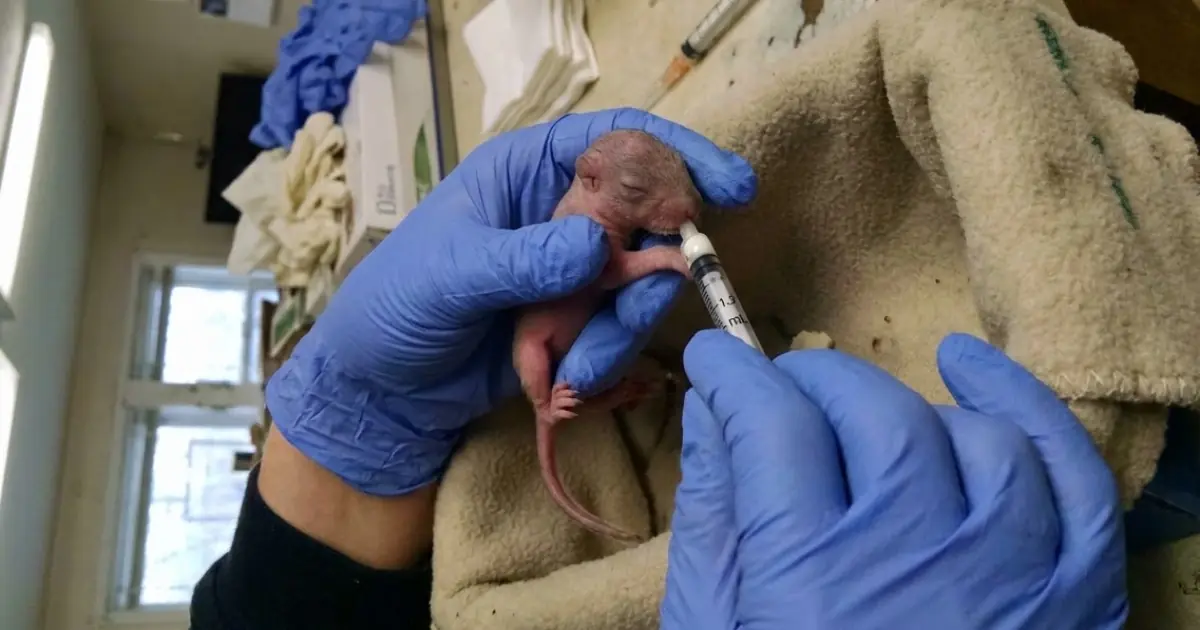
For the first few feedings, we weren't looking for dramatic changes. We were looking for tolerance. We wanted to see that she could feed appropriately, remain comfortable afterward, and continue responding normally.
The feeding itself was only part of the work.
At such a young age, orphaned squirrels may also require assistance with functions their mother would normally stimulate through grooming. Bedding has to remain clean and dry. Hydration and elimination need to be monitored. Weight changes can reveal whether nutritional support is actually translating into growth.
Everything about her care happened on a tiny scale.
A small change in weight mattered.
A stronger feeding response mattered.
A warmer body mattered.
Even the way she moved beneath the bedding mattered.
During one of those early feeding sessions, a caregiver noticed how firmly the baby's little front paws wrapped around the feeding syringe whenever she began nursing. Someone joked that she held onto it as though she had no intention of giving it back.
By the next shift, staff were calling her Pip.
There was no elaborate reason behind it. The short name simply seemed to fit the smallest patient in the nursery, and before long everyone knew exactly which baby was being discussed when someone asked how Pip had done at her last feeding.
For a while, Pip's world remained extremely small.
Warm nest.
Quiet room.
Caregiver.
Syringe.
Sleep.
Then the cycle started again.
Without her mother, that routine had to continue according to her developmental and nutritional needs, including during hours when most people would normally be asleep. Caring for a neonatal wild mammal isn't simply a matter of feeding it before work and checking again at the end of the day. Very young animals can require intensive, carefully scheduled care.
Pip gradually began making those sessions easier.
When she first arrived, we sometimes had to wait patiently for her to respond.
Several days later, she knew exactly what feeding meant.
As soon as she was positioned and smelled formula, her head began searching. Her tiny paws reached forward. Once she found the syringe, she held onto it with surprising determination.
Her body began changing too.
The nearly bare newborn appearance slowly disappeared.
Fine fur became more noticeable along her back and head. Her ears developed. Her limbs grew stronger, and the tail that had looked almost like a thin extension of her body began showing the earliest signs of the fur that would eventually make it unmistakably squirrel-like.
Her weight moved in the direction we wanted.
Each increase was recorded.
There were days when the numbers changed only slightly, but wildlife rehabilitation often progresses through dozens of small victories rather than one dramatic turning point.
Eventually, Pip began doing something she hadn't been capable of when she arrived.
She started trying to crawl out of the nest.
At first, she could only pull herself awkwardly over the bedding. Her movements were slow and poorly coordinated, and after a short exploration she would burrow back toward the warmest part of her enclosure.
Then her eyes began opening.
Suddenly, the baby who had known the world mostly through warmth, scent, and touch could begin looking at it.
Her growing awareness also marked the beginning of a transition in the way we cared for her.
The syringe was still important, but it couldn't remain the center of her world forever.
The goal was never to raise Pip into a squirrel that depended on people.
Every stage of rehabilitation had to prepare her for the next.
As she became stronger, her enclosure began providing more opportunity for safe exploration. She started using her claws deliberately. She grabbed bedding. She climbed over objects that previously would have been barriers.
Her personality became more apparent as well.
Pip was no longer content to remain exactly where she was placed.
During feeding time, she might still eagerly reach for the syringe, but afterward she increasingly wanted to investigate her surroundings rather than immediately curling up to sleep.
Soon, the young squirrel that had once fit motionless in one hand became difficult to keep still long enough for routine checks.
That was a welcome problem.
Her nutritional needs evolved as she matured. Appropriate foods were introduced gradually when she reached the proper developmental stage, allowing her to begin learning behaviors that would eventually matter far more than drinking formula.
She needed to chew.
She needed to manipulate food with her paws.
She needed to explore different textures and eventually learn to obtain nutrition without waiting for a caregiver to appear with a syringe.
Human contact was also gradually reduced as her condition allowed.
It can be tempting to cuddle an orphaned baby squirrel, particularly one that has been hand-fed for weeks. But a wildlife rehabilitation center isn't trying to create a tame squirrel.
Pip needed to associate people less and less with comfort as she grew.
The syringe that had once represented survival eventually became something she no longer needed.
That transition was one of the most significant milestones in her rehabilitation.
There had been a time when Pip couldn't maintain her own warmth and couldn't obtain a single feeding without human assistance. Now she was moving independently, eating appropriate foods, climbing, exploring, and developing the physical abilities expected of a young squirrel.
Her world expanded beyond the little heated nest.
Her movements became quicker.
Her grip became stronger.
The tail filled out.
And gradually, the baby who once reached desperately for the syringe began behaving more like the animal she was supposed to become.
At the time of this update, Pip is continuing through rehabilitation and remains under observation as she develops toward eventual independence. She still has milestones ahead of her before release can be considered. Growing larger isn't enough by itself.
A young squirrel returning to the wild must be physically healthy and appropriately developed. She needs the strength and coordination to climb, jump, balance, forage, respond to threats, and navigate an environment where no caregiver will be waiting nearby.
Her behavior toward people matters too.
The ideal ending to Pip's story isn't that she remembers us fondly.
It's that she doesn't need us.
Her case is also why we encourage anyone who finds a newborn squirrel not to immediately reach for ordinary milk or attempt syringe feeding without professional guidance. A baby found alone may sometimes still have an opportunity to be reunited with its mother, depending on the circumstances. When rehabilitation is necessary, feeding technique, formula choice, temperature, hydration, age, weight, and the baby's overall condition all matter.
What appears to be a simple act of kindness can become dangerous when liquid is delivered incorrectly to such a small animal.
For Pip, the syringe became an essential part of her story because reunification was no longer possible and she required professional supportive care.
But it was never meant to replace her mother forever.
It was only a bridge.
When Pip first arrived, her entire existence depended on things she couldn't provide for herself. Someone had to keep her warm. Someone had to monitor her. Someone had to hold a tiny syringe and patiently allow her to take one careful feeding at a time.
Today, there is considerably more squirrel than syringe.
And if everything continues in the right direction, there will eventually come a day when there is no syringe, no heated nursery, and no caregiver anywhere near her.
Just Pip, a tree in front of her, and the ability to climb it on her own.