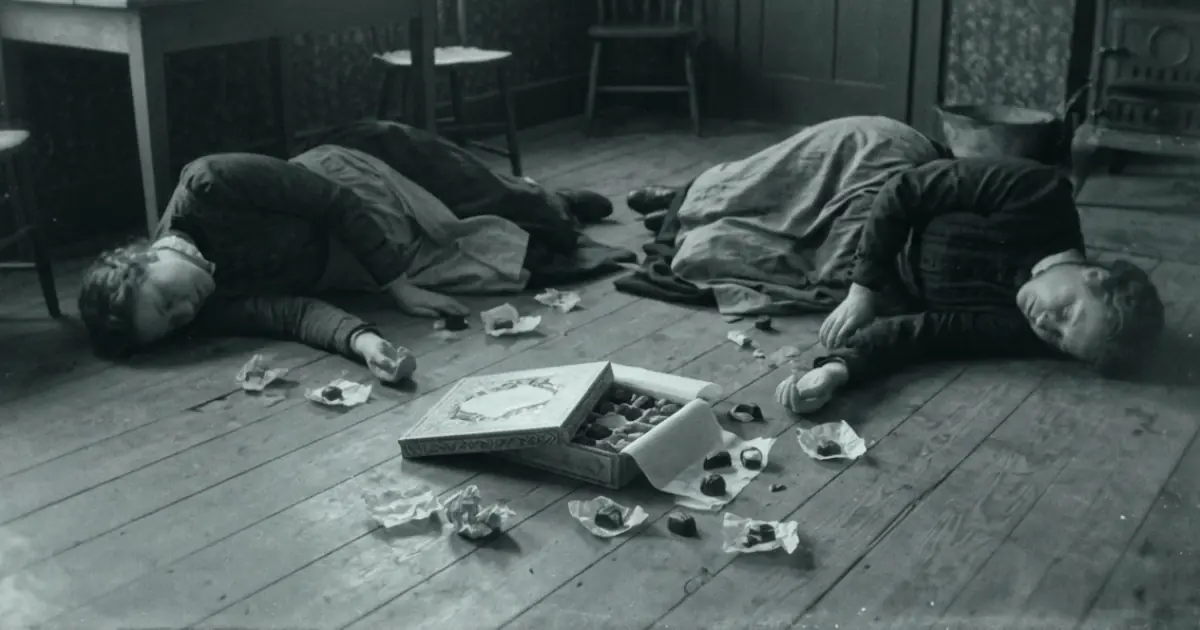
Delaware, August 1898.
The package did not look threatening.
That was the point.
It had traveled thousands of miles through the United States mail, passing from one set of hands to another, crossing nearly an entire continent before arriving in the small capital city of Dover.
There was no ticking mechanism.
No threatening message.
No warning.
Nothing leaking through the wrapping.
Nothing about its weight or shape suggested danger.
It was simply a parcel.
Inside was a box of chocolates.
A handkerchief.
And a small note.
To the woman who opened it, the package looked less like a mystery than a thoughtful gift.
Within days, two sisters would be dead.
Several other people who had eaten the candy would become violently ill.
And detectives on opposite sides of the United States would find themselves trying to answer a question that seemed almost impossible in 1898:
How do you find a murderer who may have been more than two thousand miles away when the victims were poisoned?
There was no surveillance camera recording the parcel being prepared.
No barcode.
No computerized postal history.
No DNA.
No electronic payment record.
No telephone location data.
No credit card transaction.
No internet search history.
No modern forensic toxicology database.
The package had traveled through a postal system in which millions of pieces of mail moved anonymously every day.
Once it was dropped into that system, the sender could vanish.
At least, that was the theory.
Whoever prepared the chocolates may have believed distance itself was protection.
The victims were in Delaware.
The package appeared to have come from California.
Between those two points lay thousands of miles of rail lines, postal depots, sorting rooms and strangers.
A murder weapon had crossed a continent while looking like a gift.
But the sender had made one mistake.
Actually, several.
They were tiny mistakes.
A line of handwriting.
A retail label.
A piece of wrapping paper.
A purchase remembered by a clerk.
A poison entered into a drugstore record.
A seemingly unimportant conversation.
Each clue meant almost nothing by itself.
Together, they would lead detectives toward a married woman in California named Cordelia Botkin.
And the case that followed would become not only one of the most sensational poisoning trials of the nineteenth century, but an early example of investigators solving a long-distance murder almost entirely through circumstantial evidence.
The murder weapon was chocolate.
The delivery system was the United States mail.
And the trail began on a summer evening on a porch in Dover.
The Penington House
Mary Elizabeth Dunning had returned to Delaware after living in California with her husband, John Preston Dunning.
Her father, John B. Penington, was a prominent figure in Delaware.
He had practiced law.
He had served as Delaware's attorney general.
He had represented the state in Congress.
The family lived comfortably in Dover, in a community where they were well known.
Mary Elizabeth had not always expected to be living with her parents again.
She was married.
She had a young daughter.
But her marriage had become troubled.
Her husband had built a career in journalism.
John P. Dunning worked for the Associated Press and had spent significant time in San Francisco.
He was ambitious, restless and frequently away.
His professional life would eventually take him into war reporting.
His personal life was far less orderly.
By the time Mary Elizabeth returned to Delaware, her husband's behavior had already strained the marriage badly.
She may not have known everything.
But she knew enough.
And someone in California seemed determined to make sure she knew more.
Anonymous letters began arriving.
They described another woman.
They suggested that John Dunning was involved with someone in San Francisco.
One letter described an attractive woman who was supposedly being seen frequently with him.
The writer did not identify herself openly.
Mary Elizabeth was distressed enough by the letters that her father kept them.
That decision would later prove enormously important.
At the time, they were simply unpleasant anonymous correspondence.
Months later, investigators would regard them as evidence.
And the handwriting on those letters would become one of the first bridges between a dead woman in Delaware and a suspect in California.
John Dunning
If the story were told only from the moment the chocolates arrived, one important piece would be missing.
The motive was already developing thousands of miles away.
John Preston Dunning had lived in San Francisco while Mary Elizabeth and their daughter were back east.
During that period he became involved with Cordelia Botkin.
Cordelia was herself married, though separated in practice from her husband for significant periods.
She was older than Dunning.
She lived for a time at San Francisco's Victoria Hotel.
Their relationship was not a brief encounter.
Contemporary and later accounts describe the two as frequent companions.
Dunning's life at the time was unstable.
He drank heavily.
He gambled.
His professional reputation suffered.
Accounts connected with the later case described financial misconduct and employment difficulties.
Eventually, however, journalism gave him another opportunity.
The Spanish-American War began in 1898.
Dunning received work as a correspondent.
He would leave California and travel toward the conflict.
Before departing, he told Cordelia something that changed the future of everyone involved.
He intended to return to his wife and child.
The affair, from his perspective, was finished.
That declaration gave prosecutors what they would later describe as motive.
Cordelia had invested emotionally in a man who was now leaving her.
And the woman to whom he intended to return lived more than two thousand miles away.
If someone wanted to harm Mary Elizabeth Dunning, ordinary methods created obvious problems.
Travel to Delaware would be expensive.
A stranger might be noticed.
Physical presence would create witnesses.
But there was another way.
The mail could go where the sender did not.
The Anonymous Letters
Before the chocolates, there had been letters.
That detail became crucial.
Someone in San Francisco wrote to Mary Elizabeth warning her about her husband's intimacy with another woman.
The letters were not friendly.
They were designed to interfere with reconciliation.
They placed another woman inside Mary Elizabeth's marriage without directly identifying the writer.
Mary Elizabeth's father preserved them.
This was fortunate for investigators.
In many households, anonymous letters might have been burned or thrown away.
Penington kept them.
Later, when the candy package arrived, the handwriting associated with it would look strangely familiar.
That is one of the most remarkable aspects of the case.
The first major clue existed before the murder weapon ever entered the mail.
Nobody knew it was a clue.
The family had already received a sample of the future suspect's alleged writing.
It was sitting in a drawer.
Waiting.
August 9, 1898
Historical sources differ slightly on whether the parcel arrived on August 8 or August 9, but contemporary reconstructions generally place the opening of the package on the evening of August 9.
It was summer in Dover.
After supper, members of the Penington household and visitors were gathered around the house.
The package had been addressed to Mary Elizabeth.
Inside the wrapping was a decorative candy box.
Accounts describe chocolate creams and bonbons.
There was also a woman's handkerchief.
Then the note.
It contained only a few words.
"With love to yourself and baby."
It was signed:
"Mrs. C."
The message sounded affectionate.
Not threatening.
Mary Elizabeth had known people in California whose names could make the initial seem plausible.
There was no obvious reason to believe that "Mrs. C." meant someone who wished her dead.
She liked sweets.
So the box was opened.
The candy was shared.
And that was exactly what made the crime even worse than the sender may have intended.
The package was addressed toward one woman.
The poison did not remain with one woman.