A Puppy Was Found Abandoned Inside a Trash Can—and His Condition Revealed This Wasn’t His First Night Without Care
The sound was so faint that the sanitation worker nearly missed it.
He had stopped beside a row of trash cans behind a small apartment building early in the morning. As he began moving one of the containers toward the collection truck, he heard what sounded like a short, muffled cry.
Then everything became quiet again.
He lifted the lid and looked inside.
A tiny brown-and-white puppy was lying at the bottom of the trash can beneath several loose bags. His body was tightly curled, and his dirty coat blended into the discarded material around him.
The puppy opened his eyes but did not attempt to stand.
The worker immediately moved the bags away from his face. He could see the puppy breathing, although each breath appeared shallow.
There was no carrier, blanket, food or water inside the container. The puppy wore no collar, and nothing had been left to explain who placed him there.
The worker contacted animal control and kept the lid open while waiting for help. Because the puppy appeared injured and extremely weak, he avoided pulling him out without support.
An officer arrived with a towel and small carrier.
When she reached into the trash can, the puppy gave one quiet whimper. He did not struggle as she lifted him, and his head immediately rested against her gloved hand.
The team began calling him Toby.
Outside the container, the seriousness of his condition became clearer.
Toby was painfully thin. His ribs and hip bones could be felt beneath his dirty coat, and his abdomen appeared unusually swollen compared with the rest of his body.
His gums were pale, his paws were cold and he could barely keep his eyes open.
The officer wrapped him in a towel and rushed him to a veterinary clinic.
Toby’s body temperature was dangerously low when he arrived. He was also dehydrated, anemic and hypoglycemic, meaning his blood sugar had fallen to an unsafe level.
Staff began warming him gradually and administered carefully controlled fluids and glucose.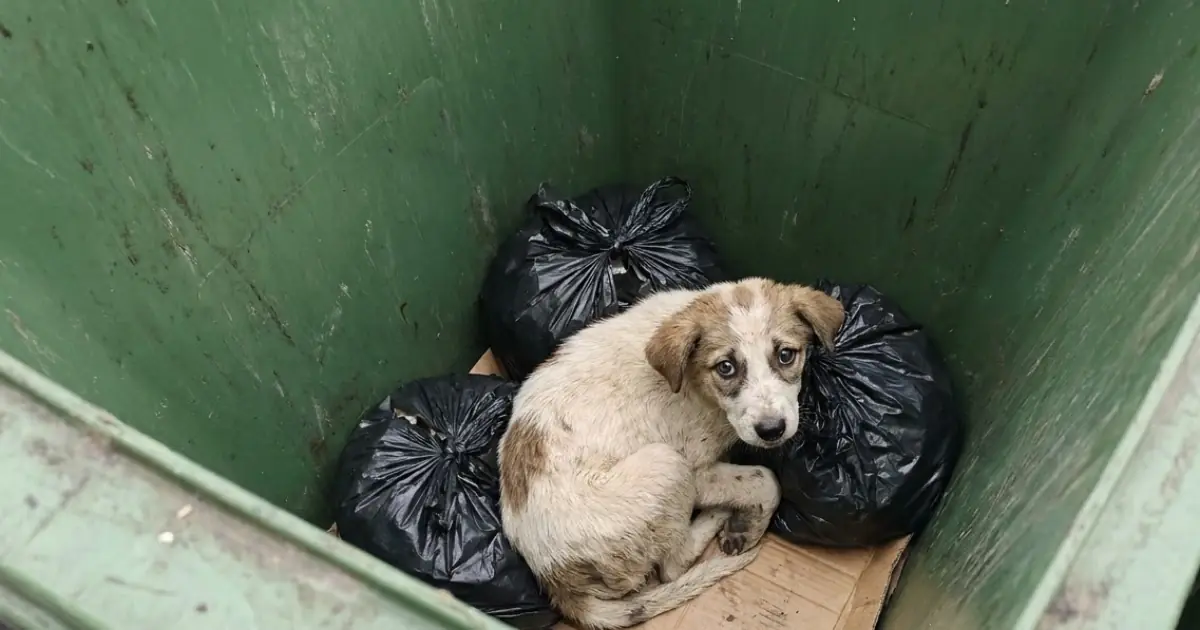
Although Toby had just been removed from a trash can, his condition could not have developed during a few hours inside it.
His lack of muscle, visible bones and heavy parasite burden indicated that he had gone without proper nutrition and care for an extended period.
The swollen abdomen was not evidence that he had recently eaten.
Tests showed that Toby carried a severe intestinal parasite infection. The parasites had taken nutrients from a body that was already receiving far too little food and had contributed to his anemia and weakness.
Several sores were also found beneath the dirt on his legs and belly. Some appeared to have formed where his thin body repeatedly rested on hard or unclean surfaces.
Veterinarians could not say exactly how long Toby had been neglected.
They could only confirm that someone had discarded an already-sick and starving puppy instead of seeking help.
Toby was too unstable to eat a normal meal.
After prolonged malnutrition, suddenly receiving too much food can cause dangerous shifts inside the body. The medical team began with tiny portions of soft puppy food while monitoring his blood sugar and electrolytes.
During the first feeding, Toby smelled the food but did not lift his head.
A technician placed a small amount against his lips. He licked once, swallowed and then closed his eyes again.
Staff offered another small portion later that afternoon.
This time, Toby raised his nose toward the dish and managed several bites before becoming exhausted.
He spent the remainder of the day inside a heated recovery enclosure. His breathing and heart rate were monitored while medication was started to address infection and parasites.
Treatment had to proceed carefully.
Killing a heavy parasite load too aggressively could place additional stress on Toby’s fragile body. The veterinary team created a staged treatment plan while continuing supportive care.
His first night remained uncertain.
Toby’s temperature improved, but his blood sugar dropped again several hours later. Staff administered additional glucose and continued checking him throughout the night.
Shortly before dawn, a technician opened the enclosure to examine him.
Toby slowly lifted his head.
When she placed the food dish nearby, he pulled himself several inches across the blanket and began eating without being hand-fed.
He could manage only a small amount, but it was the first time he had moved toward something on his own.
By the following morning, his blood sugar had stabilized.
Toby remained critically underweight, and his anemia still required close monitoring. However, he was now alert enough to follow movement with his eyes and reposition himself on the bedding.
Investigators returned to the apartment building where he had been found.
They asked residents whether anyone recognized the puppy or had seen a person approaching the trash area. No one immediately claimed him.
A nearby security camera covered part of the alley, but the trash cans were positioned outside its clearest view. Authorities began reviewing the available footage and requested information from anyone who had heard or seen anything unusual during the night.
No microchip was found.
It remained unclear whether Toby had come from one of the apartments, been brought from another neighborhood or belonged to an unwanted litter.
What was clear was that he could not have entered the tall trash can by himself.
The container’s sides were smooth, and the opening was far above the puppy’s reach. Someone had placed him inside and closed the lid, leaving him with no way to escape.
Over the next several days, Toby received multiple small meals each day.
His parasite treatment continued, and the sores on his skin were cleaned regularly. Staff also treated irritation around his eyes and nose, likely worsened by dehydration and exposure to the dirty air inside the container.
Toby gradually became more responsive.
He began sitting up when food arrived, although his legs trembled beneath him. On his third day, he attempted to stand and took two unsteady steps before lowering himself onto the blanket.
He also began making noise.
At first, his cries were barely audible. As he regained strength, he started whimpering whenever his empty dish was removed.
The staff considered every protest a sign that energy was returning to his body.
Five days after his rescue, Toby was stable enough to leave intensive care.
He moved into a quiet medical foster home where his meals, medication and weight could be closely monitored. Because he had been deprived of normal care during a critical stage of development, he would also need time to rebuild strength and learn ordinary puppy routines.
During his first evening, Toby stayed inside his open carrier.
His foster caregiver placed food and water nearby and allowed him to come out when he felt ready. Later that night, he walked onto the blanket beside the carrier and fell asleep there.
Toby is now eating on his own and beginning to gain weight.
His belly remains swollen, but it is gradually improving as treatment removes the parasites. His gums have more color, and he can walk around the room without immediately collapsing.
He is not yet medically cleared.
The rescue must continue monitoring his anemia, digestion and development. Follow-up testing will determine whether the prolonged malnutrition caused any lasting damage.
The investigation into his abandonment also remains open.
Toby survived because someone paused after hearing a sound that could easily have been mistaken for shifting trash.
Had the container been emptied into the truck, there may have been no opportunity to save him.
Abandoning an animal inside a sealed trash can is not surrendering it. It leaves that animal exposed to suffocation, crushing injuries, extreme temperatures and a death that may occur completely out of sight.
Toby had already endured hunger, parasites and neglect before he was discarded.
Today, he is no longer silent at the bottom of that container. When his foster caregiver enters with a meal, he stands on his still-unsteady legs and cries loudly enough to make sure someone hears him.