The Wyoming wind had a way of making a man feel poor.
It found every loose board in the barn, every crack around the kitchen windows, every weakness in a fence line Wade Mercer had promised himself he would repair when there was time and money enough to do the job properly. By March, the wind had spent an entire winter dragging itself across the Mercer Ranch, bending dry grass flat against the earth and polishing the cedar fence posts until they looked older than Wade felt.
Thirty-four should not have felt old.
But Wade had inherited five thousand acres, a dying cattle operation, two tractors with different opinions about starting, a house that leaked above the pantry whenever snow melted from the north side of the roof, and a mortgage that had survived longer than his father.
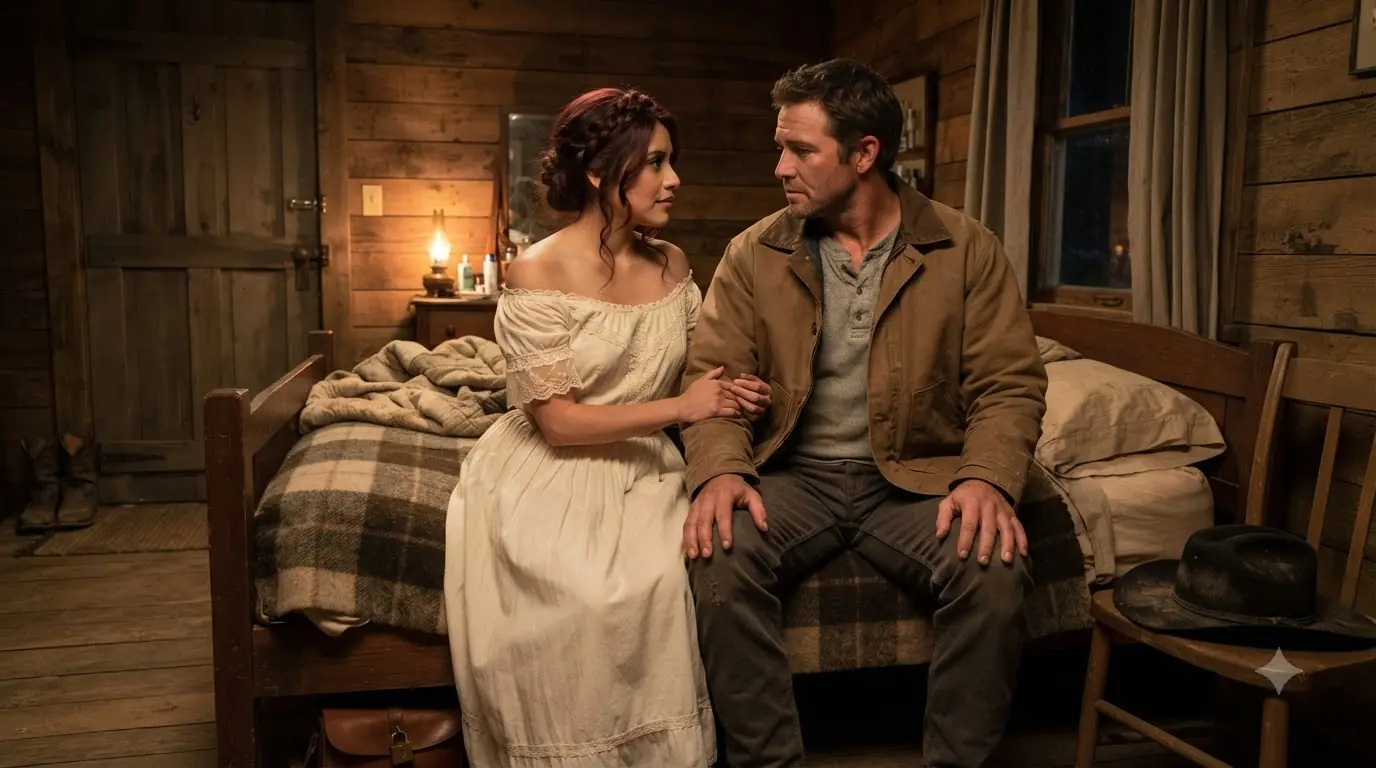
Some mornings he woke feeling sixty.
That morning he stood on the porch with cold coffee in one hand and watched sixteen Angus-cross cows nose through thin hay beside the lower pasture.
There should have been eighty-four.
Three years of drought had reduced that number first.
Feed prices had done the rest.
Then county assessments climbed.
Then the bank stopped pretending patience was profitable.
Behind Wade, Graham Whitlock closed a leather folder.
The sound was quiet.
It still felt like a rifle being cocked.
Whitlock was forty-seven, clean-shaven, silver beginning at his temples, and dressed in a navy wool suit that had no business being within fifty miles of Wade’s mudroom. He was not employed directly by North Plains Bank, though Wade had stopped caring about the technical distinction months ago. Whitlock’s Denver firm represented the bank in agricultural restructuring, foreclosure, and any other process requiring a pleasant man to explain why someone was about to lose everything.
“You didn’t answer me,” Whitlock said.
Wade remained facing the pasture.
“I heard you.”
“The mortgage is six months delinquent.”
“I know how many months.”
“The line of credit is also in default.”
“I know that too.”
“Then you understand the bank’s position.”
Wade turned.
“No. I understand arithmetic. I don’t understand why a bank that financed this place for forty years suddenly wants it auctioned before the spring calves are even on the ground.”
Whitlock’s expression did not change.
“The bank does not want your ranch.”
“Could’ve fooled me.”
“The bank wants repayment.”
“So give me until October.”
“We discussed October.”
“My cattle will be heavier.”
“If rain comes.”
“It’ll come.”
Whitlock looked toward the pale sky.
“That is not something a lender can underwrite.”
“My father used to say bankers hated weather because God didn’t take appointments.”
Whitlock almost smiled.
“Your father also maintained stronger reserves.”
The sentence landed harder than Wade expected.
He put the coffee down before he threw it.
“My father died.”
“I’m aware.”
“Then leave him out of this.”
Whitlock inclined his head.
“Fair.”
He opened the folder again.
“There is one thing.”
Wade laughed without humor.
“There’s always one thing.”
Whitlock removed a yellowed photocopy.
“The original Mercer deed contains a private agricultural preservation covenant.”
Wade stared.
“What does that mean?”
“It was executed between your great-grandfather and the lending trust that financed the original land assembly.”
“In 1889?”
“Later. Nineteen twenty-six.”
Whitlock placed the copy on the porch rail.
“It’s unusual.”
“Useful?”
“Potentially.”
Wade read.
The language was dense, full of words nobody used unless billing by the hour.
Whitlock pointed to one paragraph.
“The covenant gives a family-operated homestead additional restructuring protection if ownership remains residential and agricultural rather than speculative.”
“This is a family ranch.”
“Not under the covenant’s definition.”
Wade looked up.
Whitlock continued.
“You are an unmarried sole operator.”
“So?”
“So the original provision defined a qualifying family operation as one maintained by a legally married household residing on the property and participating in the ranch.”
Wade stared.
“You’re joking.”
“I rarely drive three hours for jokes.”
“You’re telling me the only thing between this ranch and foreclosure is a wife.”
“I’m telling you a spouse could activate the covenant.”
“Could?”
“The bank would likely challenge.”
“Of course.”
“But while the challenge is reviewed, foreclosure would be stayed.”
“How long?”
“Three years if the covenant is upheld.”
Wade went very still.
Three years.
Three years was rain.
Three calving seasons.
Time to rebuild the herd.
Time to refinance somewhere else.
Time to breathe.
“What’s the catch?”
Whitlock tapped the paper.
“The marriage must be lawful.”
“Spouse must actually reside here.”
“She must materially participate in the ranch operation.”
“Both spouses must sign transfers, mortgages, or material encumbrances.”
Wade frowned.
“You said she.”
“Statistically.”
“I know what you said.”
Whitlock closed the file.
“Thirty days.”
Wade looked at him.
“What?”