The first truck arrived before sunrise.
Luke Harper heard it from the kitchen.
A low diesel growl rolled across the frozen fields, grew louder near the east fence, then ended with the metallic complaint of a dump bed lifting into the gray morning.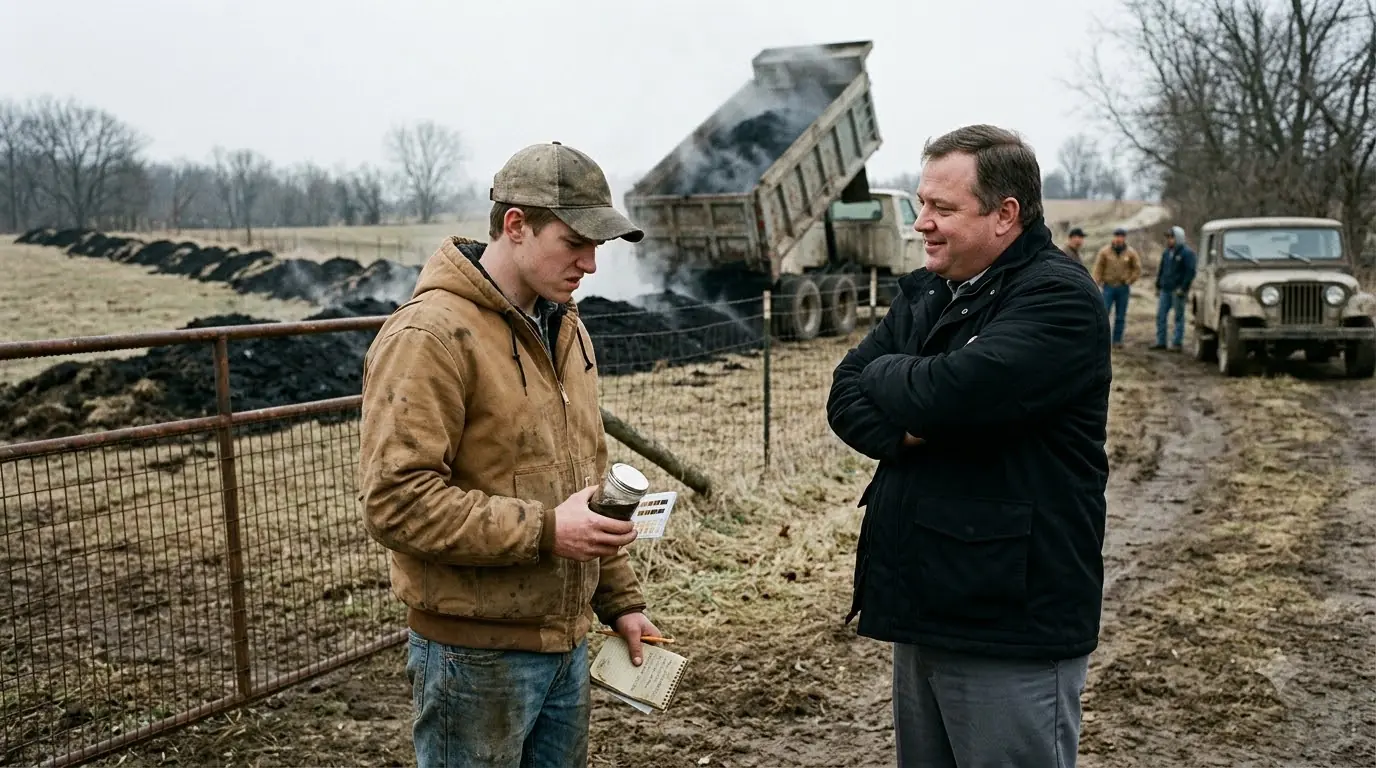
Luke stopped pouring coffee.
His grandfather did not.
Earl Harper sat at the scarred oak table beneath a yellow kitchen light, one hand wrapped around a chipped mug while the other turned a page of the county livestock paper.
Seventy-three years old.
Thin now.
Shoulders permanently bent from half a century of climbing tractors, carrying feed sacks, wrestling calves, and refusing to acknowledge the existence of back pain.
Luke looked through the window.
Steam drifted beyond the barn.
Another truck waited on the county road.
“You expecting them today?”
Earl did not look up.
“Every Thursday.”
“They usually come after eight.”
“They come when they come.”
Luke frowned.
The second truck turned through the gate.
“You know what they’re dumping?”
His grandfather finally lowered the paper.
“Same thing they’ve dumped for twelve years.”
“That isn’t an answer.”
“Furnace slag.”
“What kind?”
“The black kind.”
Luke stared.
Earl raised his mug.
“There. Science.”
Luke almost smiled.
Almost.
Three months earlier, he probably would have.
But Luke had spent the previous semester at the community college twenty-seven miles away taking introductory soil chemistry as part of an agricultural technology program.
That class had ruined several ordinary things for him.
Water was no longer water.
It had pH, hardness, dissolved solids, nitrates.
Dirt was not dirt.
It was structure, organic matter, cation exchange capacity, microbial activity.
And black industrial material arriving by the hundreds of tons from a metal-processing plant was definitely not just “the black kind.”
Luke carried his coffee to the window.
The dump bed reached its full angle.
Black material spilled from the truck in a heavy cascade.
Chunks.
Dust.
Fine powder.
Steam curled upward where the warm material hit cold ground.
The east field had once been pasture.
Luke barely remembered it that way.
He had been seven when Ashford Alloy Works first approached his grandfather.
The company operated a smelter eleven miles south of the farm, beyond the rail yard and the interstate.
It processed specialty steel and alloy scrap.
The plant employed nearly six hundred people directly and hundreds more through trucking, maintenance, and contracting.
In Bell County, saying something negative about Ashford was roughly equivalent to criticizing rain.
People might agree with you privately.
They still needed it.
The original arrangement had sounded almost too good.
Ashford needed somewhere to place processed furnace slag.
The Harpers had eighty acres of low, rough ground along their eastern boundary that grew more stones than grass.
The material, company representatives said, was inert.
Useful as fill.
Good for stabilizing muddy lanes.
Good beneath equipment pads.
Good for drainage.
And Ashford would pay the farm for every load.
At first it had been eighty dollars per truck.
Then a hundred.
Then a hundred and fifty.
Now two hundred and ten.
When cattle prices collapsed, the slag checks helped.
When Earl needed a new transmission in the combine, the slag checks helped.
When Luke’s father died and the farm suddenly lost the man who did half its work, the slag checks helped.
Ashford had become part of the farm’s financial rhythm.
Soybeans.
Corn.
Hay.
Cattle.
Black piles.
Luke watched another load fall.
Something about the pile bothered him.
Not merely because he had taken one chemistry class and suddenly thought he was smarter than a seventy-three-year-old farmer.
He knew enough to know he did not know much.
What bothered him was the smoke.
Or steam.
Whatever it was.
And the color.
Some older slag near the far fence had weathered gray.
The newest material was black as coal, with patches of greenish residue visible where the loader had broken open larger chunks.
Luke asked:
“Did it always look like that?”
Earl followed his gaze.
“Mostly.”
“That green color?”
“Sometimes.”
“Did Ashford ever give you test reports?”
Earl sighed.
“Luke.”
“What?”
“It’s six-thirty.”
“And?”
“I’d like to reach seven before you sue the steel industry.”
Luke leaned against the counter.
“I’m asking.”
“And I’m answering.”
“No, you’re avoiding.”
That made Earl look up.
For several seconds, grandfather and grandson stared at one another.
They had become good at this.
Both loved each other.
Neither enjoyed being managed.
Luke was nineteen.
Tall but lean.
Brown hair that never stayed flat beneath a work cap.
Hands already rough enough to make strangers assume he had worked longer than he had.