A SQUIRREL ARRIVED COMPLETELY STUCK TO A GLUE TRAP — THE FIRST FEW HOURS BECAME A RACE TO STABILIZE HIM
When the small cardboard carrier arrived at our wildlife rehabilitation center, there was almost no movement inside. For a moment, all we could see was a flattened patch of gray fur against a rectangular glue board. Then his chest moved. Fast, shallow breaths, one after another.
The young eastern gray squirrel was alive, but almost his entire underside was stuck.
His chest and belly were pressed into the adhesive. Both hind feet were caught, one front paw was stretched awkwardly in front of him, and a large section of his tail was glued flat behind his body. Several clumps of fur had already been pulled loose and remained embedded in the adhesive, suggesting that he had spent a long time struggling before anyone found him.
By the time he reached us, however, most of that struggling had stopped.
That was one of the things that worried us most.
A wild squirrel that can still fight will usually fight. This one barely reacted when the carrier was opened. He lifted his head slightly, tried once to pull a front leg forward, and then collapsed back against the board.
The person who brought him to us explained that the trap had been placed inside a detached garage after signs of rodents were noticed around stored birdseed. The garage door was occasionally left partially open, and the squirrel had apparently found his way inside. No one knew exactly how long he had been trapped.
What probably began with a single paw touching the adhesive had quickly become much worse. A squirrel's natural response is to pull away from restraint. But on a glue board, twisting and struggling can bring more of the body into contact with the adhesive. One paw becomes two. The belly touches the surface. The tail drops. Within minutes, an animal that normally spends much of its life running and climbing can become almost completely immobilized.
Fortunately, the finder had resisted the temptation to simply pull him free. Instead, the entire board had been placed into a ventilated container and transported with the squirrel still attached.
That decision mattered.
Forcefully pulling an animal from strong adhesive can remove fur, injure skin and place damaging tension on small toes and limbs. With the squirrel already exhausted, we needed to approach the situation carefully.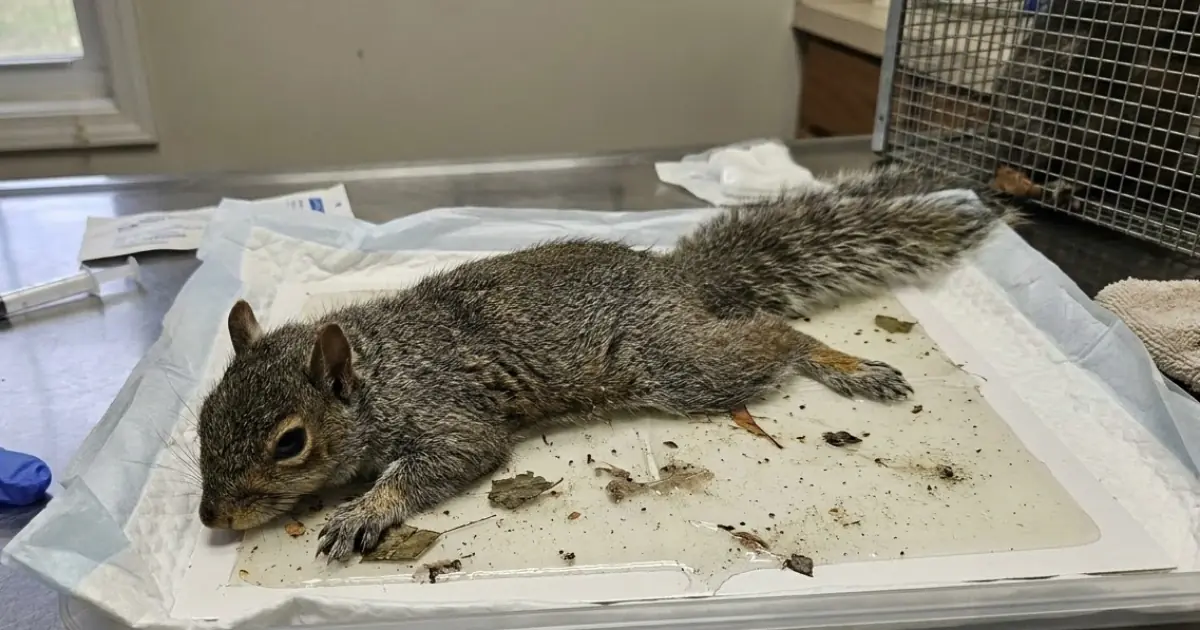
Before concentrating on the glue itself, we assessed his overall condition. His breathing was rapid, his eyes were partially closed, and his body felt depleted after what appeared to have been a prolonged struggle. Stress, dehydration, exhaustion and body-temperature problems can all become concerns when a wild animal has been trapped and unable to move normally.
The goal wasn't simply to get him off the board as quickly as possible. The goal was to get him through the entire ordeal without creating another injury.
The removal process was slow.
Working carefully, the adhesive around the trapped fur was gradually loosened using an appropriate oil while avoiding his eyes, nose and mouth. Every time another portion of his body began to separate from the board, the newly freed area had to be supported rather than pulled.
His first front paw eventually came loose.
Then part of his chest.
The second front leg took longer because fur around the wrist and toes had become heavily coated. When that paw was finally released, he tried weakly to pull it underneath his body but didn't have enough strength to lift himself.
His hindquarters were worse.
Both rear feet were attached to the board, and the fur across his lower abdomen had become a sticky, tangled layer. Each foot had to be freed carefully because squirrels depend heavily on their claws and toes for climbing. Even a relatively small injury can become a serious problem for an animal that eventually needs to race up tree trunks and leap between branches.
The tail was the final major challenge.
A squirrel's tail plays an important role in balance, movement, communication and temperature regulation, and a large portion of his was stuck. Instead of lifting it and creating unnecessary tension, the team worked gradually along the trapped section while supporting it close to the board.
Eventually, the last section released.
For the first time since he had been discovered, the squirrel was no longer attached to the trap.
But he didn't run.
He barely moved.
He lay on a clean towel with his legs tucked unevenly beneath him, exhausted from the combination of the original struggle and the careful handling required to free him. Once enough adhesive had been removed to examine his body more closely, we could finally see some of the damage hidden beneath the matted fur.
Several patches of fur were missing. The exposed skin underneath was red and irritated, with small superficial abrasions along portions of his belly and legs. We were relieved not to see an obvious catastrophic wound, but one rear leg immediately became a concern.
He wasn't using it normally.
When he attempted to reposition himself, he relied heavily on the other three limbs and kept that leg partially guarded. It was impossible to know from appearance alone whether we were dealing with swelling and soft-tissue strain from hours of struggling or a more significant injury, so veterinary assessment and continued observation were important.
For the rest of that day, however, what he needed most was remarkably simple: warmth, darkness and quiet.
He was placed in a secure recovery enclosure away from unnecessary human activity. Unlike a domestic animal, we didn't want him becoming comfortable around us. Human interaction was kept to what was necessary for treatment and monitoring.
For the first several hours, almost nothing happened.
He remained curled toward the back of the enclosure.
Every check looked nearly identical to the one before it.
Then, later that evening, something small changed.
He moved.
Not far. He had simply repositioned himself several inches from where he had been resting.
For an animal that had arrived unable to lift most of his body from a glue board, those few inches mattered.
By the following morning, he looked more alert. His eyes were open wider, and when someone approached the enclosure, he attempted to move away.
That reaction was encouraging.
People sometimes imagine a successfully rehabilitated wild animal becoming affectionate toward its caregivers, but in wildlife rehabilitation, the opposite is often preferable. A healthy wild squirrel should remain wary of people. We wanted him to recover his strength without losing the behaviors that would eventually help keep him alive outside.
Over the next few days, progress came gradually.
Residual adhesive contamination had to be managed without subjecting him to excessive handling. The irritated skin was monitored, as were the areas where fur had been pulled away. Most importantly, we continued watching that rear leg.
At first, he clearly favored it.
He could move across the enclosure, but he wasn't climbing normally. When he tried to raise himself, much of his weight remained on the other side of his body.
That meant release wasn't even a consideration yet.
Being able to eat and walk across a flat surface isn't enough for a squirrel.
In the wild, he would need to sprint, climb vertically, grip rough bark, balance on narrow branches, jump, change direction instantly and escape predators. A weakness that seems manageable inside a protected enclosure can become fatal once an animal is released.
So we gave him time.
Then another small milestone appeared.
He started placing more weight on the injured leg.
Soon after that, he began climbing short distances.
The first attempts weren't particularly graceful. He moved cautiously and didn't climb as high as a healthy squirrel normally would. But each day, his coordination improved.
His behavior changed too.
The quiet, flattened animal from intake began disappearing whenever staff entered the room. He became quicker about retreating to the protected portion of his enclosure. If someone remained nearby longer than necessary, he watched carefully from a distance.
We were starting to see a wild squirrel again.
As his immediate medical concerns improved, his rehabilitation shifted from stabilization toward rebuilding normal function. His environment gave him opportunities to climb and move while human contact remained minimal. We paid particular attention to how securely he gripped, whether he used all four limbs evenly and whether the damaged tail interfered with his balance.
Some of the fur still looked rough from the adhesive, and patches remained noticeably thinner than the surrounding coat. But appearance alone doesn't determine whether a wild animal can eventually return to its habitat.
Function matters.
His tail moved normally. His feet gripped securely. The previously guarded rear leg gradually stopped limiting him.
Then came one of the clearest signs of progress: speed.
The squirrel that had once been unable to move more than his head became increasingly difficult to observe closely because he no longer wanted anyone near him. He could climb rapidly, change position without hesitation and disappear into the sheltered portion of the enclosure as soon as he noticed a person.
That's exactly the problem we wanted to have.
At the time of this update, he is alert, eating normally, moving comfortably and continuing through rehabilitation while his readiness for release is evaluated. The irritated areas have improved significantly, and the rear leg that initially concerned us is no longer producing the same obvious limitation.
We still aren't rushing the final step.
Wildlife rehabilitation isn't about opening the enclosure as soon as an animal looks better. Before release, we need confidence that an animal can survive without food, protection or medical support from people.
For this squirrel, that means more than healing the visible injuries. He needs appropriate strength, coordination, climbing ability, coat condition and normal avoidance behavior.
His case is also a reminder that glue traps don't distinguish between the animal someone intends to catch and wildlife that accidentally encounters them. A squirrel, small bird, reptile or other animal that touches exposed adhesive can become trapped, and its instinctive attempts to escape may cause additional parts of the body to become stuck.
If a live wild animal is discovered on a glue trap, simply pulling it free can cause additional injury. Keeping the situation as calm as possible and contacting a licensed wildlife rehabilitator or appropriate wildlife professional can give the animal a safer path forward.
When this squirrel first arrived, there was so little movement inside the carrier that we weren't sure what the next several hours would bring.
We remember the board covered in loose gray fur.
We remember the tiny front paw stretched forward in the adhesive.
And we remember how, once he was finally free, he still didn't have enough strength to stand normally.
Now, when we approach his enclosure, we're lucky to get more than a brief glimpse before he climbs away from us.
If his progress continues and he meets the requirements for release, that's exactly how we hope his story eventually ends—not sitting calmly beside the people who helped him, but racing away from them, finding the nearest tree, and becoming a wild squirrel again.