A Squirrel Nesting Box Came Crashing Down With a Baby Still Inside — The Tiny Survivor Was Found Injured Beside the Wreckage
The first thing the homeowner noticed was the box.
It was lying on its side beneath a mature tree at the edge of the backyard, partially split along one corner. The lid had shifted, nesting material was scattered across the damp grass, and the mounting point that had once held the squirrel nesting box above the ground was visibly damaged.
Then something moved beside it.
A young eastern gray squirrel was lying only a short distance from the broken box.
He wasn't running.
He wasn't trying to climb the tree.
He was pressed low against the grass with one side of his body turned toward the ground. His tail barely moved, and when the homeowner approached carefully, the baby made only a weak attempt to lift his head.
It immediately looked wrong.
The nesting box had apparently come down sometime that morning. Whether a mounting component had failed, the wood had deteriorated, or weather and movement had gradually weakened the attachment wasn't something anyone could determine with certainty. What mattered was that the box had fallen from the tree with at least one young squirrel apparently still inside or immediately around it.
The impact had been significant enough to damage the box.
For an animal weighing only a fraction of what an adult squirrel eventually would, there was every reason to worry about what the same fall had done to his body.
The homeowner contacted a wildlife professional for guidance. Because the youngster was visibly injured rather than simply displaced, this wasn't a situation where placing the box back up and waiting for the mother was the only consideration.
The caregiver who responded found him still beside the fallen nest box.
He was gently lifted with his body supported as evenly as possible and transferred into a small, secure carrier lined with soft material. The goal wasn't to examine every injury in the yard. With significant trauma, excessive handling can add stress and potentially worsen an unstable injury.
By the time he reached our rehabilitation center, his condition looked even more serious.
He lay on his side during much of the initial assessment.
One front leg was tucked tightly against his chest and wasn't being used normally. There was swelling around one hind limb, and the fur along his shoulder and flank was disheveled where his body appeared to have taken part of the impact. A small abrasion was visible near his nose.
But the most concerning part wasn't any single visible wound.
It was how little he moved.
A healthy juvenile eastern gray squirrel generally has very strong opinions about being handled by humans. This baby barely resisted.
His breathing was rapid. His eyes remained partly open, but his responses were slow. When he attempted to raise himself, his head came up briefly before his body tipped back onto the pad.
A fall serious enough to produce this degree of weakness required us to think beyond the injuries we could see.
Trauma can affect the head, chest, abdomen, spine, and internal organs without leaving dramatic external evidence. A limb that looks swollen may be only one part of the problem. Veterinary evaluation was therefore important, and until we knew more, the safest approach was to treat him as a significant trauma patient.
He was stabilized in a quiet environment with carefully controlled warmth while handling was kept to what was necessary.
There was no attempt to make him walk.
No climbing test.
No immediate large feeding simply because he was young.
The first question was much more basic.
Could we get him stable?
For the next several hours, he mostly rested.
His breathing and responsiveness were monitored closely. His limbs were assessed carefully, and the areas of swelling were evaluated while we watched for neurological signs or changes that could indicate a more serious injury.
During one check, he managed to pull his front feet beneath his chest.
For several seconds, he almost held himself upright.
Then he slowly lowered his head back onto the pad.
It wasn't much.
That afternoon, it felt enormous.
One of the caregivers had brought a handful of the nesting material that had been found around the broken box so the circumstances of the rescue could be documented. A few dried maple leaves were tangled through it.
By the evening shift, the little squirrel had acquired a name.
Maple.
There wasn't any formal decision. Someone wrote it beside his identification number on the care sheet, and everyone else simply started using it.
Maple spent his first night in a deliberately simple recovery setup.
There were no branches above him.
A squirrel's instinct is to climb, but instinct doesn't know when bones and soft tissues need rest. If Maple suddenly felt strong enough to attempt a vertical escape before his injuries were understood, another fall was the last thing he needed.
Instead, everything remained low.
Soft bedding.
A protected hiding area.
Controlled warmth.
Quiet.
We wanted him resting, not proving that he was still a squirrel.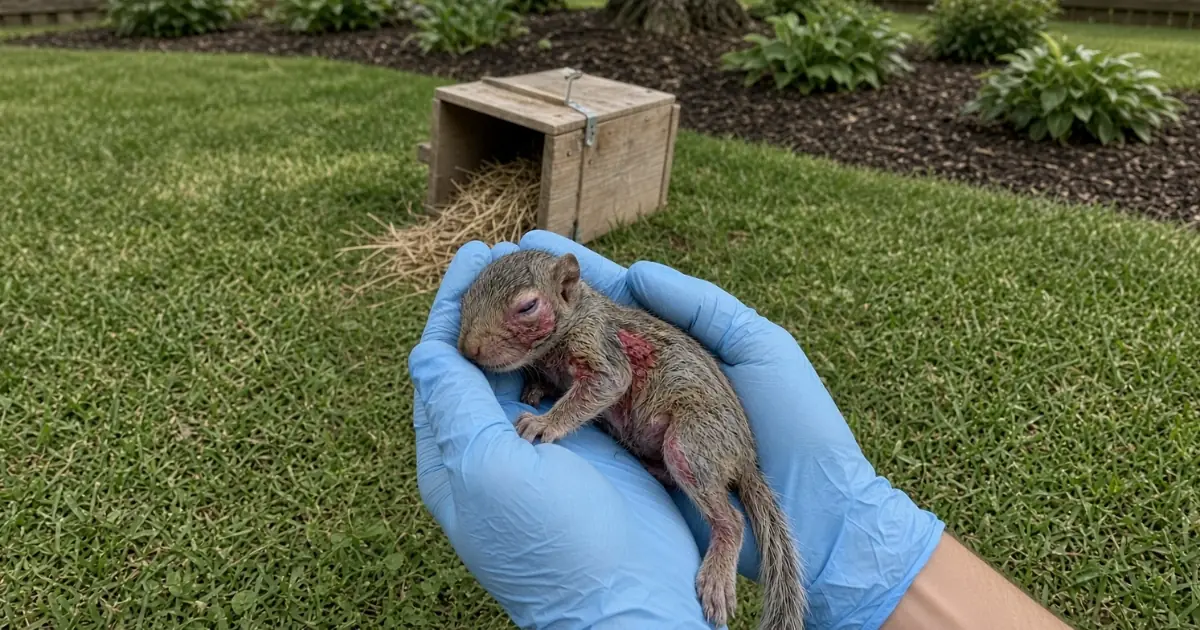
By the next morning, Maple had made it through the most uncertain period.
He still wasn't standing normally, but his awareness had improved.
When a caregiver approached, his head came up.
When a hand entered the enclosure for necessary care, Maple attempted to move away.
The attempt was awkward and short, but the reaction itself was encouraging.
He knew we were there.
More importantly, he didn't want us there.
Further assessment helped us build a clearer picture of his injuries. The limbs that had worried us required continued monitoring and restricted activity, but fortunately there was no indication at that point that Maple had lost the ability to use them permanently. Much of the swelling and abnormal movement appeared consistent with substantial trauma that would need time and veterinary-guided supportive care.
That was good news.
It wasn't the same thing as being out of danger.
The next several days were quiet.
Maple slept for long stretches.
When nutritional support was appropriate for his age and condition, it was provided cautiously. His intake and weight were monitored, along with hydration, elimination, breathing, responsiveness, and mobility.
The little abrasion around his face began healing.
The swelling didn't disappear immediately.
Neither did his reluctance to move.
On the second day, Maple could hold himself upright longer.
On the third, he changed sleeping positions without assistance.
Soon afterward, he began placing more consistent weight through his limbs.
These weren't the kinds of milestones that would look dramatic in a photograph.
Inside a rehabilitation room, they meant everything.
Then one morning Maple was found somewhere we hadn't left him.
He had moved from his sleeping area to the opposite side of the enclosure.
It wasn't far, but he had done it on his own.
A few days earlier, the same baby had struggled simply to keep his head elevated.
Now he had decided where he wanted to be.
His appetite strengthened along with his movement.
So did his attitude.
Maple began reacting sooner whenever the enclosure was opened. He no longer remained flattened against the bedding while care was performed. He tried to retreat into his protected area and occasionally gave us the unmistakable impression that he considered the entire rehabilitation team an unnecessary intrusion.
That was exactly what we wanted.
As the swelling continued to decrease and his mobility improved, we could begin thinking about the problem that would eventually determine whether Maple could return to the wild.
Could he climb normally again?
For a squirrel, simply being able to walk isn't enough.
Trees are the real test.
A releasable eastern gray squirrel needs powerful hind limbs, secure grip, coordination between all four feet, balance, accurate jumping, and the ability to change direction rapidly on narrow and irregular surfaces.
Maple's first opportunities for increased movement were intentionally modest.
Low structures were introduced before height.
At first, he pulled himself upward mostly with his front legs.
The hindquarters followed cautiously.
He paused often.
But he climbed.
Over the following days, his movement became increasingly symmetrical. The limb that had once been visibly swollen began contributing normally. He stopped hesitating before putting weight through it.
Then came his first small jump.
It was hardly the kind of leap an adult squirrel makes between branches.
Maple moved from one low surface to another, landed securely, and immediately continued forward.
No collapse.
No obvious hesitation.
No refusal to use the previously injured limbs.
From there, rehabilitation began looking less like trauma recovery and more like preparation for being wild.
Maple's environment became more complex as his condition allowed. He had opportunities to climb vertically, balance, explore, and manipulate appropriate foods. His developing body needed exercise, but his brain also needed to start solving the kinds of problems a squirrel encounters outside.
Food couldn't always simply appear directly in front of him.
He needed to investigate.
He needed to chew.
He needed to use his paws.
And he needed to stop expecting humans to be part of his normal environment.
That final transition happened naturally.
The more capable Maple became, the less interested he was in us.
Eventually, opening his enclosure no longer revealed a baby lying quietly on bedding.
Instead, there would be a flash of gray.
A quick climb.
Then Maple would position himself as far from the caregiver as possible and watch from above.
Sometimes the only part of him immediately visible was his tail.
For an animal whose story had begun with a fall, seeing him deliberately choose the highest available safe position felt particularly significant.
The damaged nesting box had once carried him toward the ground.
Now Maple was determined to move in the opposite direction.
His recovery also raised an important issue about nesting boxes themselves.
Artificial nest boxes can provide useful shelter for some wildlife when they are appropriately designed, installed, maintained, and positioned. But anything attached outdoors is exposed to weather and deterioration. Wood can weaken. Fasteners can loosen. Mounting points can fail.
A box that was secure when installed shouldn't automatically be assumed to remain secure indefinitely.
Periodic inspection matters.
In Maple's case, we can't say exactly why the box came down or precisely what position he was in when it happened. We also don't know whether other squirrels had already left the box before the fall. The homeowner continued observing the area for activity and signs of the adult squirrel.
What we can say is that Maple's condition was consistent with a young animal that had experienced significant trauma, and the broken nesting box beside him provided a very plausible explanation.
At the time of this update, Maple is still progressing through rehabilitation.
He is eating independently for his current developmental stage, moving actively, climbing confidently, and using the limbs that initially caused so much concern. His body condition has improved, and the frightened, minimally responsive baby from intake is becoming increasingly difficult to observe at close range.
That is a good thing.
We don't want Maple learning that people are safe companions.
We want him learning that branches are safe places to put his feet.
Before release can happen, however, he still has to demonstrate that his recovery holds up under the demands of normal squirrel movement. His climbing, jumping, grip, balance, stamina, foraging behavior, coat condition, and response to people all matter.
There will be no rush simply because he looks better.
Wildlife rehabilitation isn't finished when an animal survives.
It's finished when that animal has a reasonable opportunity to survive without us.
Maple's intake photograph is difficult to reconcile with the squirrel we see now.
In that first image, he is lying on his side.
His head rests against the pad.
One limb is held close to his body.
There is very little about the picture that suggests climbing.
Behind the story is the broken wooden box that had once been his shelter high in a tree.
Today, Maple's instinct is pulling him upward again.
Higher onto a branch.
Farther away from a caregiver.
Closer to the kind of life he was supposed to have before his entire nest suddenly came down.
If his recovery continues, there will eventually be one final climb we won't follow.
We'll open the way forward, Maple will choose the trees, and the little squirrel who once came crashing down with his home will finally be able to go back up on his own.