A Stray Cat Was Found Barely Alive Beside a Residential Street—and How We Helped Save His Life
A severely emaciated stray cat was found barely conscious beside a residential street, too weak to lift his head or move away from passing cars. Rescuers initially feared he had been struck, but his examination suggested he had been slowly deteriorating in plain sight for much longer than anyone realized.
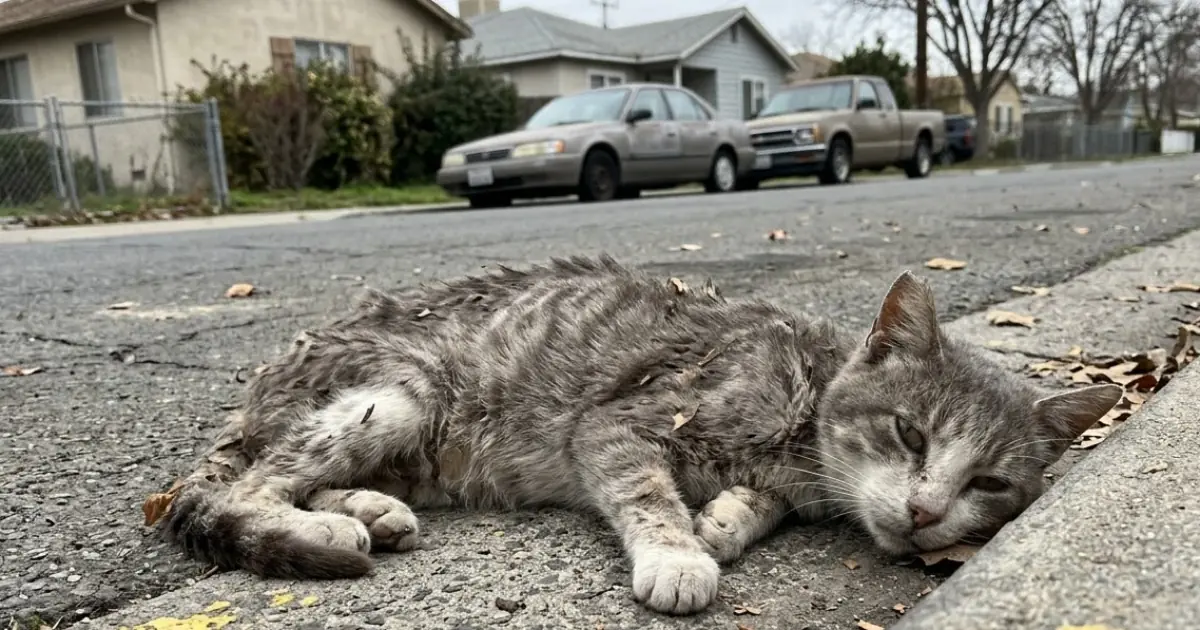
The gray-and-white cat was first noticed early in the morning on a quiet residential street.
He was lying on his side beside the curb, only a few feet from passing cars. His eyes were partly open, but the rest of his body remained motionless.
Several neighbors assumed he had been struck during the night.
One woman approached to move him away from the road before another vehicle came too close. As she crouched beside him, one of his front paws moved slightly against the pavement.
The cat was still alive.
She placed a towel beneath his body and called a local rescue organization. While waiting for help, she set a shallow bowl of water near his face.
The cat smelled it but could not raise his head far enough to drink.
When a rescuer arrived, she immediately noticed how thin he was. His ribs and hip bones were visible beneath his dirty, uneven coat. Dried leaves clung to his fur, and the white areas around his legs and chest had turned gray from prolonged exposure outdoors.
He did not attempt to run when she touched him.
That lack of resistance was more concerning than aggression would have been. Even frightened stray cats usually try to retreat, hiss, or protect themselves when approached by a stranger.
This cat appeared to have nothing left.
The rescuer wrapped him in the towel and lifted him carefully into a carrier. He opened his eyes during the movement but allowed his head to fall back onto the fabric.
The team began calling him Ellis.
At the emergency clinic, veterinarians first searched for injuries consistent with a vehicle impact. They found several superficial scrapes, worn paw pads, and an older wound near one ear, but no obvious fractures or major external trauma.
Ellis had not collapsed because he had just been hit by a car.
His body had been failing gradually.
He was severely dehydrated, dangerously underweight, and hypothermic despite the relatively mild weather. His gums were almost white, and his heart rate was weaker than expected.
Bloodwork revealed profound anemia.
A heavy flea infestation had been hidden beneath Ellis’s thick, dirty coat. Flea dirt covered his skin, particularly around his neck and back, and several areas had become inflamed from constant scratching.
For a healthy adult cat, fleas are uncomfortable. For a starving and already weakened cat, a severe infestation can contribute to dangerous blood loss.
But that was only part of the problem.
Further testing indicated that Ellis was also fighting an infection. A puncture wound beneath the fur near his shoulder had closed at the surface while infection continued developing underneath. The resulting abscess had begun draining internally through damaged tissue.
His immune system no longer had the strength to contain it.
The combination of prolonged hunger, dehydration, parasites, anemia, and infection explained why he had eventually collapsed beside the road.
Veterinarians could not determine how long Ellis had been living outside. The condition of his muscles suggested the weight loss had developed over weeks rather than days.
Someone may have seen him moving through the neighborhood before he became visibly ill.
Like many cats, Ellis likely hid his weakness for as long as he could. He may have slept beneath porches, behind sheds, or under parked vehicles, emerging only when he needed water or food.
By the time he remained exposed beside the curb, he was no longer capable of hiding.
Ellis was admitted for emergency treatment.
The veterinary team warmed him gradually and began administering carefully controlled fluids. Because his red blood cell level was dangerously low, staff prepared for the possibility that he might require a transfusion.
The infected area near his shoulder was opened, drained, and cleaned. He received antibiotics, pain medication, and treatment for fleas.
Food had to be introduced cautiously.
Ellis showed interest when a small dish of warmed wet food was placed near him, but he could manage only a few licks before lowering his head.
A technician offered tiny portions throughout the afternoon.
Each time the dish returned, Ellis opened his eyes. He still could not sit upright, but he began turning his nose toward the smell.