Some puppies enter the world inside quiet homes, surrounded by soft blankets and people waiting to welcome them.
This puppy’s first sounds were barking dogs, metal kennel doors and the hurried voices of shelter employees preparing for an emergency delivery.
His mother had arrived only the previous afternoon.
Animal control found the small, heavily pregnant dog wandering near a convenience store. She had no collar or identification, and no one in the surrounding neighborhood recognized her.
Her abdomen was large, her coat was dirty and the pads of her feet were worn. She accepted food immediately but remained nervous whenever anyone approached her from behind.
During her intake examination, shelter staff realized that she was close to giving birth.
They moved her away from the main kennel area and prepared the quietest room available. A plastic whelping pool was lined with clean blankets, and food and water were placed within easy reach.
The team began calling her Daisy.
Daisy paced through the night.
She repeatedly scratched at the bedding, circled the small room and lay down for only a few minutes before standing again. Shortly before sunrise, her contractions became stronger.
A staff member remained nearby while contacting the shelter’s veterinary team.
The first puppy arrived without complications.
Daisy immediately turned toward him, removed the membrane from his face and began licking him. He cried loudly and soon started searching for milk.
A second puppy followed.
Then came a third.
The third baby was much smaller than the others.
He emerged motionless inside the birth sac, and Daisy did not respond to him as quickly as she had to the first two. A staff member gently opened the membrane around his face and began rubbing his tiny body with a warm towel.
For several seconds, nothing happened.
Then the puppy drew one shallow breath.
A faint squeak followed.
The staff member continued rubbing him while another prepared oxygen and warmed blankets. The puppy’s tongue was pale, his body felt cool and his movements were much weaker than those of his siblings.
He was alive, but he was already struggling.
The team began calling him Bean because he was so much smaller than the others.
Once Bean was breathing more regularly, he was placed beside Daisy. She licked his head and pulled him toward her abdomen with her nose.
Bean tried to nurse.
His front paws moved weakly against his mother, but he could not remain attached to a nipple. Each time he found one, his mouth slipped away within seconds.
His stronger siblings unintentionally pushed him aside.
Shelter staff repositioned him several times, but he continued losing his place. He became tired so quickly that even lifting his head appeared difficult.
Newborn puppies cannot regulate their body temperature well. They depend on their mother, their littermates and a properly controlled environment to remain warm.
For Bean, becoming chilled would make nursing even harder. Without enough milk, his blood sugar could fall, leaving him weaker and less able to stay warm.
The cycle could become life-threatening very quickly.
Staff transferred Bean to a small heated incubator positioned beside Daisy’s whelping area. The clear enclosure allowed his mother to see and smell him while the team controlled his temperature and oxygen level.
Daisy stood when he was moved.
She followed the incubator and pressed her nose against its side. When Bean made a faint sound, her ears lifted immediately.
The staff kept him close enough that Daisy could remain aware of him.
The veterinarian examined Bean and found no obvious deformity. His heart was beating, but his breathing remained shallow and his suckling reflex was weak.
He may have been premature.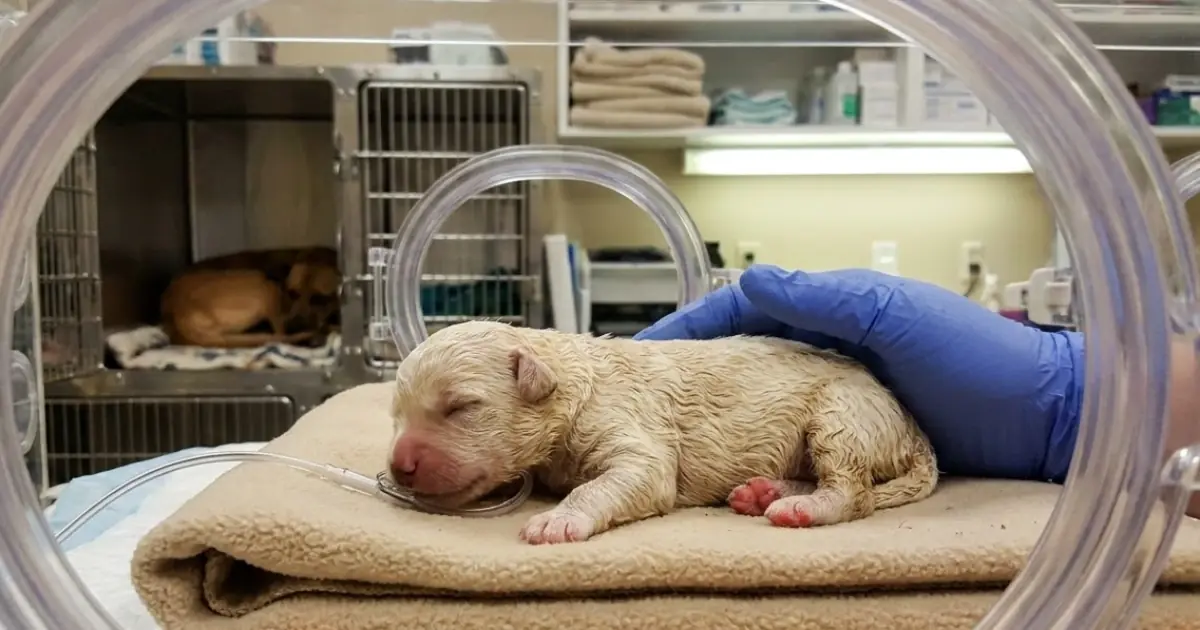
It was also possible that he had received less nutrition in the womb than his siblings or experienced difficulty during delivery. Without prenatal records or any history for Daisy, the team could not know exactly why he was so fragile.
What they did know was that he could not survive without help.
Bean was weighed and measured. He was significantly smaller than expected, even compared with the other puppies in the litter.
Because he could not nurse effectively, staff offered warmed puppy formula in carefully controlled amounts. Feeding a newborn in his condition required patience and caution.
If formula entered his airway instead of his stomach, he could develop aspiration pneumonia.
A caregiver held Bean in a natural belly-down position and placed a tiny amount of formula against his lips.
At first, he did not respond.
Then his tongue moved.
He swallowed one drop, rested and swallowed another.
The feeding took several minutes, although he consumed only a very small amount. When it was finished, Bean was returned to the controlled warmth of the incubator.
His condition remained uncertain.
Staff checked him frequently throughout the morning. They monitored his temperature, breathing and blood sugar while offering small feedings according to the veterinarian’s instructions.
Daisy continued caring for her other puppies.
She cleaned them, allowed them to nurse and curled around them protectively. But whenever Bean cried from inside the incubator, she raised her head and looked toward him.
Later that afternoon, the team tried placing Bean with his mother again.
Daisy immediately began licking him.
A staff member kept his stronger siblings slightly to one side and guided Bean toward a nipple. This time, he latched for several seconds.
Then his jaw stopped moving.
The caregiver gently stimulated him, but Bean was already exhausted. He was returned to the incubator before his temperature could fall.
Those few seconds showed that the instinct to nurse was present.
His body simply did not yet have the strength to keep going.
The first night became a continuous schedule of warming, feeding and monitoring.
Shelter employees divided the hours so Bean would never be left unchecked for long. The main kennel building became quiet, but the light in the maternity room remained on.
Every two hours, a caregiver prepared formula, checked the temperature and recorded how much Bean managed to swallow.
Some feedings went better than others.
During one, he drank several drops without stopping. During the next, he was too tired to respond and had to rest before trying again.
His weight was checked repeatedly.
For a newborn this small, even a slight loss could be serious.
Shortly after midnight, Bean’s body temperature began to fall.
Staff increased the controlled heat and contacted the veterinarian. His gums appeared paler, and he no longer moved when the enclosure door opened.
His blood sugar had dropped.
A carefully measured glucose supplement was given while the team continued warming him. Bean remained almost completely still inside the caregiver’s hands.
Daisy became restless on the other side of the room.
She stood over her puppies, then walked toward the incubator and began whining. A staff member sat beside her while another continued treating Bean.
For nearly an hour, there was little change.
Then Bean flexed one front paw.
A few minutes later, he lifted his head just enough to move it against the blanket.
His temperature slowly began to rise.
By sunrise, Bean was still fragile, but his blood sugar had returned to a safer level. He accepted a small feeding and produced a faint cry when he was placed back inside the incubator.
Daisy heard him immediately.
The team allowed her to approach while the enclosure was open. She gently licked Bean’s back, and he moved his head toward her warmth.
He was not yet strong enough to remain with the litter full-time.
But he had survived his first night.
Over the next two days, Bean continued receiving special care around the clock. His feedings remained small and frequent, and his temperature was checked before and after each one.
Staff also watched closely for any sign of infection or breathing difficulty.
Newborn puppies can decline very quickly. A baby who appears stable at one feeding may become critically weak by the next.
Bean’s progress came in tiny changes.
He began crying more loudly when hungry.
His mouth held onto the feeding nipple for longer periods.
When placed beside Daisy, he crawled toward her instead of remaining where the staff had set him down.
On his third day, Bean managed to nurse from his mother for nearly a minute.
A caregiver supported his body and kept the other puppies from pushing him away. Daisy lay completely still while he fed.
When Bean released the nipple, he did not immediately collapse.
He rested against his mother’s abdomen and began searching again.
It was the strongest he had appeared since birth.
The team continued supplementing him because he was not yet taking enough milk on his own. However, he was now spending short supervised periods with Daisy and his siblings.
Daisy accepted every reunion.
She cleaned Bean more thoroughly than the others and often rested her nose beside him while he slept. When staff returned him to the incubator, she watched until the door was closed.
No owner came forward for Daisy.
The shelter had posted her photograph and notified nearby clinics and rescue groups, but no one reported a missing pregnant dog matching her description.
It was impossible to know where she had lived before animal control found her.
Her worn paws suggested she had traveled some distance. Yet she remained comfortable around people, indicating that she had likely belonged to someone at some point.
Had Daisy given birth outside, Bean’s chances would have been extremely poor.
He could not stay warm on his own. He could not compete with his siblings for milk, and his blood sugar had already fallen to a dangerous level despite continuous monitoring.
In a parking lot, under a porch or beside the road, there may have been no one to notice him fading.
Instead, he was born inside a shelter where someone was watching.
One week after his birth, Bean remained smaller than his siblings, but he had begun gaining weight.
He could nurse for longer periods and no longer required oxygen. The incubator was still used between supervised visits with his mother, especially when staff could not continuously monitor the litter.
His care was not over.
Bean needed to continue gaining weight consistently before he could safely remain with the family overnight. The veterinary team also wanted to ensure that his lungs, heart and digestive system were developing normally.
Daisy and the other puppies remained in the shelter’s maternity room.
Although the setting was not a home, staff did everything possible to keep it quiet and predictable. The lights were dimmed between examinations, visitors were restricted and Daisy was given privacy to care for her litter.
Bean gradually became strong enough to stay beside her for several hours at a time.
He still lost his place during nursing, but he no longer stopped trying. When a sibling crawled over him, Bean pushed forward until he reached his mother again.
By the end of his second week, he had nearly doubled his birth weight.
He was not completely out of danger, but the weakest puppy in the litter was beginning to behave like the others.
His eyes remained closed, and his legs were not yet strong enough to support him. Still, he crawled across the blanket, protested when separated from Daisy and settled quickly when returned to her side.
Bean did not enter the world in a warm family home.
There was no nursery waiting for him and no owner counting the hours until his birth. His first bed was inside a shelter, and his earliest days were filled with medical checks, feeding schedules and controlled heat.
But he was not ignored.
From the moment staff realized he could not nurse, someone was there to warm him, feed him and make sure his tiny breaths continued.
Bean is now resting beside Daisy rather than alone inside the incubator.
He remains the smallest puppy in the litter, but when feeding time begins, he crawls through his larger siblings and holds tightly to his place beside his mother.
For the first time since he was born, no one has to help him stay there.