A Tiny Squirrel Was Found Alone in a Backyard — Keeping Her Alive Without Her Mother Became a Round-the-Clock Job
She was so small that when she arrived at our wildlife rehabilitation center, she fit almost entirely in the palm of a gloved hand.
The baby squirrel had been discovered earlier that morning in a backyard beneath a mature oak tree. The homeowner had gone outside expecting an ordinary start to the day when they noticed something moving near the edge of a flower bed. At first, they thought it was a large leaf shifting in the breeze.
Then the tiny animal moved again.
She was lying partly on her side in the grass, alone and exposed. Her eyes were still closed, her ears were only beginning to unfold away from her head, and a thin layer of short gray fur covered her body. She was clearly far too young to be wandering around on her own.
There was no adult squirrel nearby.
The homeowner backed away and watched the area from a distance, hoping the mother might return. That possibility is important whenever a healthy baby squirrel is found because a mother squirrel may retrieve a fallen youngster if she can safely reach it. Sometimes babies fall from damaged nests during wind or storms. In other cases, an entire nest can be disturbed when a tree is trimmed or a branch breaks.
For several hours, however, no mother appeared.
The baby remained on the ground.
As the morning went on, the temperature began to change, and concern grew that leaving such a young animal exposed much longer could become dangerous. By the time advice was sought and arrangements were made to bring her to us, she had been alone for an unknown number of hours.
When we first examined her, the most immediate concern wasn't an obvious wound.
It was how cold she felt.
Very young squirrels aren't yet equipped to regulate their body temperature as effectively as healthy adults. Normally, a baby this age would spend most of her time pressed against her mother and littermates inside a protected nest. Without that warmth, a tiny body can lose heat quickly.
She was also quiet.
Not peacefully quiet, but the kind of stillness that makes wildlife rehabilitators pay attention.
Her limbs moved when she was handled for assessment, and she responded to touch, but the movements were weak. Her skin and overall condition also raised concern that she had gone some time without nursing.
At this age, even several missed feedings can matter.
There was one encouraging finding: we couldn't identify an obvious major traumatic injury. There was no visible bleeding, no clearly deformed limb, and nothing immediately suggested that she had suffered catastrophic damage when she reached the ground.
That meant we could focus on the problem directly in front of us.
Before feeding her, we needed to warm her.
People understandably associate rescuing an orphaned baby animal with immediately offering milk, but a chilled neonate requires careful stabilization. Feeding an animal whose body temperature and condition aren't appropriate can create additional problems. The first stage of care was therefore controlled warmth, quiet, and assessment rather than trying to make her drink as quickly as possible.
We prepared a small, secure space with soft nesting material and a carefully controlled heat source that allowed her to remain warm without being directly exposed to excessive heat.
Then we waited.
During those first hours, staff checked her frequently while keeping handling to a minimum.
Slowly, her body temperature improved.
The change in her behavior was subtle at first. She began shifting beneath the bedding rather than remaining in exactly the same position. When touched during a check, her response became stronger.
One member of the rehabilitation team commented that she kept burrowing so deeply into the fleece that only the top of her head remained visible.
By the end of the day, someone had started calling her Clover, partly because she'd been discovered tucked into the greenery of a backyard garden.
The name stuck.
Clover had survived the first hurdle, but keeping a squirrel this young alive without her mother meant trying to replace a system that nature normally provides almost continuously.
A mother squirrel doesn't simply deliver calories.
She provides warmth, protection, grooming, stimulation, and the social environment in which her babies develop. In rehabilitation, we can support many of those physical needs, but the goal is never to turn a wild baby into a pet.
Our job was to help Clover grow into a squirrel that eventually wouldn't need us at all.
Once she was warm and stable enough, her feeding plan could begin.
This wasn't a matter of giving her ordinary cow's milk from the refrigerator. Wildlife rehabilitators use species- and age-appropriate nutrition protocols, and the amount and frequency of feeding have to reflect the animal's size, hydration, condition, and developmental stage.
Clover was weighed so her progress could be followed objectively.
Her early feedings were careful and controlled.
Young squirrels can aspirate liquid if feeding is rushed or delivered incorrectly, meaning fluid can enter the respiratory tract rather than being swallowed normally. That is one reason attempting to syringe-feed a baby squirrel at home without guidance can be risky.
For Clover, every feeding required patience.
At first, she wasn't particularly enthusiastic.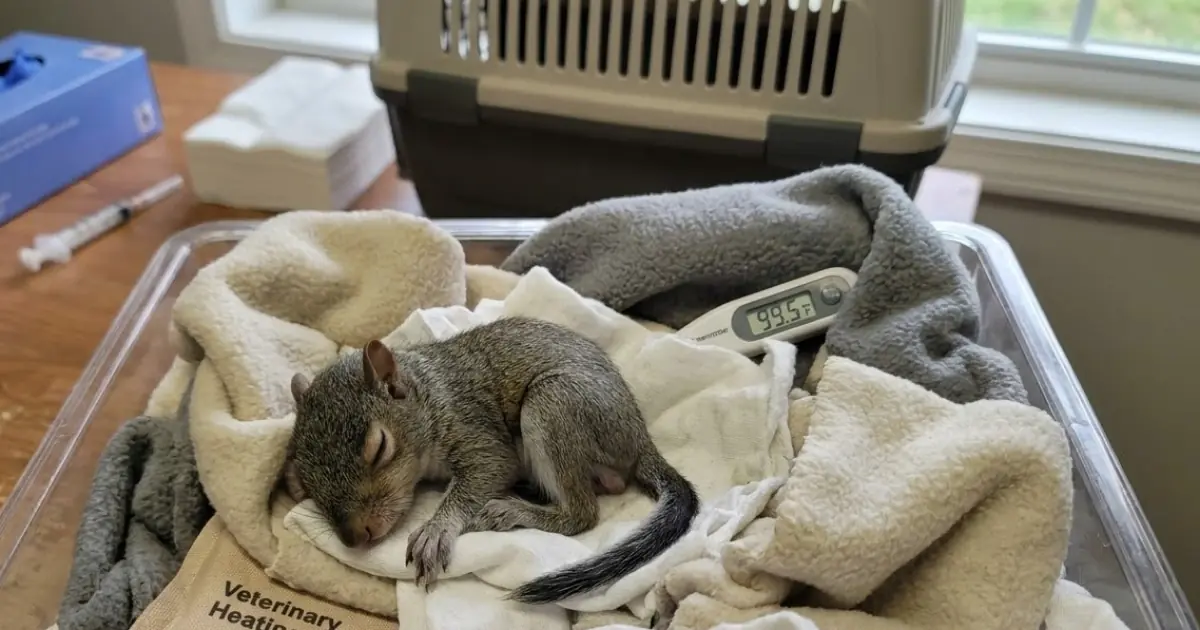
She would take a small amount and then stop. Her body still seemed focused more on recovering from being cold and depleted than on aggressively feeding.
Later that night, something changed.
When it was time for another feeding, Clover began actively searching.
Her tiny front paws pressed forward. Her head moved from side to side. Instead of simply accepting what was offered, she behaved like a hungry baby trying to find her mother.
It was one of the first moments when we felt we were seeing more than survival.
We were seeing strength returning.
The next several days revolved around a repetitive schedule that would have been almost invisible from the outside: warm, feed, monitor, clean, weigh, repeat.
Baby wildlife rehabilitation often isn't dramatic.
There may be no major surgery and no miraculous overnight recovery. Sometimes success is measured in grams.
Clover began gaining them.
Her body became fuller. Her movements became more deliberate. The thin fur along her back thickened, and her tail slowly began developing the fuzzy outline that would eventually become one of the most recognizable features of an adult squirrel.
Then her eyes began to open.
One morning there was only a narrow slit.
By the following day, she was looking out at the strange world around her.
That developmental milestone also meant our relationship with her needed to begin changing.
A tiny squirrel with closed eyes can do little more than eat, sleep, and seek warmth. An older baby starts exploring. Soon after that comes climbing, chewing, jumping, and learning how to navigate a three-dimensional environment.
Clover's enclosure changed as she changed.
She needed room to move safely and opportunities to develop the muscles and coordination that had little purpose when she was still curled inside a nest.
Before long, she was attempting to climb anything she could grip.
Her first efforts weren't impressive.
She would pull herself upward, pause, reconsider the decision, and occasionally end up back in the bedding below.
But squirrels are built to climb.
Within a relatively short period, Clover went from a baby that needed to be kept warm simply to maintain her body temperature to a young squirrel determined to reach the highest available perch.
Her diet evolved too.
Milk replacement could not remain her entire nutritional world forever. As her developmental stage advanced, appropriate solid foods and natural items were introduced gradually as part of the transition toward independence.
This stage is especially important because a squirrel preparing for life in the wild needs to learn far more than how to accept food from a human hand.
We wanted Clover investigating.
Chewing.
Manipulating objects with her paws.
Searching for food.
Choosing secure sleeping locations.
And, increasingly, avoiding us.
That last part can feel strange to people unfamiliar with wildlife rehabilitation.
When Clover was tiny, human intervention was the reason she survived.
But if she continued to associate people closely with comfort and food as she matured, that could become a disadvantage after release.
So as her condition improved, direct interaction was reduced to what was necessary for her care.
She didn't object.
The affectionate-looking infant behavior disappeared surprisingly quickly.
Clover became busy.
Then cautious.
Then fast.
Eventually, opening her enclosure for routine care meant watching a young squirrel disappear upward before we had much chance to look at her.
That was progress.
There was another challenge we had to consider as she developed: Clover had arrived without her mother and apparently without any siblings.
Whenever circumstances and health considerations allow, young squirrels can benefit from being raised alongside compatible squirrels of a similar developmental stage. They are not supposed to grow up believing that humans are their family.
Later in Clover's rehabilitation, an opportunity arose to place her with other young squirrels receiving care.
The introduction was monitored carefully.
At first, Clover kept some distance.
Then the distance became smaller.
Before long, the young squirrels were resting together.
For an orphan that had spent her first night with us curled alone beneath artificial warmth, seeing her sleep pressed against other squirrels felt like another important step toward giving back something she had lost when she fell from that tree.
From there, the changes came quickly.
Clover became stronger and increasingly independent. Her tail filled out. Her balance improved. Her claws became tools she used constantly rather than tiny features we carefully examined during intake.
She could move vertically almost as easily as horizontally.
She began making the rapid, unpredictable direction changes that make healthy squirrels so difficult to follow.
And she no longer needed the kind of intensive feeding schedule that had defined her earliest days with us.
Eventually, the squirrel we had spent so much time trying to keep warm was spending her days climbing, exploring, foraging, and interacting with other squirrels while maintaining distance from people.
That is the direction we want rehabilitation to take.
At the time of this update, Clover is continuing to mature while we evaluate the behaviors and physical abilities she will need before release. Her story isn't finished simply because she survived infancy.
A releasable squirrel must be physically healthy, appropriately developed, capable of finding and processing natural foods, able to climb and navigate effectively, and behaviorally prepared for life without human assistance. Timing and suitable habitat matter as well.
For now, she is doing what a young squirrel should be doing: growing increasingly difficult to care for.
She doesn't wait patiently for us.
She doesn't seek out human attention.
And she certainly doesn't spend her days curled quietly inside the tiny nest where we first placed her.
Those changes are exactly what we hoped for.
Clover's case is also an important reminder that finding a baby squirrel alone doesn't automatically mean it has been abandoned. Mother squirrels may retrieve babies that have fallen from a nest, and when a baby is uninjured and conditions are safe, wildlife professionals may recommend attempting reunification before assuming the youngster is orphaned.
The circumstances matter.
A visibly injured baby, a cold or unresponsive animal, known death of the mother, immediate danger, or a failed reunification attempt can change what should happen next. Domestic pets and other hazards around the site also have to be considered.
That's why contacting a licensed wildlife rehabilitator for guidance can be so valuable before feeding or attempting to raise a baby squirrel at home.
Baby squirrels are extraordinarily appealing animals.
That also makes them easy to accidentally habituate.
But successful wildlife rehabilitation has a different goal from raising a companion animal. Every warm feeding, every overnight check, every gram gained, and every enclosure change is ultimately supposed to lead toward separation.
Clover came to us because, at an age when she should have been sleeping beneath her mother's body in a nest high above the ground, she was lying alone in someone's garden.
That first day, she couldn't even keep herself adequately warm.
We had to do it for her.
For a while, we also had to provide the nutrition, protection, and careful monitoring that her mother normally would have provided.
But those jobs were always temporary.
Now Clover can climb away from us faster than we can approach her. She sleeps alongside other squirrels rather than depending on human contact. She investigates her environment, handles food on her own, and is steadily becoming less interested in the people responsible for her care.
Eventually, if she continues meeting the milestones required for release, even the enclosure protecting her will become unnecessary.
And that will be the real measure of what happened after someone looked down into a backyard flower bed and found a tiny squirrel who was still far too young to survive there alone.