The wagon climbing the long dirt track toward Martha Higgins’s farm carried no flour, no seed, no tools, and no good news.
It carried a man the town had already decided was worthless.
Martha noticed the wagon because there was no reason for anyone to visit her in the middle of August. The nearest neighbor lived almost four miles away, and most people in Willow Plains preferred keeping that distance from the heavy widow who had spent two years refusing every suggestion that she sell her property and move somewhere more “suitable.”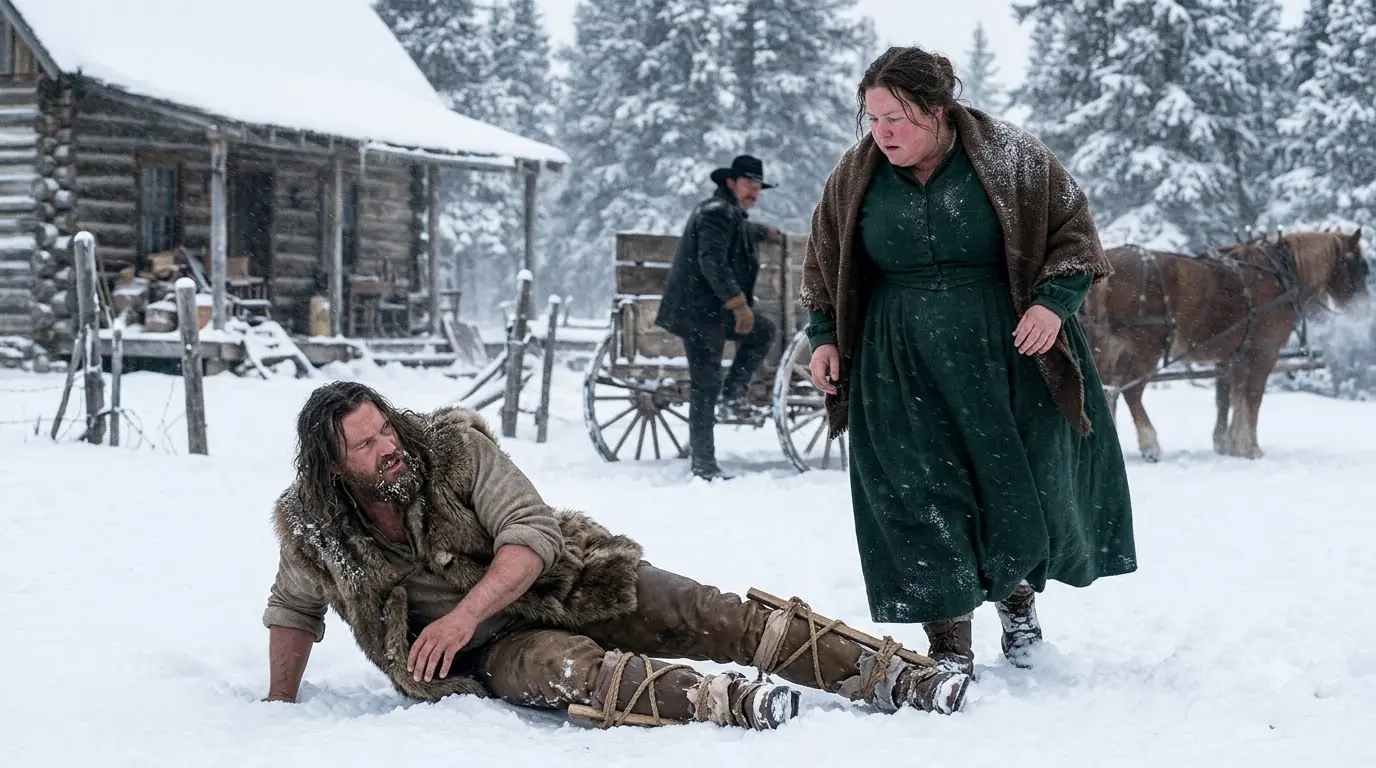
She was standing beside a wooden washtub beneath the cottonwoods, sleeves rolled above thick forearms, when the wagon wheels groaned through the gate.
The afternoon heat had baked the plains until cracks zigzagged across the earth. Sweat darkened the collar of Martha’s forest-green work dress, and damp strands of brown hair clung to her broad round face.
At forty-four, Martha weighed close to five hundred and fifty pounds.
There was no delicate way to describe her.
She was enormous.
Her arms were thick enough that sleeves had to be altered twice before they fit. Her hands were large, soft across the palms but calloused at the fingertips. Her legs were massive beneath the skirts she sewed herself because no shop in Willow Plains carried anything remotely close to her size.
People had spent years acting as though her body were an argument they had won merely by looking at it.
Her late husband, Elias, had been different.
He had called her strong.
Not as consolation.
As fact.
Elias had been dead for almost two years.
Since then, the town had returned to deciding what Martha’s body meant.
Too large to remarry.
Too cumbersome to run a farm.
Too expensive to feed.
Too much woman and somehow not enough of the kind they respected.
Martha plunged another shirt into the gray wash water and looked toward the gate.
Amos Higgins sat behind the wagon reins.
That alone was reason for suspicion.
Amos was Elias’s younger brother, a thin, narrow-eyed cattle buyer with a chewing habit and a permanent expression suggesting someone else had just made a mistake he intended to profit from.
He grinned when he saw her.
Martha straightened.
“What do you want?”
Amos brought the wagon to a stop.
“Good afternoon to you too.”
“I asked what you want.”
“Brought you something.”
“I ain’t buying.”
“It’s free.”
“That makes me more suspicious.”
Amos spat tobacco into the dust.
“You really ought to work on gratitude, Martha.”
“You really ought to work on leaving.”
His grin widened.
Then Martha heard movement in the wagon bed.
Not cargo.
A person.
She stepped around the washboard.
“What’s back there?”
Amos climbed down.
“The council had a meeting.”
“That never ends well.”
“They’ve been trying to figure what to do with him.”
Martha approached the wagon.
Then stopped.
A man lay in filthy straw beneath a torn gray blanket.
He was huge.
Even half-starved, he looked built from the same material as bridge timbers.
Broad shoulders.
Massive arms.
A thick chest barely covered by a dirty shirt cut open near the collar.
Long dark-brown hair lay tangled around a weathered face, and a heavy beard obscured most of his jaw.
His legs were wrapped in crude splints.
Neither moved.
The man looked at Martha.
His eyes were pale blue.
There was pain in them.
But pain was not what struck her.
Humiliation was.
Amos slapped the wagon rail.
“Found him after the ridge accident.”
Martha kept watching the stranger.
“What accident?”
“Bear.”
The man in the wagon looked toward Amos.
Something flickered across his face.
Martha noticed.
“Bear crushed him?”
“Near enough.”
Amos shrugged.
“Back’s ruined. Legs are dead. Poorhouse says they’ve got no room. Doctor says he might last a month, might last ten years. Nobody wants to spend money finding out.”
Martha turned slowly.
“And what has any of that got to do with me?”
Amos smiled.
“The council thought you could provide Christian charity.”
Martha’s eyes narrowed.
“Did they.”
“Well, you’ve got space.”
“No, I don’t.”
“You’ve got food.”
“Barely.”
“And you’re strong enough.”
There it was.
Martha’s jaw tightened.
“Strong enough for what?”
Amos looked deliberately over her body.
“Bearing weight.”
The stranger’s eyes closed briefly.
He understood the joke.
So did Martha.