Rosa Valdés’s hands were almost numb when she heard the horse.
At first she told herself not to look.
Looking did not change who came down the narrow trail toward the house.
It did not make debts disappear.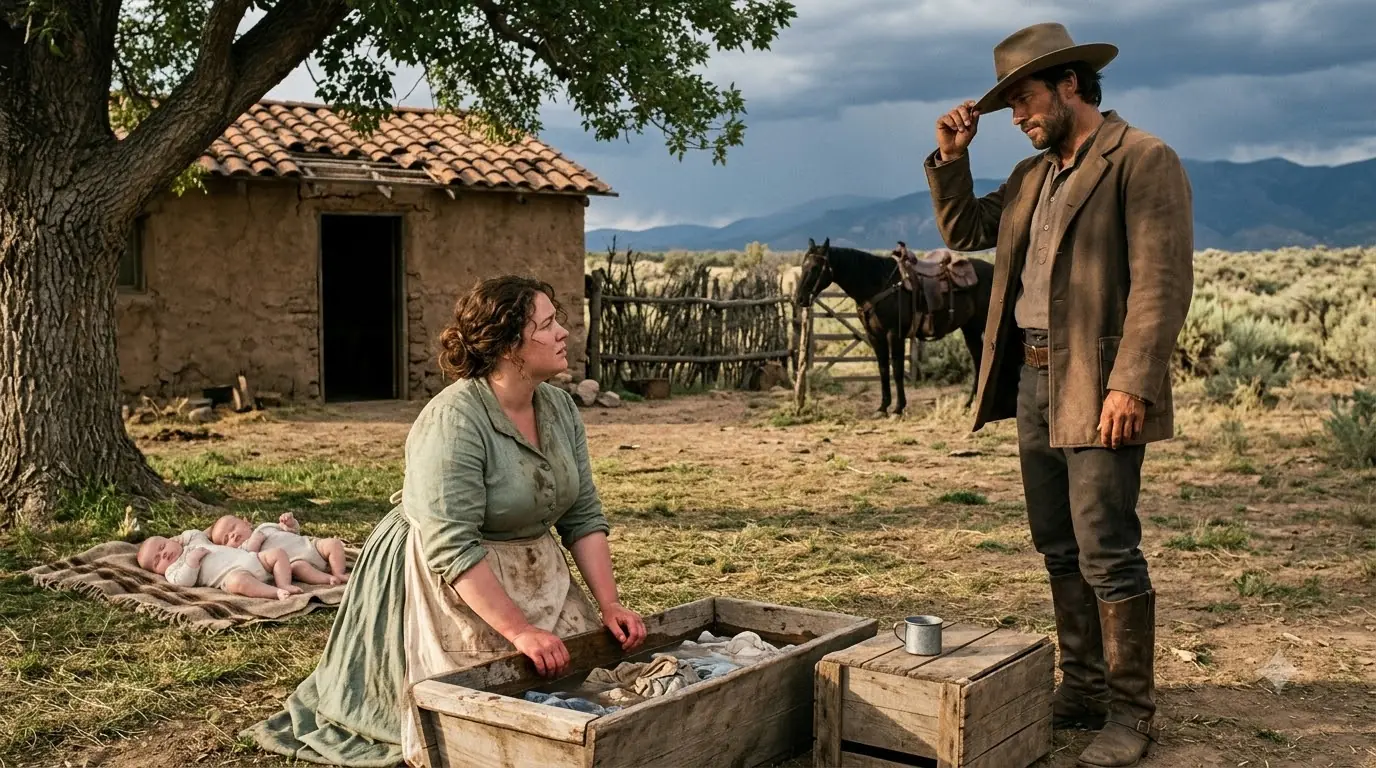
It did not put flour back in the kitchen jar.
It did not repair a leaking roof or persuade babies to sleep through the night.
And it certainly did not bring Julián back.
So Rosa kept both hands submerged in the wash trough and dragged a man’s work shirt across the wooden board until gray water ran from the cloth.
The shirt belonged to the baker’s eldest son in San Isidro.
His mother would pay Rosa twelve cents when she delivered it clean and pressed.
Twelve cents mattered.
Everything mattered now.
A bar of soap mattered.
Two eggs mattered.
A broken needle mattered.
An hour of daylight mattered.
Five months earlier, Rosa had known what tomorrow would look like.
Julián would rise before sunrise.
He would complain that the rooster had no understanding of civilized hours even though he woke before the bird every morning.
Rosa would feed the fire.
He would milk the goat.
They would argue over whether Tomás or Lucía had cried first during the night.
Then Julián would kiss both children and leave to work.
Life had been poor.
But it had been shaped.
Now every morning arrived like loose fabric Rosa had to sew together before it unraveled.
The hoofbeats grew louder.
She finally lifted her head.
Her six-month-old twins slept beneath the old ash tree several yards from the trough.
Tomás lay on his back with one tiny fist curled beside his cheek.
Lucía had rolled toward him until her round cheek rested against his shoulder.
A woven blanket protected them from the dirt, and Rosa had positioned an overturned wooden crate nearby to block the coldest wind.
She checked them first.
Always.
Then she looked toward the road.
The rider coming through the mesquite was not Silas Mercer.
Rosa released a breath she had not realized she was holding.
Silas usually rode a gray gelding with polished tack and a silver-studded saddle that announced him before he opened his mouth.
The approaching horse was dark bay and dust-coated.
Its rider wore a plain brown coat, dark riding breeches, and boots that had traveled far enough to lose any interest in appearance.
He was a tall man, perhaps thirty-five, broad through the shoulders but not built with the exaggerated heaviness of men who spent more time impressing saloons than working ranches.
Dark hair curled slightly beneath his hat.
A short beard shadowed a weathered face.
He slowed well before reaching the fence.
That mattered too.
Silas Mercer never slowed.
Silas entered property as though ownership were merely waiting for him to announce itself.
This stranger stopped several paces from the gate, dismounted, and removed his hat.
“Forgive the intrusion.”
Rosa said nothing.
The man glanced toward the stone spring beside the wash trough.
“Could I trouble you for some water?”
His horse was sweating.
The man himself looked nearly as thirsty.
Rosa studied him.
Since Julián’s death, kindness had acquired conditions.
A sack of flour from one neighbor became an invitation to discuss whether she should remarry.
A repaired fence post became an excuse for another man to suggest she owed him dinner.
Offers to “help with the property” somehow always ended with somebody asking what price she would accept for it.
Rosa had become skilled at hearing the sentence behind the sentence.
This stranger’s request sounded like exactly what he said.
Water.
Nothing else.
Still, she did not open the gate.
She filled a metal cup from the spring.
Then she placed it on the fence post.
“You can drink there.”
The stranger nodded.
“The cup doesn’t leave this side.”
One corner of his mouth moved.
Not mockery.
Approval, perhaps.
“You’re right to be cautious.”
He took the cup.
Drank slowly.
Then set it exactly where she had left it.
That detail bothered Rosa.
Not because it was wrong.
Because it was right.
People who wanted something often tried too hard to appear respectful.
This man did not perform respect.
He simply behaved as though boundaries existed whether he liked them or not.
A faint cry came from beneath the ash tree.