A Young Eastern Gray Squirrel Was Found Flattened Beneath a Tree After the Storm — One Swollen Leg Was Only the First Concern
When the young eastern gray squirrel arrived at our wildlife rehabilitation center, he was lying on his side with his head pressed flat against the absorbent pad beneath him.
He wasn't trying to climb out of the carrier.
He wasn't even trying to sit up.
The fur covering his belly and tail was still wet, muddy, and clumped together from the storm that had passed through the area earlier that day. Several patches along his side looked thin and ragged, as though fur had been rubbed or pulled away. One rear leg was visibly swollen compared with the other, and when he shifted slightly, he made no attempt to place weight on it.
The person who found him had gone outside after hours of heavy rain to inspect the yard for fallen branches. Beneath one of the larger trees, close to where rainwater had washed leaves and small twigs into a shallow pile, they noticed a gray shape in the grass.
At first, the squirrel looked dead.
Only after getting closer did they see his chest moving.
There was no obvious nest on the ground, and no one had seen the moment he came down. A storm can leave a young squirrel on the ground for several reasons. A nest may be damaged, a branch may break, or a youngster old enough to move around the nest can fall during severe weather. In this case, we couldn't know exactly what happened.
His swollen leg made a fall or other traumatic event a serious possibility.
What concerned us just as much, however, was what had happened afterward.
He may have spent a significant amount of time exposed to rain.
By the time he was discovered, his underside was soaked. Mud had dried in some areas while other sections of fur remained cold and wet. For a compromised young animal, prolonged exposure can turn an injury into a much larger emergency.
At intake, our immediate priority wasn't washing the mud from his coat.
It was stabilizing him.
He was weak, cold, and minimally responsive. His breathing was monitored, and handling was kept as limited as possible while we looked for additional injuries. The swollen rear leg was obvious, but trauma isn't always limited to what can be seen externally. A squirrel found beneath a tree after a severe storm could potentially have injuries involving the chest, abdomen, head, or other limbs.
For now, the safest thing we could give him was controlled warmth and quiet.
He was transferred onto clean, dry material and placed in an appropriately warmed recovery space. Rather than aggressively scrubbing the mud from his fur, the worst moisture and debris were dealt with carefully while avoiding unnecessary manipulation of his injured body.
For nearly an hour, he barely changed position.
Every few minutes his nose moved.
Occasionally one front paw flexed against the pad.
Then his head lifted perhaps an inch before slowly dropping again.
It wasn't much, but it was the first deliberate movement we had seen.
As his temperature and responsiveness improved, we were able to assess him more thoroughly. The rear leg remained concerning. Swelling extended around part of the lower limb, and he continued to avoid using it. There were also superficial abrasions beneath some of the damaged fur, although we found no large open wound.
The ragged coat told its own story.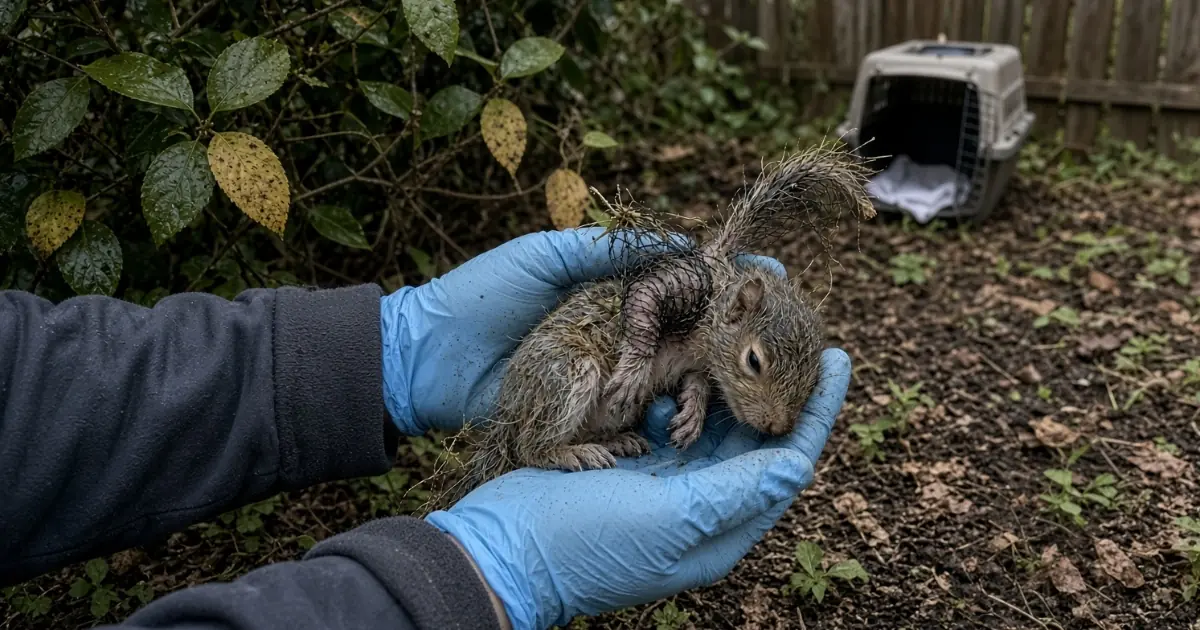
Whether some of that damage had happened during the fall, while he struggled through wet vegetation, or from lying exposed on rough ground wasn't something we could determine with certainty. Wildlife patients rarely arrive with witnesses who can explain every injury.
We work with what their bodies tell us.
This squirrel's body was telling us that he had been through more than a wet afternoon.
Veterinary assessment was needed to evaluate the injured leg and determine whether we were dealing with a fracture, significant soft-tissue trauma, or another type of injury. Until we knew more, his movement had to remain restricted. A young squirrel may begin climbing as soon as he feels slightly better, even when his body isn't ready for it.
So his first recovery enclosure was deliberately uncomplicated.
No high branches.
No opportunities for ambitious jumps.
Just a protected place where he could remain warm, dry, and quiet.
That evening, one of the caregivers checking the enclosure noticed that he had finally moved away from the exact spot where he'd been placed. He had pulled himself partly underneath a folded piece of fleece and tucked his face into the corner.
Someone began referring to him as Rainy because every part of his intake—the soaked coat, the muddy tail, the fallen branches—seemed tied to the storm.
Another caregiver shortened it to Rain.
That was the version that stayed.
By the following morning, Rain looked different.
Not well.
But different.
His head was upright.
When the enclosure was approached, his eyes followed the movement. He attempted to pull himself farther into the protected area rather than simply remaining where he was.
His injured leg still wasn't being used normally, but the rest of him seemed more connected to his surroundings.
For a wildlife patient that had arrived nearly flattened against a pad, that was meaningful progress.
The next several days were much less dramatic than his arrival.
Rain slept.
He ate according to the nutritional plan appropriate for his age and condition.
He was monitored.
His injuries were reassessed.
And we waited to see what the swollen leg would do.
Fortunately, evaluation did not reveal the kind of devastating injury we had initially feared. The leg had sustained significant trauma and swelling, but the focus could remain on supportive treatment, controlled activity, and careful monitoring rather than immediately facing the loss of normal limb function.
That didn't mean he was ready to use it.
During the early days, Rain moved using three legs whenever possible. If he needed to reposition himself, the injured hind foot might briefly touch the bedding, but he quickly shifted his weight away again.
We didn't force the issue.
Pain and swelling need time.
Meanwhile, the rest of his condition continued improving.
Once his coat had dried and the remaining dirt could be managed safely, the difference in his appearance became striking. The gray fur across his back began fluffing normally again, although the damaged patches along his side remained thin and uneven.
His tail looked particularly rough.
The normally soft developing fur had arrived twisted into wet clumps. As it dried and recovered, it still looked far less full than that of a healthy young squirrel.
But the tail moved.
That mattered more than whether it looked perfect.
Rain also started eating with increasing enthusiasm.
At first, feeding had been another part of supportive care for a depleted patient. Soon, he began anticipating it.
Then he became impatient.
And finally, he started behaving as though our presence was an inconvenience.
That was when we knew another part of Rain was returning.
Wild squirrels aren't supposed to enjoy being handled by people. As he became stronger, we wanted to see him become more alert, more independent, and less tolerant of unnecessary proximity.
One morning, a caregiver opened his enclosure and Rain immediately pulled himself into the far corner.
He still had a limp.
But he was fast enough to make his opinion clear.
Leave me alone.
Perfect.
Over the following week, the swelling in his hind leg gradually decreased. Then came the change we had been waiting for.
Rain placed the foot down and left it there.
At first, he used it only for balance.
A few days later, he began putting more weight through the limb while walking.
We watched carefully for setbacks. Increased activity can sometimes reveal problems that aren't obvious while an animal is resting, so his progression couldn't simply be based on enthusiasm.
Rain had plenty of enthusiasm.
What he needed was function.
As his leg improved, his enclosure was gradually adjusted to allow more natural movement without immediately giving him access to challenging heights.
He started climbing low surfaces.
The first attempts were cautious. He relied heavily on his front legs and healthy rear limb to push himself upward.
Then the injured leg began joining in.
One afternoon, Rain climbed onto a low branch and remained there with all four feet gripping securely.
For most squirrels, sitting on a branch would be completely ordinary.
For Rain, it was one of the biggest milestones since the storm.
His world expanded from there.
The low recovery setup gave way to an environment that allowed increasingly complex climbing and movement as his condition permitted. Rain began moving vertically. He practiced balancing and changing direction. As his strength returned, short controlled jumps became part of his normal activity.
The awkward three-legged movement became harder to see.
Then, during ordinary movement, it became difficult to see at all.
His damaged coat took longer to catch up.
Some areas remained visibly thin even after the underlying abrasions had healed. Fur recovery doesn't happen overnight, and coat condition is something that matters for an animal returning to outdoor conditions, particularly when insulation and weather protection are involved.
So while Rain seemed increasingly convinced that he was finished with rehabilitation, we weren't.
A squirrel doesn't become releasable simply because he can run across an enclosure.
He needs to function as a squirrel.
That means climbing quickly and confidently, gripping bark, balancing, jumping accurately, foraging, responding appropriately to danger, and remaining physically capable of escaping threats.
Rain also needed to demonstrate that the injured hind leg could tolerate normal activity rather than only short periods of movement.
We continued watching.
He continued making that increasingly difficult.
The quiet animal that once allowed us to stand nearby without moving now disappeared as soon as someone approached. Sometimes all we saw was his tail slipping behind a climbing structure.
Even that tail was changing.
The wet, muddy strip of fur from intake had gradually begun filling out. The uneven patches across his body were less conspicuous, and his overall condition increasingly resembled that of a healthy juvenile squirrel rather than a storm patient.
At the time of this update, Rain remains in rehabilitation while we continue evaluating his readiness for the next stage.
He is warm without supplemental support, eating independently, moving actively, and using the previously swollen hind leg far more normally. His climbing ability has improved considerably, and his avoidance of people has strengthened along with his body.
Those are all encouraging signs.
His story is also a reminder that a young squirrel found beneath a tree after severe weather shouldn't automatically be assumed to be orphaned—or immediately taken home and fed.
Depending on the baby's age, injuries, temperature, exact circumstances, and whether the mother is still present, reunification may sometimes be possible. A mother squirrel may return for a displaced youngster when conditions allow.
But an animal that is injured, cold, weak, unresponsive, or otherwise compromised requires a different response.
Rain wasn't simply sitting beneath a tree waiting for his mother.
He was lying on his side.
His coat was soaked through.
One leg was badly swollen.
And he didn't have enough strength to lift his head for more than a moment.
Those were the details that changed his situation from a young squirrel temporarily on the ground to an animal in need of professional assessment and rehabilitation.
We still don't know exactly what happened above that yard during the storm.
Maybe Rain fell when part of his nest or branch was damaged.
Maybe he lost his footing while the tree was being battered by wind and rain.
There was no witness, and we won't invent an answer that his injuries can't provide.
What we do know is what happened afterward.
A tiny gray body that could barely move was spotted beneath a tree.
Rain arrived wet, muddy, injured, and exhausted.
He spent his first hours here lying almost exactly where we placed him.
Now, when someone enters his rehabilitation space, keeping track of where he went is becoming the difficult part.
If his leg, coat, strength, and wild behaviors continue moving in the right direction, the goal is that one day soon we won't have to keep track of Rain at all.
He'll be back where a young eastern gray squirrel belongs—somewhere above our heads, on four strong legs, with a tree beneath his claws and no rehabilitation pad waiting below.