A Young Raccoon Came Out of Emergency Treatment With His Front Leg Wrapped — He Was Still Too Weak to Lift Himself From the Fleece
When the young raccoon was transferred into his recovery enclosure after emergency treatment, he didn't try to stand.
He didn't investigate the unfamiliar bedding or reach toward the walls with the curious front paws we normally associate with a healthy juvenile raccoon.
Instead, he remained almost completely flat against the fleece.
A large section of fur had been shaved from one shoulder and across part of his upper chest so the veterinary team could properly examine and treat the injured area. The exposed skin made his small body look even more vulnerable. One front leg was wrapped in a clean protective bandage, and the other was tucked weakly beneath him.
His head rested sideways on the fleece.
Every few moments, his nose moved.
Otherwise, there was very little activity.
Only hours earlier, he had arrived as an emergency trauma patient.
The young raccoon had been discovered near the edge of a residential property, partially concealed beneath low shrubs. The person who spotted him initially noticed that he was moving strangely. Instead of walking away when approached from a distance, he attempted to pull himself forward while keeping one front leg off the ground.
After only a short distance, he stopped.
There was no mother nearby, and no one had witnessed whatever caused the injury.
The shoulder and front leg immediately raised concerns when he reached professional care. The fur around the area was dirty and matted, and swelling made it difficult to determine the full extent of the trauma from the outside. Several abrasions were present, and he reacted when the injured region was examined.
Exactly what had happened remained uncertain.
He may have suffered a fall or collision. Another animal could have been involved. He might have become caught somewhere and injured himself while struggling to escape.
Without a witness, those possibilities remained possibilities.
What wasn't uncertain was how compromised he had become.
By the time he arrived, the raccoon was weak, stressed, and unable to use the affected front limb normally. His condition warranted veterinary evaluation and urgent treatment rather than simply cleaning the visible injuries and waiting.
The shoulder area had to be clipped so the team could see what was hidden beneath the dense coat.
Once the fur was removed, the extent of the superficial trauma became clearer. The skin across portions of the shoulder and upper limb was irritated and damaged, and the leg itself needed protection and restricted use while the underlying injury was evaluated and managed.
The wounds were addressed appropriately, the affected area was cleaned and treated, and the front limb was supported with a protective bandage as indicated by his veterinary care plan.
But completing emergency treatment didn't mean the crisis had passed.
That became obvious when he entered recovery.
For the first hour, the young raccoon remained almost exactly where he had been placed.
One caregiver adjusted the fleece around him so he could rest without needing to reposition his injured shoulder. He opened his eyes briefly, followed the movement, and then lowered his head again.
Someone commented that he looked as though all the energy had simply drained out of him.
That evening, the team began calling him Otis.
There wasn't a complicated reason for the name. One of the caregivers used it while updating the treatment notes, another person repeated it during the next check, and somehow it stayed.
For the rest of that first night, Otis needed very little from us emotionally and a great deal from us medically.
He needed quiet.
He needed an appropriately controlled recovery environment.
He needed monitoring.
He needed the injured area and bandage checked without repeatedly disturbing him.
And he needed time for his body to recover from both the original trauma and the stress of emergency treatment.
Because he was still so weak, the enclosure was intentionally simple.
There were no climbing structures.
No elevated shelves.
No branches.
For a healthy raccoon, that environment would have been boring.
For Otis, it was protection.
Even an injured juvenile may attempt to climb if frightened, and the last thing his shoulder needed was another fall or a sudden load through the recovering limb.
His fleece-covered floor allowed him to remain low and supported.
Through the night, staff watched his breathing, responsiveness, posture, and ability to reposition himself. The exposed shaved area made it easier to monitor the treated skin, while the wrapped front leg was checked for changes that might indicate swelling or problems with the bandage.
For several hours, progress was almost invisible.
Then Otis moved.
He didn't stand.
He simply pulled the uninjured front paw farther underneath his chest and lifted his head.
This time, instead of immediately dropping it back onto the fleece, he held it there.
A few seconds became ten.
Then he lowered himself again.
For a young raccoon that should normally be climbing, grabbing, and investigating everything within reach, holding up his own head shouldn't have been remarkable.
That night, it was.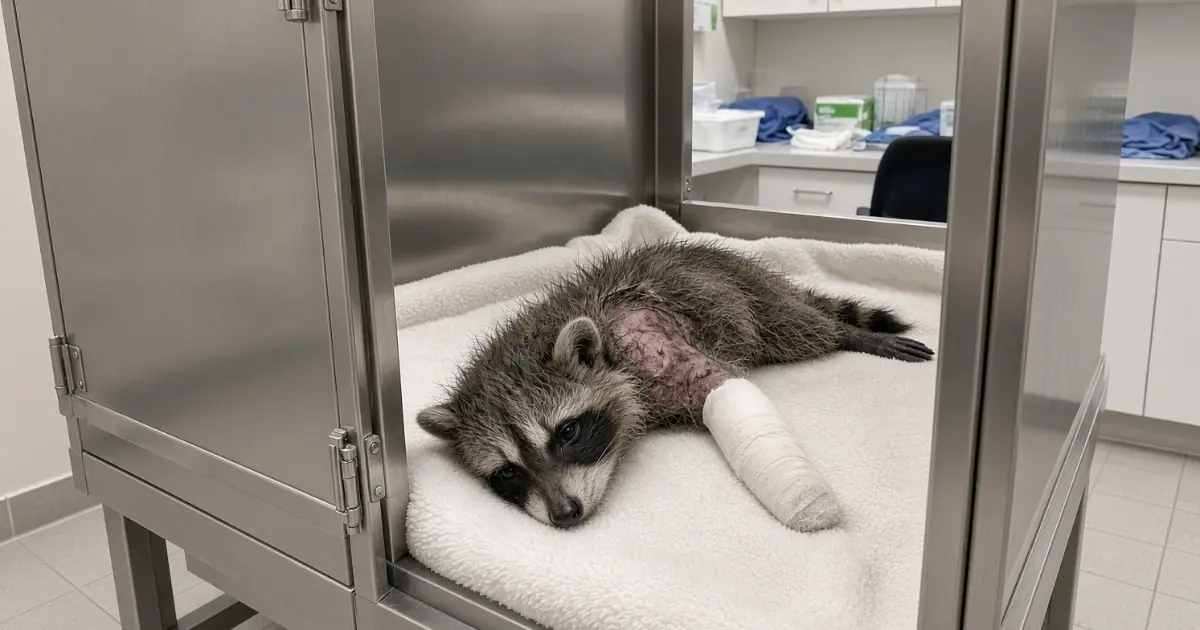
The following morning brought another small improvement.
When a caregiver opened the enclosure for a necessary check, Otis attempted to move away.
His body didn't cooperate particularly well.
He pushed with his hind legs and uninjured front limb, shifted perhaps a foot across the fleece, and then stopped to rest.
But the motivation had returned.
He no longer wanted to remain exactly where we put him.
That was encouraging.
The next several days became a balance between protecting his injury and allowing his body to recover normal function as his veterinary plan permitted.
The bandaged leg required regular monitoring. A wrap on a growing wild animal can't simply be applied and forgotten. Changes in swelling, moisture, position, circulation, or the condition of the underlying injury can all affect what happens next.
Otis also had another problem.
He was a raccoon, and raccoons use their front paws constantly.
Once his energy began returning, convincing him not to use the injured limb became increasingly difficult.
At first, he continued protecting it.
When he shifted around the enclosure, most of the work came from his hind legs and healthy front limb.
Then he began placing the wrapped foot down briefly for balance.
A few days later, we saw him use it during a slow change of position.
Those moments were monitored carefully rather than encouraged too quickly.
The fact that Otis wanted to use the limb didn't necessarily mean the tissues were ready for unrestricted activity.
Meanwhile, his appetite and awareness were improving.
The raccoon who had initially remained flattened against the fleece began sitting upright for short periods.
Then he started touching things.
That was when we began seeing more of the animal hidden beneath the trauma.
Raccoons experience much of their environment through remarkably sensitive front paws. A recovering juvenile that begins reaching, manipulating, and investigating again is showing us something beyond simple mobility.
Otis first used his healthy paw to pull at the edge of the fleece.
Soon he was examining appropriate food with it.
He would touch an item, turn it, smell it, and occasionally seem more interested in the investigation than in eating.
His injured limb couldn't participate normally yet.
But Otis clearly wanted it to.
As the shoulder healed, the large shaved patch also changed appearance.
During those first days, it made the severity of his treatment impossible to miss. The border between thick raccoon fur and exposed skin was abrupt, and several treated areas remained visible.
Over time, the skin settled.
The abrasions improved.
Then the earliest new fur began appearing.
It would take much longer for the coat to return fully, but we weren't judging his recovery by how quickly the shaved patch disappeared.
Function mattered more.
Could Otis move the shoulder comfortably?
Could he bear weight through the leg?
Could he use the paw?
Could he eventually climb without compensating?
Those were the questions that would determine his future.
As his condition improved, the protective wrap no longer represented the whole story either.
Eventually, according to the progress of the injury and veterinary guidance, his care could move beyond the stage that required the same level of external support.
Seeing the limb uncovered again was only the beginning.
Otis still needed to rebuild normal use.
His first unrestricted movements were cautious.
He placed the recovering paw down but shifted much of his weight elsewhere. When he moved faster, a slight hesitation remained.
So we didn't immediately give him a tall enclosure and assume the problem was solved.
Rehabilitation progressed in stages.
Low, secure opportunities for movement came first.
Otis began walking across different safe surfaces.
Then he started using both front paws to manipulate objects.
One of the clearest milestones came when he sat back and held an appropriate piece of food between both paws.
For a moment, the previously injured leg wasn't being protected or held away from his body.
It was simply being used.
After everything that limb had been through, ordinary was exciting.
Climbing came later.
His first structures were deliberately low. Otis approached one, placed both front paws against it, and pulled.
The recovering shoulder took weight.
His hind legs pushed.
He climbed onto the top.
A few weeks earlier, he hadn't been able to lift his chest from fleece.
Now he was pulling his own body upward.
From there, the challenges gradually increased as his condition allowed.
Otis became stronger through the shoulder.
His coordination improved.
The hesitation became harder to detect.
And the more physically capable he became, the less cooperative he became with us.
That was another important part of recovery.
Young raccoons can become habituated to people when prolonged rehabilitation involves too much unnecessary interaction. A raccoon that approaches humans after release can create dangerous situations for itself and for the people it encounters.
So our relationship with Otis needed to become less important as he became healthier.
Human contact was limited to necessary care.
Natural exploration became more important.
Foraging opportunities became more complex.
Instead of simply receiving everything in an obvious location, Otis had reasons to search and manipulate his environment.
He loved that part.
Soon his paws were working constantly.
He explored crevices.
Moved objects.
Investigated unfamiliar textures.
Climbed.
Reached.
And increasingly, disappeared from view whenever a caregiver entered.
The large shaved area remained visible for a while, even after Otis had begun moving almost normally. New fur grew slowly across the shoulder and upper chest, producing a short, uneven patch surrounded by his longer coat.
It made for a strange contrast.
His appearance still said “recovering patient.”
His behavior increasingly said “wild raccoon.”
At the time of this update, Otis is still progressing through rehabilitation rather than being rushed toward release.
His front limb is functioning far better than it did at intake, and he is using the shoulder and paw during ordinary movement, feeding, exploration, and climbing. The treated skin has healed substantially, and the shaved coat is gradually returning.
Most importantly, he is no longer spending his days flattened against fleece.
Now he wants elevation.
He wants things to investigate.
He wants places to hide.
And he wants distance from us.
Before any release decision is made, those abilities need to remain reliable under more demanding conditions. Otis must be capable of climbing, balancing, manipulating food, foraging, moving efficiently on all four limbs, and responding appropriately to his surroundings without human support.
His case is also a reminder that a wild raccoon found unusually weak or injured shouldn't be handled casually.
Even juveniles can defend themselves, and raccoons can present important zoonotic disease risks. Keeping people and pets away and contacting appropriate wildlife professionals is safer than attempting prolonged hands-on care at home.
We still don't know exactly what injured Otis.
There was no witness.
The marks on his body told us where he had been hurt, not precisely how it happened.
But his rehabilitation has given us another timeline that we understand much better.
First, there was the young raccoon who arrived unable to use one front leg normally.
Then there was the emergency patient with a shaved shoulder and a wrapped limb.
After that came the little body lying almost completely flat against the fleece, too exhausted to do much more than breathe and occasionally raise his head.
Then he sat up.
He moved away from us.
He touched the floor with the injured foot.
He began using the paw.
He held food with both front feet.
And eventually, he climbed.
Those changes didn't happen all at once.
They happened one ordinary movement at a time.
Today, the fleece that once seemed to hold Otis's entire world is simply the place where his recovery began.
If everything continues moving in the right direction, the next part of his story will require much more than lying still and healing.
It will require strong shoulders, four working limbs, curious paws, healthy caution, and the ability to climb away from us without needing to come back.
For Otis, that's exactly what we're working toward.