A Young Raccoon Can Finally Sit Up After a Severe Facial Injury — But One Eye Still Won’t Fully Open
Several days ago, the young raccoon could barely lift his head.
Today, he can sit up by himself.
That should feel like an enormous change, and it is. But when we look into the corner of his recovery pen, it's impossible to miss how much healing still has to happen.
He usually sits low against the fleece, his hindquarters tucked beneath him and his front paws resting close together.
One side of his face looks almost like that of any young raccoon.
The other still tells the story of why he is here.
A large section of fur has been shaved from the injured side so the damaged tissue can be properly monitored and treated. The skin across his cheek is uneven and dotted with dark healing scabs. His muzzle is still slightly asymmetrical, and although the worst of the swelling has gone down, one eye remains only partially open.
When he's tired, that eye sometimes narrows until it looks almost closed again.
We started calling him Milo during his first few days with us.
Milo doesn't know that his face looks unusual.
He only knows that he feels well enough now to sit up.
That alone is very different from the raccoon who arrived.
Milo had been found near the back edge of a suburban property early in the morning. The homeowner noticed him because he wasn't behaving like the raccoons they occasionally saw moving through the neighborhood after dark.
He wasn't climbing.
He wasn't searching for food.
He wasn't even trying to hide properly.
The juvenile was crouched beneath low vegetation near a fence, his head held unusually low.
When the homeowner observed him from a safe distance, Milo attempted to move deeper into cover. He made it only a short distance before stopping.
That was when the injury to his face became obvious.
One side was dramatically swollen.
The tissue around the eye had enlarged enough that the eye itself was almost impossible to see. Fur across the cheek was dirty and stuck together, and there were visible abrasions around the side of his muzzle.
Nobody had seen what happened.
There was no adult raccoon nearby when he was discovered, and there was no single piece of evidence that could tell us whether Milo had fallen, become trapped somewhere, encountered another animal, or suffered some other form of trauma.
We weren't going to invent an explanation simply because his injuries looked dramatic.
What mattered was that Milo needed help.
Because injured raccoons can still defend themselves and may present disease risks to people and pets, the homeowner didn't attempt to pick him up barehanded or bring him inside like a stray kitten. Wildlife professionals were contacted, and Milo eventually reached appropriate care.
His condition at intake was concerning.
The facial swelling was even more pronounced up close.
One side of his muzzle was distorted, and the injured eye remained hidden behind swollen tissue. The fur over the cheek made it difficult to see exactly what was happening underneath.
Milo was also weak.
That concerned us almost as much as his face.
A healthy juvenile raccoon generally doesn't welcome human examination. Even a young animal may pull away, vocalize, grab, or attempt to escape.
Milo barely had the energy.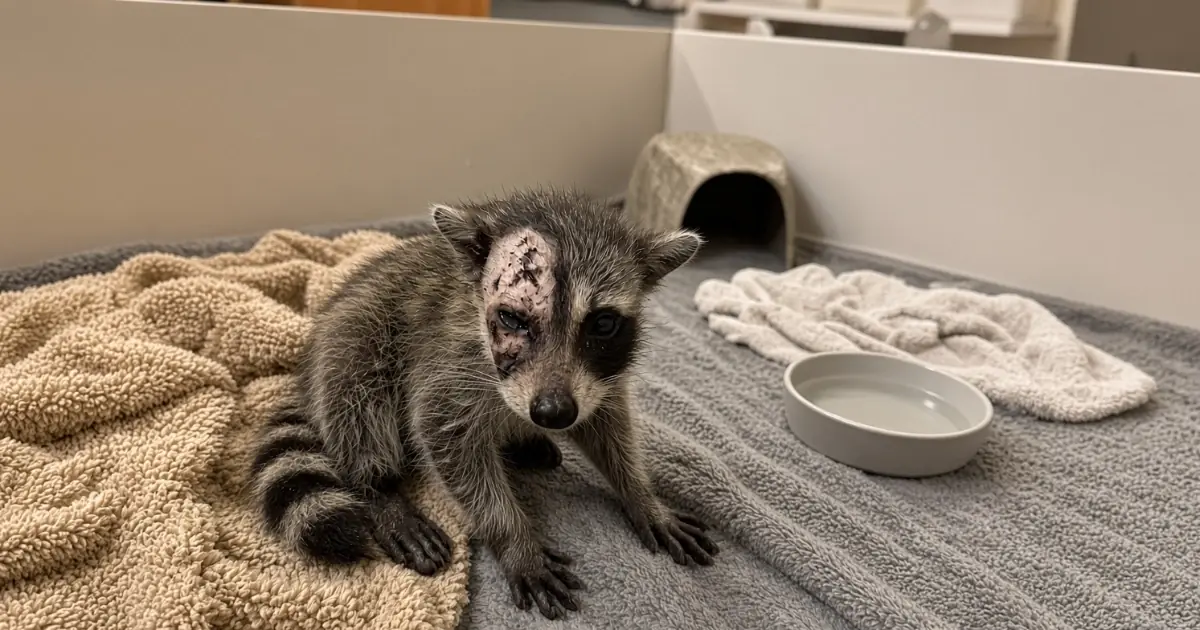
He remained low during much of the initial assessment.
The facial injuries required veterinary evaluation, particularly because they involved structures around the eye, nose, and mouth. The surrounding fur was clipped where necessary so the damaged tissue could be properly assessed and managed.
That was when the true appearance of the injured cheek became easier to see.
There were multiple superficial wounds and abrasions across the area, along with significant inflammation.
But the question everyone wanted answered couldn't be resolved immediately.
What had happened to the eye underneath all that swelling?
Not being able to open an eye doesn't necessarily mean the eye itself has been lost or permanently damaged. Severe inflammation of the surrounding tissues can also prevent normal opening.
At that stage, however, we couldn't judge recovery by appearance alone.
The priority was stabilizing Milo and addressing the injuries in front of us.
His first recovery setup was deliberately simple.
Soft fleece covered the floor.
A protected area gave him somewhere to retreat.
There were no high climbing structures.
For a raccoon, removing climbing opportunities might sound unnatural. For an exhausted trauma patient, it was temporary protection.
Milo needed to recover before he needed an obstacle course.
For most of that first day, he lay down.
Occasionally he changed the position of his head.
Sometimes his nose moved when someone entered.
Otherwise, he seemed interested only in sleeping.
Then, during an evening check, Milo did something new.
He pushed his front paws beneath his chest.
His head came up.
His shoulders followed.
For several seconds, he sat.
Then his strength gave out and he lowered himself back onto the fleece.
It wasn't dramatic.
But after watching him lie almost motionless for hours, seeing him support his own body mattered.
The following morning, he did it again.
This time he stayed upright longer.
That became the beginning of the posture we see so often now.
Milo sits low in the corner of the recovery pen, usually with his back close to the wall.
He isn't relaxed around us.
He isn't asking for attention.
He is choosing the place where he feels most protected while keeping his surroundings in view.
For a recovering wild raccoon, that caution is welcome.
Meanwhile, his face began changing.
The massive swelling gradually decreased.
The improvement was easiest to appreciate through photographs.
On the first day, the injured side looked almost ballooned around the cheek and eye.
A few days later, the natural outline of Milo's muzzle was beginning to return.
Then a narrow opening appeared between the eyelids.
We could finally see the eye.
That was encouraging, but it wasn't the end of the concern.
Even as the surrounding swelling continued to improve, Milo still couldn't open that eye as widely as the other.
So we kept watching.
Could he respond to movement from that side?
Did the eye appear increasingly comfortable?
Was the surrounding tissue continuing to heal?
Did his behavior suggest that vision was helping him navigate normally?
Those functional questions mattered more than whether his face looked symmetrical in a photograph.
The shaved cheek also entered an awkward stage of healing.
With the thick fur gone, every mark remained visible.
Some of the abrasions dried and formed scabs.
Others gradually became flatter and less inflamed.
The area looked rough even as it improved.