A Young Raccoon Escaped a Brush Fire Without Severe Burns — But He Wouldn’t Let Either Front Paw Touch the Ground
At first, everyone looked for burns.
The young raccoon had been discovered near an area recently affected by a small brush fire, so that was the obvious concern.
His coat wasn't extensively burned.
There were no large areas of severe skin damage across his body.
He was alive, alert enough to react, and from a distance he looked far more fortunate than we had feared.
Then he tried to move.
Instead of placing both front paws normally on the ground, the juvenile shifted his weight backward and kept them slightly raised.
He lowered one.
Immediately lifted it again.
Then he tried the other.
The same thing happened.
By the time he reached our wildlife rehabilitation center, that strange posture had become almost constant.
Inside a padded recovery enclosure, surrounded by soft bedding, the young raccoon lay low with both front legs extended slightly forward.
But his palms weren't resting comfortably against the surface.
He kept them lifted.
Even on padding.
That was the detail that worried us.
We began calling him Ember.
His name came from where he had been found, but the fire itself was only part of the story we needed to understand.
No one had seen exactly what happened to Ember.
We knew there had recently been a brush fire in the area. We knew he had been found nearby afterward. But we couldn't know his exact movements during the fire or say with certainty what surfaces he had crossed.
Wildfires and smaller brush fires can leave hazards behind even after visible flames have passed.
The ground itself can remain dangerously hot in places. Ash can conceal hot material. Debris can injure feet. Smoke and heat exposure can create concerns that aren't immediately obvious from looking at an animal's coat.
So although Ember had escaped without the extensive body burns someone might expect from the word “fire,” that didn't mean he had escaped unharmed.
His front paws told us otherwise.
During his initial assessment, the undersides of both front feet showed obvious tissue damage and irritation.
The exact depth and severity required professional evaluation.
His reluctance to place the paws down made sense.
Every time Ember tried to support his front half normally, those sensitive surfaces had to take his weight.
He didn't want them to.
That created another problem.
Raccoons depend enormously on their front paws.
They aren't simply feet.
A raccoon uses them to climb, grasp, investigate surfaces, manipulate food, search for objects, and navigate much of its environment.
For a juvenile raccoon eventually expected to return to the wild, having two functional front paws isn't optional.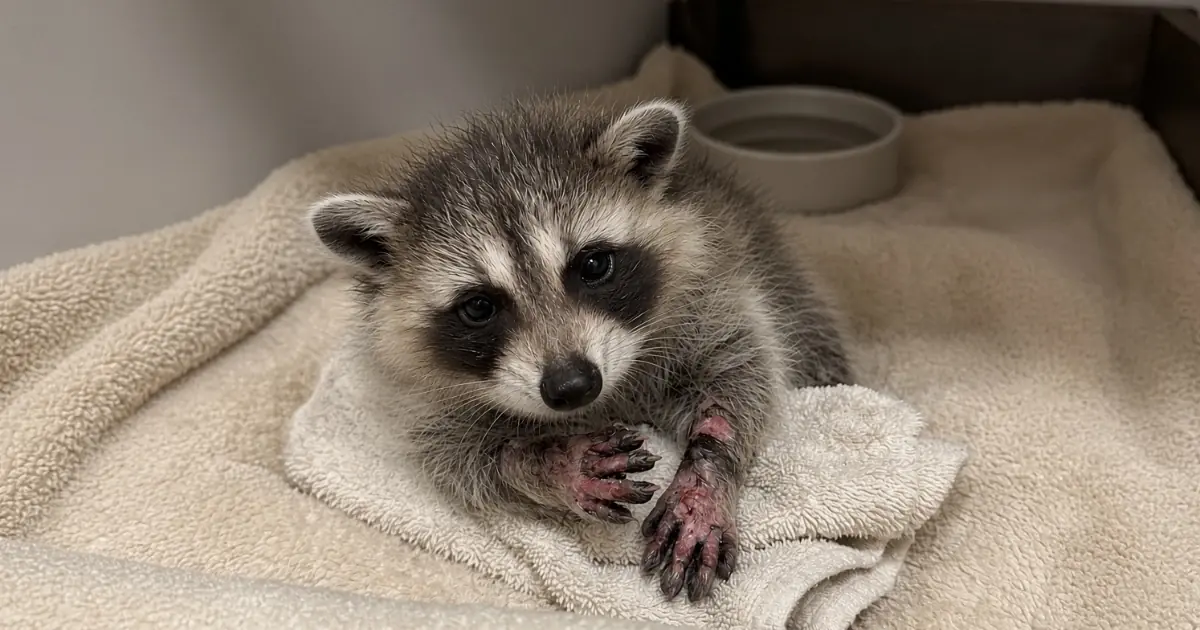
Ember needed them.
For now, however, he barely wanted to touch the floor with them.
His recovery environment was designed accordingly.
Soft padding reduced unnecessary pressure and abrasion.
Climbing opportunities were temporarily restricted.
The enclosure was kept simple enough that Ember didn't have to repeatedly cross hard or rough surfaces.
And his activity was monitored closely.
That first day, he spent much of his time lying down.
Whenever he needed to reposition himself, the movement looked awkward.
He pushed more heavily with his hindquarters.
Sometimes he briefly touched one front paw to the bedding.
Then it came back up.
Watching a raccoon avoid using its front paws is unsettling precisely because those paws are normally so busy.
Healthy raccoons touch everything.
Ember touched almost nothing.
During routine care, he remained wary of us, which was encouraging.
He was injured, but he was still wild.
We wanted to keep it that way.
The goal was never to comfort him through unnecessary handling.
Necessary treatment was provided.
Otherwise, Ember was given quiet.
The first days didn't produce a dramatic transformation.
His paws still bothered him.
He still shifted his weight backward.
He still rested with them slightly elevated.
But the damaged tissues began changing.
Inflammation started to settle.
Areas that had looked intensely irritated became less angry.
Healing surfaces began developing.
We watched carefully for complications.
Paw injuries can be particularly challenging because an animal eventually has no choice but to use them.
A wound elsewhere on the body may be protected from direct pressure.
Feet are different.
Every step tests them.
And Ember had four reasons to want to move long before we were ready to let him climb.
He was young.
He was curious.
He was a raccoon.
As his general strength returned, keeping him quiet became increasingly difficult.
One morning, a caregiver entered the room and noticed that Ember wasn't in his usual position.
He was sitting.
His hindquarters were beneath him.
His back was against the protected side of the enclosure.
And for the first time, one front paw was resting flat against the bedding.
The other remained slightly lifted.
It was a small change.
But we had been waiting for it.
Later that day, Ember switched paws.
Then, briefly, both touched down.
He didn't walk.
He simply allowed his weight to move forward.
A few seconds later, one paw lifted again.
That was enough.
The next milestone came when Ember took several steps without immediately pulling both front feet away from the surface.
His gait was still cautious.
Each paw seemed to test the bedding before accepting weight.
He moved slowly and stopped frequently.
But he was using them.
As healing progressed, Ember's front paws became active in another way.
He started touching things.
At first, it was just the edge of his bedding.
His toes moved over the fabric.
Then he investigated part of the enclosure.
Soon he began manipulating appropriate food.
That mattered enormously.
A paw that can bear weight is useful.
A raccoon paw also needs sensitivity, coordination, flexibility, and grip.
Ember began showing us those abilities one by one.
He held food.
Turned it.
Transferred it between his paws.
Felt around the edge of a container.
The juvenile who had once refused to place either palm against fleece was beginning to use those same surfaces to explore again.
Then came the behavior that made it obvious Ember was feeling better.
He tried to climb.
His first attempt wasn't impressive.
He stood against a low structure, lifted both front paws, and placed them onto the surface.
For several seconds he seemed uncertain.
Climbing required exactly what he had avoided since arrival: pressure through the front paws.
Ember pulled.
His hind legs pushed.
He made it partway up.
Then he stopped and climbed back down.
We didn't encourage another attempt.
He would tell us when he was ready.
A few days later, he tried again.
This time he went all the way.
Both front paws gripped.
His weight shifted forward.
His hindquarters followed.
Ember reached the low platform and immediately began investigating it as though nothing remarkable had happened.
For him, perhaps it hadn't.
For us, it was one of the most important moments of his rehabilitation.
His paws weren't merely healing while he rested.
They were beginning to work.
As Ember's condition improved, his environment became gradually more complex.
Soft surfaces remained important while the paws continued healing, but he needed opportunities to demonstrate normal function.
He had to walk.
Grip.
Reach.
Pull.
Manipulate food.
Balance.
Eventually, he would need to climb with the confidence expected of a healthy young raccoon.
We also needed to see what happened after activity.
Would increased use make him start lifting the paws again?
Would he become reluctant to move?
Would the healing tissues remain stable?
Recovery couldn't be judged from one good morning.
It had to persist.
Fortunately, Ember continued moving forward.
The unusual posture that had defined his first days became less frequent.
He stopped sitting with both front feet suspended above the bedding.
He moved around the enclosure.
His paws became increasingly busy.
And when caregivers appeared, Ember began doing something else we were very happy to see.
He moved away from us.
As direct treatment became less necessary, we reduced human interaction.
A juvenile raccoon recovering in rehabilitation should not leave believing people are part of its social world.
Ember needed to remain cautious.
He needed to choose cover.
He needed to become increasingly independent.
The stronger he became, the less interested he was in tolerating our presence.
That was another form of healing.
At the time of this update, Ember is almost unrecognizable from the raccoon lying in that padded enclosure with both front paws hovering above the bedding.
He is standing normally.
He walks using all four feet.
He manipulates food with both front paws.
He investigates his environment.
And he has begun climbing again.
The damaged areas still require monitoring, and the appearance of healing tissue doesn't automatically mean those paws are ready for everything the wild will demand.
Outside, Ember won't walk exclusively on fleece.
He may encounter bark.
Soil.
Rock.
Branches.
Uneven terrain.
He'll need his front paws to tolerate repeated contact while retaining the dexterity that makes raccoons such capable climbers and foragers.
That is the real test ahead.
His case also carries an important lesson about wildlife found after a fire.
An animal doesn't need to have dramatic burns across its coat to have been injured.
Feet may contact heated ground or damaged surfaces. Smoke exposure can also create concerns that aren't obvious to an untrained observer.
Wildlife found in or near a recently burned area should not be chased, handled unnecessarily, or treated at home based only on what can be seen externally.
If an animal appears injured, weak, disoriented, or unable to move normally, an appropriate wildlife rehabilitator or wildlife authority can provide guidance.
Ember's injuries were easy to underestimate at first.
He hadn't emerged with a badly burned coat.
He wasn't covered in dramatic wounds.
But put him on the softest bedding we had, and his body told the story immediately.
He still wouldn't put his palms down.
There is footage from those early days showing him lying inside the padded recovery enclosure.
His front legs are extended.
Both paws hover just above the fleece.
Every so often, Ember lowers one toward the surface.
He touches it.
Then quickly lifts it again.
Compare that with him now and the difference isn't simply that the paws look better.
It's what he does with them.
He walks on them.
He holds food with them.
He explores with them.
And now, increasingly, he uses them to pull himself upward.
For a young raccoon, that last part may become the most important.
Because Ember's recovery won't ultimately be measured by whether the marks on his paws disappear.
It will be measured by whether those two injured feet can once again carry him over rough ground, grip a branch, pull him into a tree—and eventually take him somewhere he no longer needs us at all.