A Young Raccoon Was Found Motionless Beside the Road — The Injuries We Could See Were Only the First Concern
The young raccoon didn't try to run when the vehicle stopped beside him.
He didn't even lift his head.
He was lying near the edge of a suburban road, partly on his side, with his hindquarters angled toward the grass. Cars were still passing nearby, but there was almost no response from the small body on the pavement.
At first, the person who spotted him wasn't certain he was alive.
Then his chest moved.
Once.
Then again.
From a safe distance, several injuries were already visible. One side of his face looked swollen and scraped. The fur over his shoulder was disturbed and matted, and one hind leg rested at an unnatural angle compared with the other.
Everything about his position suggested that something serious had happened.
There was no witness to the exact moment of impact, but the location and pattern of trauma made a vehicle collision the primary concern.
Wildlife assistance was contacted, and the young raccoon was moved only as necessary to get him out of immediate danger and into secure transport.
A blanket was spread across the rear cargo area of the vehicle.
When the raccoon was carefully placed onto it, he simply sank into the fabric.
He didn't stand.
He didn't turn around.
His injured hind leg remained extended awkwardly behind him, and his head rested sideways against the blanket.
For most of the emergency drive, the only obvious movement was his breathing.
That image would stay with us.
A young wild animal that should have been climbing, searching, and defending himself was instead lying almost completely motionless in the back of a vehicle while someone drove toward help.
And the injuries visible from the outside weren't necessarily the most dangerous ones.
When a small animal experiences significant blunt trauma, what we can see is only part of the picture.
There can be injuries to the head, chest, abdomen, spine, or internal organs without dramatic external wounds.
That meant the swollen face, damaged shoulder, and abnormal hind leg couldn't be treated as three isolated problems.
The entire raccoon had to be considered a trauma patient.
By the time he arrived for assessment, he was still conscious but profoundly weak.
His breathing was monitored immediately.
So were his responsiveness, circulation, body temperature, posture, and neurological reactions.
The injured side of his face was swollen around the cheek and muzzle. There were abrasions across the area, although the damage looked less dramatic than it might have if the skin had been deeply open.
The shoulder showed evidence of impact as well.
But the hind leg drew particular attention.
The youngster wasn't using it normally.
Whenever his body shifted, he attempted to compensate with the other limbs rather than pushing through the injured side.
Veterinary evaluation was necessary to understand what could not be determined from appearance alone.
For the moment, however, nobody was interested in making him demonstrate whether he could walk.
He needed stabilization.
He needed quiet.
He needed to stop spending energy he didn't have.
He was settled into a controlled recovery environment with soft support beneath him and minimal unnecessary handling.
That first evening, he spent most of his time in nearly the same position.
Someone on the care team began calling him Rory.
The name appeared on his notes without ceremony and stayed.
Rory didn't seem interested in much of anything that night.
Every so often, his nose moved.
His eyes opened briefly when someone approached.
Then his head settled back down.
During one check, however, he tried to pull a front paw underneath his chest.
He couldn't raise his entire body.
But he tried.
For that first night, trying was enough.
There was no dramatic overnight recovery.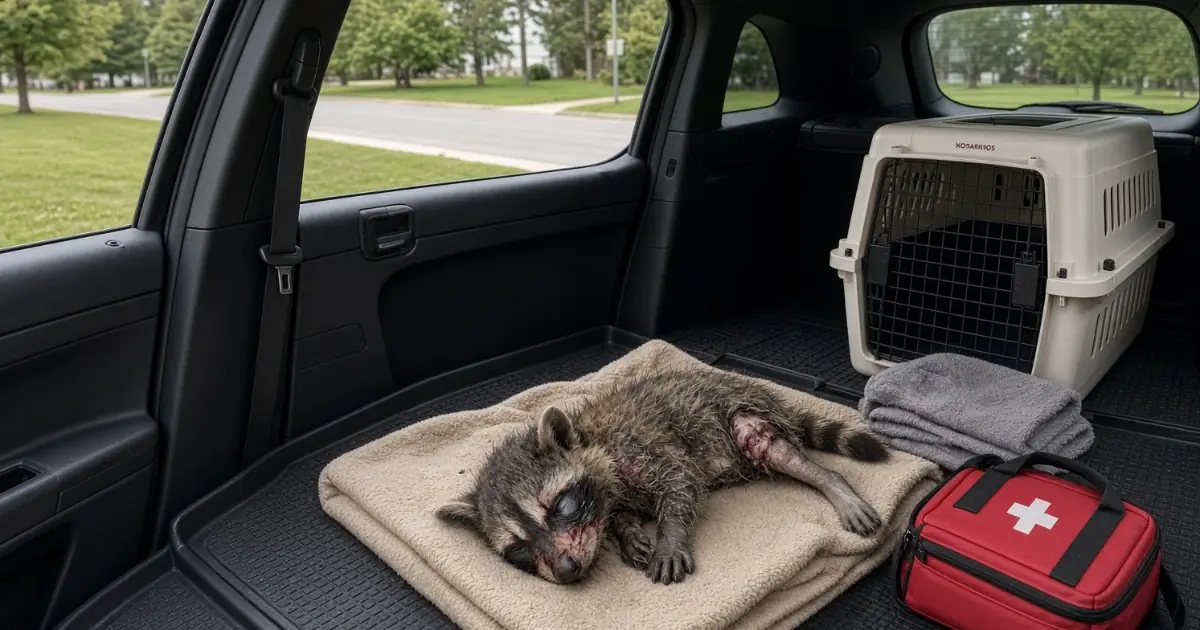
By morning, Rory was still visibly injured.
The facial swelling remained.
His shoulder was sore.
The hind limb continued to require careful management.
But something important had changed.
He was more aware.
When the recovery enclosure was opened, Rory raised his head and watched the movement.
A caregiver came closer.
Rory attempted to retreat.
It wasn't an effective escape. He moved only a short distance before stopping.
But the animal who had barely reacted in the back of the transport vehicle now wanted distance from us.
That was encouraging.
The following days were deliberately uneventful.
Trauma recovery often needs to be.
Rory rested.
His condition was monitored.
The facial abrasions began settling.
The swelling around his muzzle gradually decreased.
His shoulder became less guarded.
His hind leg took longer.
At first, Rory avoided putting meaningful weight through it. When he changed position, he relied heavily on the other three limbs.
We didn't force the issue.
The fact that a wild animal wants to move doesn't mean an injured structure is ready for unrestricted activity.
Instead, his recovery environment remained simple while his veterinary care plan guided what could safely happen next.
Then Rory stood.
It happened during a quiet period when nobody was interacting with him.
He pushed upward with his front limbs.
His hindquarters followed.
For several seconds, he remained standing.
The injured rear leg touched the floor but wasn't carrying normal weight.
Then Rory lowered himself again.
It was far from normal movement.
Compared with the raccoon who had arrived unable to rise from a blanket, it was enormous progress.
Over the next several days, standing became walking.
Walking was initially awkward.
Rory took short steps and compensated for the injured leg. His balance wasn't what we wanted, and he tired quickly.
But the pattern slowly changed.
He began placing the affected foot more consistently.
Then he started shifting weight onto it.
The facial injuries were improving at the same time.
As swelling receded, the shape of Rory's muzzle returned.
The abrasions dried and healed.
For a while, one side of his face still looked rougher than the other, but appearance wasn't our main concern.
Could he see normally?
Could he eat?
Could he move his jaw without difficulty?
Could he navigate his environment?
Those questions mattered more.
His appetite provided another encouraging change.
During the earliest phase, Rory had been too compromised for food to be the simple solution people sometimes imagine when they find an injured wild animal.
Once his condition allowed appropriate nutrition, however, his interest strengthened.
Soon he wasn't simply eating.
He was manipulating food.
That meant his paws were coming back into the story.
Raccoons investigate much of their world through their sensitive front feet. Rory began holding appropriate foods, turning them, feeling around the edges of containers, and exploring unfamiliar objects.
Then he started making a mess.
We welcomed that too.
A raccoon actively rearranging his environment was very different from the animal who had once been carried on a blanket because he couldn't move himself.
As Rory's condition improved, we faced a new challenge.
He wanted to climb.
The first attempts were discouraged by the deliberately low recovery setup. His hind leg needed to demonstrate reliable function before we gave him meaningful height.
Eventually, as his condition permitted, low climbing opportunities were introduced.
Rory immediately investigated them.
He placed both front paws onto a low structure.
Pulled.
Pushed with his hindquarters.
For an instant, the recovering leg hesitated.
Then it contributed.
Rory climbed onto the platform.
He stayed there for several minutes.
Soon getting him to remain on the floor became harder than getting him onto something elevated.
That was a much better problem.
His environment became progressively more complex as his strength and coordination returned.
Walking on a flat surface was no longer enough.
A wild raccoon needs to climb irregular structures, balance, descend safely, manipulate food, forage, and respond quickly when something changes around him.
Rory had to prove that the leg could participate in those behaviors consistently.
He improved gradually.
His stride became more even.
His climbing became stronger.
The hesitation in the hind limb became less obvious.
He could turn, reach, and reposition himself without the same awkward compensation we had seen earlier.
At the same time, Rory became increasingly inconvenient around people.
He stopped sitting in the open during routine checks.
When someone entered, he moved toward cover.
If a caregiver lingered, Rory watched from a protected position rather than approaching.
That behavioral recovery mattered.
Juvenile raccoons can become habituated to people during prolonged care, particularly when unnecessary handling or interaction occurs.
That isn't the outcome we want.
Rory isn't being prepared to become comfortable around someone's backyard.
He's being prepared to avoid us.
So as his need for intensive care decreased, human interaction decreased with it.
His environment provided the stimulation.
Foraging provided the challenge.
Caregivers became something he generally preferred not to see.
Weeks into recovery, it became difficult to reconcile Rory with the photograph taken during transport.
In that first image, he is stretched across a blanket in the back of a vehicle.
His head is down.
One side of his face is swollen.
His shoulder is injured.
One hind leg looks wrong.
There is almost no tension in his body because he barely has the strength to react.
The photographs from later in rehabilitation look very different.
Rory is upright.
Sometimes he is climbing.
Sometimes only part of him is visible because he has chosen cover before the camera arrives.
The hind leg that once remained extended behind him is supporting his body.
His face has healed substantially.
His paws are busy.
And his eyes are alert.
That doesn't mean a release decision is automatic.
Surviving a vehicle collision and looking better inside an enclosure are not enough.
Rory still has to demonstrate that the recovery holds up under the demands of wild life.
His mobility needs to be reliable.
His hind limb must tolerate climbing and normal activity.
His coordination and endurance need to be appropriate.
He must forage independently.
And his behavior around humans needs to remain suitably cautious.
Wildlife rehabilitation isn't finished when an animal stops looking injured.
It's finished when the injury is no longer preventing that animal from functioning in the environment where it belongs.
Rory's case is also a reminder of what to do when injured wildlife is found along a road.
Stopping in traffic or attempting to grab a conscious raccoon can create additional danger. An injured animal may still bite or scratch, and raccoons can carry diseases of concern to people and domestic animals.
When possible, people should keep themselves, children, and pets safely away and contact an appropriate wildlife rehabilitator, animal control agency, or wildlife authority for guidance.
Rory was fortunate that someone noticed the small body beside the road.
Had the driver continued past, another vehicle might have struck him.
Instead, he ended up on a blanket in the back of a car.
At that moment, nobody knew whether he would stand again.
We didn't know how serious the unseen effects of the impact might be.
We didn't know what the injured hind leg would eventually be able to do.
There was only a young raccoon lying flat while the vehicle moved toward emergency care.
Today, Rory is no longer willing to lie quietly simply because someone wants a good look at him.
He gets up.
He moves.
He climbs.
And increasingly, he disappears from us.
There may eventually come a day when Rory does that one final time.
No recovery enclosure.
No fleece.
No caregiver waiting nearby.
Just four working limbs carrying him into cover.
If that day comes, the most important part of the story won't be that a young raccoon survived being found beside a road.
It will be that he recovered well enough to leave us behind.