The call reached our team through local conservation officers with the Indiana Department of Natural Resources after residents near a lake in northern Indiana reported an adult Bald Eagle that had remained on the ground for an unusually long period of time. According to the people who first noticed the bird, the eagle had been in roughly the same area for at least 24 hours and had shown little ability to leave on its own. Because another Bald Eagle had reportedly been seen nearby and there had been some activity between the birds in the area, the initial suspicion among observers was that the eagle may have been injured during a territorial encounter. That explanation seemed reasonable at first. Adult Bald Eagles can become aggressive toward one another around nesting territories, food resources, or established areas, and injuries from those encounters are not uncommon. However, no one had actually witnessed a fight, and from the beginning there was no way to know whether the bird’s condition was the result of trauma, illness, toxin exposure, or another process entirely. The fact that the eagle had remained grounded for so long was itself concerning. A healthy adult Bald Eagle may spend time on the ground while feeding or resting, but a bird that stays in one place for many hours, cannot leave normally, and allows people to approach more closely than expected deserves immediate assessment. The residents did the right thing by keeping their distance and contacting wildlife authorities instead of attempting to capture the eagle themselves. When conservation officers arrived, the bird was still alive but clearly compromised. It was able to open its eyes and react to movement, yet its posture was weak and it did not display the strong defensive behavior expected from a healthy adult raptor. The officers safely contained the eagle using appropriate protective equipment and transported it to our facility for emergency evaluation. At that point, everyone involved still believed trauma remained a possibility, but the case began to look very different within minutes of the bird’s arrival.
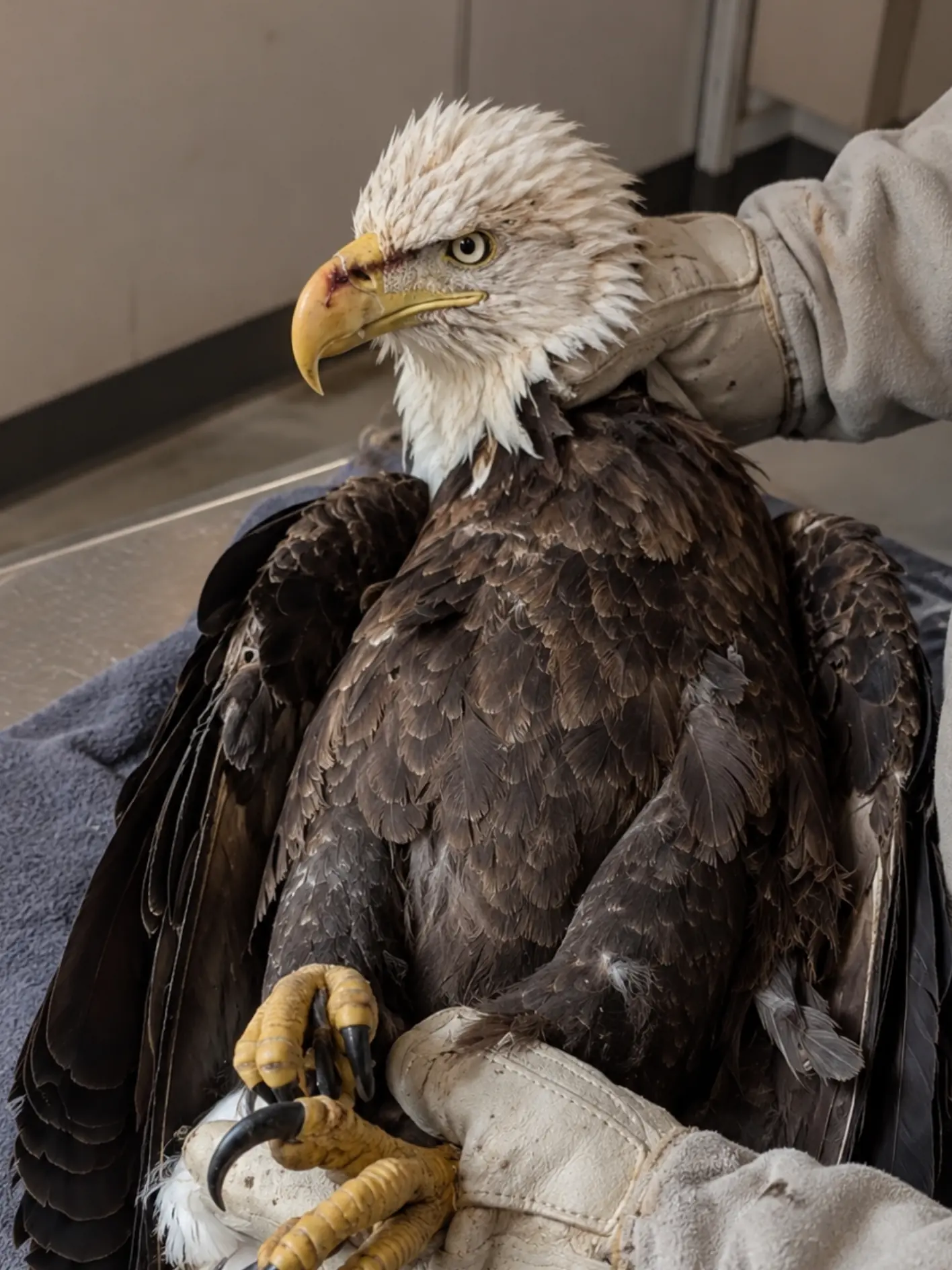
As soon as the eagle was brought into the examination area, staff noticed neurologic abnormalities that immediately changed the direction of the assessment. The bird was not simply weak or reluctant to move. It displayed intermittent tremoring and seizure-like activity, and the pupils were rapidly changing size in a way that did not appear consistent with a straightforward orthopedic injury. The eagle had difficulty maintaining a stable posture and seemed periodically disoriented. Its head control was abnormal at times, and its responses to surrounding movement were inconsistent. These signs raised concern for a neurologic process rather than a simple injury caused by a fight. The team began a full physical examination while minimizing handling as much as possible because severely compromised raptors can deteriorate quickly under stress. Both wings were palpated carefully. The legs and feet were examined. The spine, chest, skull, eyes, and beak were assessed for evidence of trauma. There were no major open fractures, no dramatic external wounds, no obvious dislocation, and no significant hemorrhage that could explain the neurologic signs we were seeing. The image of the eagle during examination might make the bird appear outwardly intact except for minor abrasions, but that was precisely why the case became more concerning. There was no obvious external injury severe enough to account for the degree of weakness and neurologic dysfunction. In many wildlife cases, a visible wound points the team toward a clear treatment plan. A fractured wing can be stabilized. A laceration can be cleaned and repaired. A bleeding injury can be controlled. In this case, there was no single external lesion that explained the bird’s condition. The most serious problem appeared to be happening internally.
One of the first diagnostic concerns in a neurologically abnormal Bald Eagle is lead toxicosis. Bald Eagles are scavengers as well as predators, and exposure to lead can occur when they consume tissue from animals containing fragments of lead ammunition or other sources of contamination. Lead poisoning can produce weakness, altered behavior, gastrointestinal problems, poor coordination, and neurologic signs, so it had to be considered immediately. An in-house blood lead screening test was performed as part of the initial workup. The result did not indicate a clinically significant elevation in blood lead concentration. In practical terms, the test did not support lead poisoning as the explanation for the eagle’s condition at that time. That result was important because lead exposure is common enough in raptors that it can easily become the first assumption when an eagle arrives weak or neurologically abnormal. In this case, the screening forced us to look more closely at other possibilities. The team continued evaluating the bird for evidence of trauma, but the lack of major external injury and the negative lead screening made the neurologic signs increasingly difficult to explain through the two most obvious causes. This is where wildlife medicine often becomes less about identifying a single dramatic injury and more about building a list of differential diagnoses from patterns of clinical findings. The eagle’s tremors, intermittent seizure-like activity, abnormal pupil changes, poor coordination, weakness, and inability to remain normally active could potentially be associated with head trauma, infectious disease, another toxin, severe systemic illness, or a number of less common conditions. Without diagnostic confirmation, it would have been inappropriate to claim one cause. Still, one possibility moved much higher on the list as the examination progressed: avian influenza.
Highly pathogenic avian influenza has become an important concern in wild bird medicine because affected birds can show neurologic signs, weakness, abnormal posture, incoordination, tremors, seizures, and rapid clinical decline. Raptors may be exposed through contact with or consumption of infected birds, and Bald Eagles can be vulnerable because they sometimes scavenge carcasses or prey on weakened animals. The eagle’s presentation was therefore concerning enough that biosecurity precautions became a priority. The bird was isolated from other raptor patients, and staff used dedicated protective equipment and limited the number of people who had direct contact with the enclosure. Equipment associated with the case was kept separate so that, if an infectious disease was involved, the risk of transmission to other patients would be reduced. It is important to emphasize that avian influenza was not diagnosed at that stage. The bird had not yet undergone confirmatory laboratory testing, and the neurologic signs were not unique to influenza. Several other conditions can produce similar abnormalities. The correct wording, both medically and scientifically, was that avian influenza had become an important differential diagnosis. It was a concern, not a confirmed cause. This distinction matters because wildlife cases are often discussed publicly before laboratory results are available, and speculation can quickly become repeated as fact. The responsible approach was to treat the bird according to its clinical needs, protect other animals and staff through appropriate biosecurity, and collect the necessary samples for later testing if the eagle did not survive or if the clinical course continued to support infectious disease as a possibility.
The eagle was stabilized with supportive care through the evening. Fluids were administered carefully to address dehydration and circulatory support. The bird was kept in a quiet, low-stimulation environment because unnecessary noise and handling can worsen stress in neurologically compromised wildlife. Body temperature was monitored, and the eagle was positioned on padded material to reduce the risk of additional injury during tremors or abnormal movement. Feeding was approached cautiously because a bird with altered neurologic function may have impaired coordination and could aspirate if food or fluids are given improperly. The goal during those first hours was not to correct a single known disease process because we did not yet have one. The goal was to maintain circulation, hydration, body temperature, and safety while giving the eagle as much physiologic support as possible. There were periods when the bird appeared somewhat more stable. It could hold its head upright for short intervals, and its eyes remained open for longer periods. Respiration did not show the kind of dramatic failure that would immediately indicate a terminal respiratory event. However, the abnormal neurologic activity continued. The pupils still showed rapid changes in size, and intermittent tremoring remained present. The eagle did not regain normal strength or coordination. This was one of the most difficult aspects of the case. There was no external wound to clean that might suddenly improve the bird’s comfort, no fracture to stabilize that would immediately explain the inability to move, and no elevated lead level that would allow the team to begin chelation therapy with a defined toxicologic target. We were supporting an adult Bald Eagle whose most serious disease process appeared to be occurring inside the nervous system or elsewhere internally, and the exact cause remained unknown.