An adult bald eagle found grounded near the Skagit River in northwestern Washington is receiving veterinary care after wildlife staff discovered multiple puncture wounds hidden beneath its feathers, injuries veterinarians say are consistent with the type of trauma that can occur when bald eagles clash with one another.
The eagle was first reported in Skagit County after a member of the public noticed the bird remaining on the ground and apparently unable to take flight normally.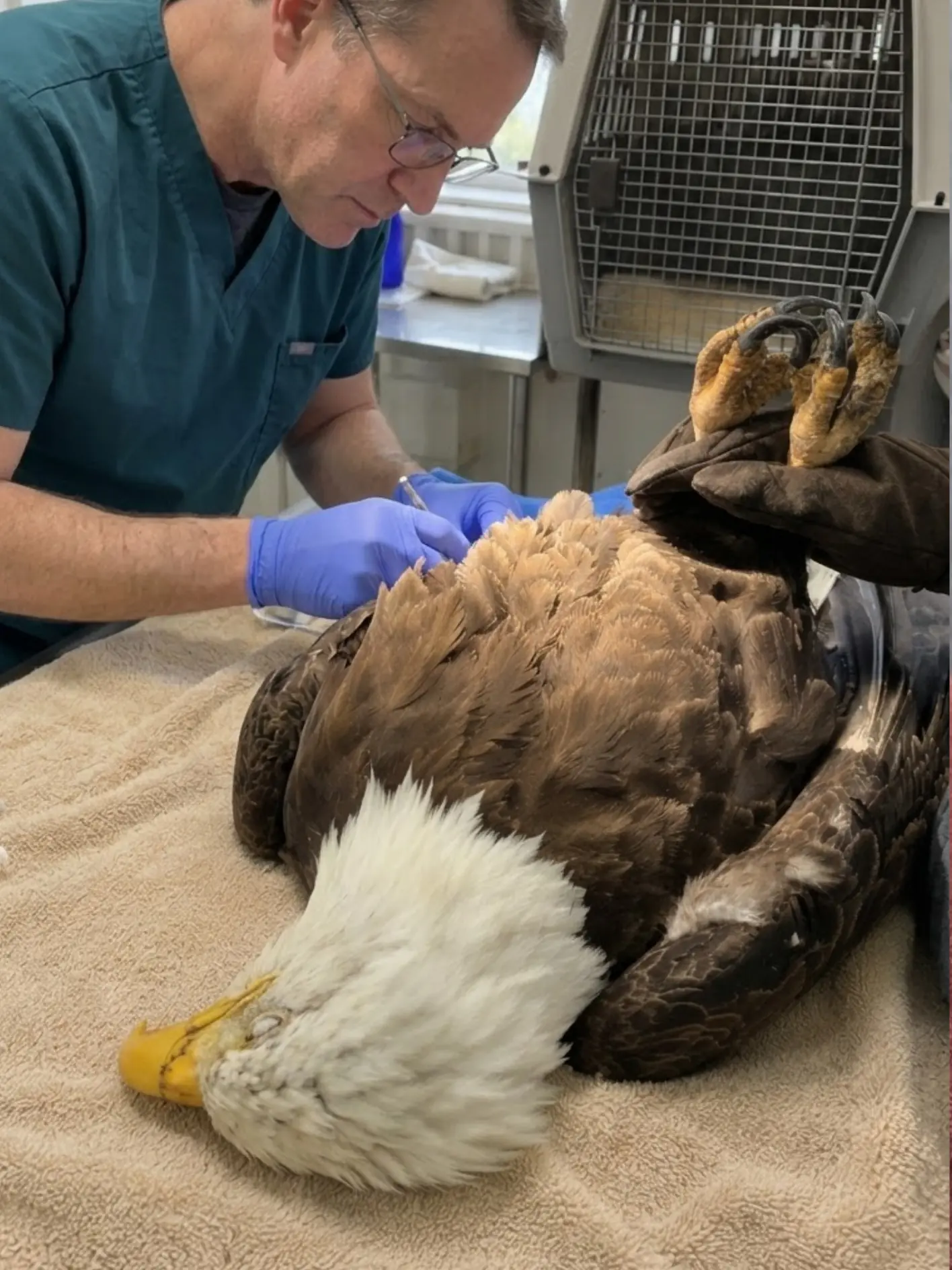
A state wildlife officer responded to the location, approached the bird carefully, and determined that it needed professional medical evaluation.
Although the eagle remained alert and defensive enough to respond to the officer’s presence, it did not attempt a normal sustained escape flight.
That behavior immediately raised concern.
The bird was safely captured, placed in a secure transport carrier, and brought to a licensed wildlife rehabilitation center in northwestern Washington.
At first, there was no obvious explanation for why such a powerful adult raptor could not leave the ground.
There was no dramatically dangling wing.
No large open fracture was visible.
No major external bleeding immediately explained the loss of flight.
Radiographs provided the first encouraging information.
No major fracture or obvious catastrophic skeletal injury was identified.
But the absence of broken bones did not solve the case.
During a detailed physical examination lasting close to an hour, veterinary staff worked carefully through the eagle’s dense feathers and discovered several puncture-type wounds that had been difficult to see from the outside.
The injuries were small at the skin surface but extended into the underlying soft tissue.
Their appearance and distribution, staff said, were consistent with the kinds of wounds that may be produced by another eagle’s talons during a territorial conflict.
No one witnessed such a confrontation, however, and veterinarians are treating that explanation as a working hypothesis rather than a confirmed account of what happened.
For now, the priority is simpler.
The wounds must remain clean.
Infection must be prevented.
The eagle must regain enough comfort and strength to use both wings normally again.
Only then will staff know whether the bird can safely return to the Skagit River corridor.
A Powerful Bird That Could Not Leave the Ground
Bald eagles are familiar residents of the Skagit River region.
The river system, surrounding wetlands, agricultural fields, wooded areas, and seasonal concentrations of fish provide extensive habitat for the species.
Adult eagles can often be seen perched in large trees overlooking waterways or crossing open stretches of valley between feeding areas.
Seeing an eagle on the ground is not automatically unusual.
They may descend to feed.
They may rest temporarily.
They may investigate carrion.
The concern begins when a bird remains grounded despite nearby human activity or shows repeated difficulty taking off.
That was the situation with this eagle.
The bird did not behave like a healthy adult capable of simply leaving.
The state wildlife officer who responded therefore had to consider several possibilities.
A fracture.
Head trauma.
Lead exposure.
Soft-tissue injury.
Exhaustion.
Or another medical condition that could interfere with flight even if no obvious wound was visible.
Because a bald eagle can cause serious injury with its feet and talons even while weakened, capture required care.
The bird’s wings had to be controlled.
The talons had to be secured.
The body had to be supported without adding unnecessary stress.
Once the eagle was contained, it was placed into a transport carrier and driven to the rehabilitation center for examination.
The First Question Was Whether Anything Was Broken
When a raptor arrives unable to fly, one of the first concerns is orthopedic trauma.
A fracture of the humerus, radius, ulna, shoulder girdle, or other major structure can prevent normal wing movement.
Some fractures are obvious.
Others can remain concealed beneath thick plumage.
Veterinary staff therefore obtained radiographs to examine the skeleton more closely.
The images were reassuring.
No major fracture was identified.
There was no obvious skeletal injury severe enough to explain the eagle’s inability to fly normally.
That was good news.
It also created a new problem.
Something was still keeping the bird on the ground.
If the bones were intact, staff needed to determine whether the problem involved muscle, tendon, ligaments, pain, soft tissue, or another process entirely.
The examination therefore continued.
The Photograph Shows the Kind of Hands-On Examination That Was Needed
Images recorded during the veterinary workup show the eagle lying on a padded examination surface while a veterinarian inspects the body and another handler controls the feet.
The talons are powerful enough to injure a person even when the bird is debilitated, so the handler’s role is critical.
Protective gloves and controlled restraint allow the medical team to examine the bird without allowing sudden movement to worsen an injury.
The image does not itself reveal the puncture wounds.
That is part of what made the case challenging.
Most of the injuries were hidden beneath feathers.
The bird’s body had to be examined systematically, section by section.
Nearly an Hour of Examination Revealed What the Feathers Had Hidden
The veterinary team began working through the plumage carefully.
They examined the shoulders.
The upper wings.
The back.
The chest.
The areas around the sides of the body.
The legs and feet.
Dense feathers can conceal surprisingly significant wounds.
A puncture produced by a talon may leave only a small opening at the skin surface.
The deeper damage can be much greater.
During the extended examination, clinicians identified multiple puncture-type injuries in areas of soft tissue beneath the feathers.
Some were surrounded by bruising.
Others required the feathers around them to be separated carefully before the full depth could be appreciated.
None appeared as dramatic as an open fracture.
But their distribution provided a possible explanation for why the eagle was reluctant or unable to fly.
Pain alone can dramatically alter a raptor’s use of a wing.
Deeper soft-tissue damage can reduce strength.
Swelling can interfere with normal movement.
A bird may therefore have completely intact bones while remaining functionally grounded.
The Wound Pattern Suggested Talon Trauma
Veterinarians said the appearance of the injuries was consistent with punctures that may occur when bald eagles engage in physical conflict.
Adult bald eagles can use their feet aggressively.
During confrontations, the talons can penetrate feathers and enter the skin beneath.
Because the feet are designed to seize and hold prey, they can create narrow but deep wounds.
“The X-rays were reassuring, but once we began working through the feathers, we found several puncture wounds that were easy to miss from the outside,” one veterinarian said. “Their appearance and distribution are consistent with the kinds of injuries we can see when eagles engage one another with their talons.”
The word consistent is important.
No one witnessed another eagle attack this bird.
There is no video of a territorial fight.
There is no way to know exactly when or where the injuries occurred.
The team therefore cannot say with certainty that another bald eagle caused them.
The wounds simply fit a pattern wildlife clinicians have seen in raptors injured during conflicts.
Why Bald Eagles Fight
Bald eagles can be highly territorial, especially around valuable resources.
They may defend nesting areas.
Feeding sites.
Preferred perches.
Established territory.
Conflicts can involve posturing and vocalization without physical contact.
Some encounters escalate.
Two birds may pursue one another in flight.
They may strike with their feet.
They may briefly lock talons.
If contact occurs at speed, even a short encounter can produce significant trauma.
A bird that is punctured in the chest, shoulder, or wing region may be able to remain airborne long enough to leave the immediate conflict but later become grounded when pain, swelling, or weakness develops.
That is one possible explanation for this case.
It is not the only one.
The clinicians are using the wound pattern to guide care rather than to create a story that cannot be confirmed.
No One Knows Exactly When the Injuries Occurred
That uncertainty matters medically.
Fresh puncture wounds and older puncture wounds can behave differently.
A wound that occurred only hours before rescue may still be relatively clean.
A wound several days old may already have begun developing infection.
Wildlife patients rarely arrive with reliable timelines.
Veterinarians have to estimate age from:
- swelling,
- tissue appearance,
- inflammation,
- discharge,
- bruising,
- and the bird’s overall condition.
This eagle’s wounds required careful cleaning regardless of when they occurred.
The team’s immediate concern was not reconstructing the fight.
It was preventing the next complication.
A Puncture Wound Can Be More Serious Than It Looks
One of the most deceptive characteristics of puncture injuries is the mismatch between surface appearance and underlying damage.
The opening can be tiny.
The wound track can extend much deeper.
A talon may pass through feathers, skin, and muscle while leaving only a narrow entrance point.
If the surface begins closing quickly, bacteria can remain trapped deeper inside.
That creates an environment where infection can develop even when the outer skin appears relatively minor.
For that reason, veterinary staff do not simply wipe the surface of these wounds and consider them treated.
Each puncture has to be evaluated individually.
Depth matters.
Location matters.
The condition of surrounding tissue matters.
The Wounds Were Flushed and Cleaned Individually
During the examination, staff carefully separated or trimmed feathers around affected areas when necessary so they could reach the skin safely.
The wounds were flushed.
Debris was removed.
The tissue around each puncture was evaluated for swelling, damage, and possible contamination.
The procedure took time because the goal was not simply speed.
The team needed to identify every wound that could become a source of infection later.
“With puncture wounds, what worries us is not just what is visible on the skin,” the veterinarian said. “A talon can carry bacteria deep into tissue, so cleaning and monitoring those wounds carefully is extremely important.”
The bird was also assessed for pain and given appropriate supportive care based on its condition.
Specific medication choices depend on the veterinary record, the depth of the injuries, and the bird’s overall health.
Infection Is One of the Biggest Risks
A territorial confrontation may last only seconds.
The consequences can unfold over days.
If bacteria enter deep tissue, swelling may increase after the initial event.
An abscess can form.
Cellulitis may develop.
Infection may move along tissue planes.
In severe cases, deeper structures around the shoulder or wing can become affected.
That is why staff remain cautious even after reassuring X-rays.
A fracture was not found.
That does not mean complications cannot still emerge.
The next several days are important.
The wounds need to remain clean.
Swelling needs to decrease rather than increase.
The eagle needs to become more active, not less.
Soft-Tissue Trauma Can Be Enough to Stop Flight
Flight requires extraordinary coordination.
The wing is not simply a collection of bones.
Large muscles generate force.
Tendons transmit that force.
Ligaments stabilize joints.
Soft tissues around the shoulder allow the wing to move through a large, precise range.
Even relatively localized trauma can alter that system.
If the eagle experienced punctures near important muscle groups, each wingbeat could become painful.
The bird may reduce the amplitude of the stroke.
It may hesitate to extend the wing fully.
It may remain grounded because takeoff demands more force than the injured tissues can tolerate.
This is one reason a raptor can have normal radiographs and still require weeks of rehabilitation.
The Shoulder Region Requires Particular Attention
Veterinary staff will continue monitoring the shoulders closely.
The shoulder is one of the most mechanically important regions in avian flight.
A fracture is not required to create major dysfunction.
Deep bruising or soft-tissue injury can affect movement.
Puncture wounds near the shoulder can also become more complicated if infection reaches deeper structures.
Staff therefore watch how the eagle holds its wings at rest.
A normal eagle should carry both sides symmetrically.
A wing that consistently droops may signal pain or weakness.
They will also observe natural stretching behavior once the bird becomes more comfortable.
The Eagle Needs Rest Before It Needs Exercise
After the initial examination and wound treatment, the eagle was placed in a quiet medical enclosure.
The purpose of that space is not to test flight.
It is to let the body recover.
Early exercise could reopen wounds.
Forceful wing movement could aggravate bruised tissue.
A poor landing could add another injury.
The rehabilitation team therefore restricts activity during the acute phase.
The bird can rest.
Eat.
Remain warm and dry.
Be observed without repeated handling.
This stage may look uneventful from the outside, but it is essential.
Healing requires time.
Appetite Is an Important Early Sign
One of the first things staff monitor in a recovering raptor is whether it begins eating independently.
A bald eagle that refuses food may be in significant pain, severely stressed, or systemically ill.
A bird that begins feeding voluntarily provides a more encouraging signal.
Food intake supports immune function.
It helps maintain muscle mass.
It provides the energy required for tissue repair.
In this case, staff hope to see the eagle settle into care and begin eating normally as discomfort decreases.
A strong appetite would not prove the wounds are healed.
It would show the bird’s overall condition is moving in the right direction.
Weight and Body Condition Matter Too
The eagle’s body condition will be monitored throughout rehabilitation.
Even a short period of inactivity can reduce flight-muscle condition.
If the bird spent time grounded before rescue, it may already have lost some strength.
That means the eventual return to flight will require more than wound closure.
The pectoral muscles may need conditioning.
Cardiovascular endurance may need to be rebuilt.
Staff will therefore track body weight and muscle condition alongside wound healing.
A bird can look physically impressive and still lack the endurance needed for wild flight.
Bloodwork Can Help Identify Hidden Problems
Although the puncture wounds provide a plausible explanation for the loss of flight, bloodwork may still be useful.
Veterinarians can look for:
- anemia,
- inflammation,
- signs of infection,
- changes in organ function,
- and other abnormalities that may influence recovery.
Depending on the clinical picture and facility protocol, lead screening may also be considered because bald eagles can encounter lead through scavenging.
There is no indication from the current premise that lead poisoning caused this bird’s condition.
The point is simply that a grounded eagle may have more than one problem.
Wildlife clinicians have to avoid stopping the investigation after finding the first plausible injury.
The Wounds Will Be Rechecked
Puncture wounds can change quickly.
A clean wound today may become swollen tomorrow.
Staff therefore monitor:
- heat,
- redness,
- discharge,
- odor,
- swelling,
- tissue viability,
- and the bird’s response when the surrounding area is examined.
If the wounds continue closing cleanly and the eagle becomes more active, the prognosis improves.
If swelling increases or discharge develops, treatment may need to change.
A wound culture could be considered if infection becomes difficult to control.
Again, those decisions depend on what the bird shows over time.
Normal Wing Extension Will Be an Important Milestone
Before the eagle enters a flight enclosure, staff want to see normal wing use at rest.
One encouraging behavior is spontaneous stretching.
A recovering eagle may extend one wing and leg, then the other.
If both sides extend fully and symmetrically without obvious discomfort, that is useful information.
Staff also look for normal preening.
A bird willing to manipulate feathers around the injured region may be experiencing less pain.
These small behaviors can provide early clues before formal flight testing begins.
Perching Must Also Be Normal
Although the primary concern is flight, feet and balance remain essential.
Bald eagles use their feet to perch, land, and secure food.
If a territorial fight caused injury to the feet or talons, that could complicate release even if the wings recover.
The eagle therefore needs to:
- stand evenly,
- grip securely,
- balance normally,
- and use both feet without persistent favoring of one side.
A normal perch posture is an important early rehabilitation milestone.
The First Flight Test Will Not Happen Until the Wounds Are Ready
There is little benefit in testing an eagle too soon.
A bird may force itself through one painful flight and create the impression of recovery while aggravating the injury.
Rehabilitation teams therefore wait until:
- puncture wounds are healing,
- swelling is controlled,
- pain is reduced,
- wing range of motion is appropriate,
- and the eagle is medically stable.
Only then does flight evaluation become useful.
The Flight Enclosure Will Provide the Real Functional Answer
Radiographs can show that bones are intact.
The examination can show that wounds are healing.
The flight enclosure reveals whether the entire system works.
The eagle will need to launch strongly from a perch or suitable surface.
Both wings must generate equal power.
The bird must gain altitude.
Turn.
Maintain flight.
Land accurately.
Then repeat those behaviors without rapid fatigue.
This is where subtle soft-tissue injuries become obvious.
A bird may appear completely normal while sitting still but show a reduced wingbeat when flying.
It may protect one side during turns.
It may lose altitude after several passes.
It may land sooner than expected.
Those signs tell rehabilitators whether recovery is complete enough for the wild.
Landing May Be More Difficult Than Straight Flight
An eagle returning from soft-tissue injury has to do more than travel through the air.
Landing is a demanding combination of visual judgment, muscle control, and foot placement.
The bird must slow itself.
Adjust the tail.
Coordinate both wings.
Extend the feet.
Absorb the landing.
Grip immediately.
Pain around the shoulder or chest may become more obvious during braking, when wing position changes rapidly.
That is why staff watch landings as closely as takeoffs.
Repeated Flights Matter More Than One Good Attempt
Wild eagles do not need to fly once.
They need to fly every day.
A bird that manages one strong pass through an enclosure but becomes exhausted afterward is not ready.
The rehabilitation team will therefore look for consistency.
Multiple strong flights.
Normal wing position afterward.
No recurrent swelling.
No increasing reluctance to use the injured side.
No early fatigue.
Endurance is part of medical recovery.
Territorial Injuries Can Have a Favorable Outcome When Bones and Joints Are Spared
The current lack of major skeletal damage is important.
Soft-tissue wounds can be serious, but they often offer a better path toward functional recovery than a badly displaced fracture or catastrophic joint injury.
If infection is prevented and the underlying muscles heal normally, the eagle may regain full flight.
That is why the prognosis can reasonably be described as cautiously favorable at this stage.
The word “cautiously” remains necessary.
Puncture wounds can become infected.
Soft tissues can heal with scar formation.
Hidden joint involvement can sometimes become apparent later.
The team needs to see how the bird progresses before making stronger predictions.
No One Is Calling the Cause Confirmed
The territorial-fight explanation fits the injuries.
It is still an inference.
That distinction protects the accuracy of the case.
There is no known witness who watched two eagles collide.
The staff cannot say whether the conflict involved:
- a nest,
- food,
- a mate,
- or general territorial defense.
They cannot say exactly where it occurred.
They cannot know whether the bird was injured in the air or on a perch.
Those details remain unknown.
What the clinicians can say is that multiple narrow puncture wounds are compatible with talon injuries, and that territorial conflict is a plausible explanation.
The Case Shows Why a Thorough Examination Matters
If the team had stopped after the X-rays, the conclusion might have been misleading.
No fracture.
No obvious major skeletal injury.
But the bird still could not fly normally.
The hour-long physical examination changed the picture.
The feathers had concealed injuries that imaging alone did not fully explain.
That is an important principle in wildlife medicine.
Diagnostic tests are tools.
They do not replace a careful hands-on examination.
A radiograph can show bone.
It cannot always show the full extent of a narrow soft-tissue puncture.
The body has to be examined directly.
The Most Dangerous Problems May Be Small
The puncture wounds in this case are a good example.
They are not visually dramatic.
They are not large open injuries.
But their depth and location can matter greatly.
A small opening can lead to deeper muscle damage.
A small contaminated tract can become an abscess.
A wound near the shoulder can interfere with flight.
Size at the surface is therefore a poor measure of medical importance.
The rehabilitation team is treating each wound according to what lies beneath it, not according to how impressive it looks in a photograph.
What the Next Several Days Will Tell Staff
The immediate questions are straightforward.
Does the swelling decrease?
Do the wounds remain clean?
Does the bird eat normally?
Does it become more active?
Does it begin holding both wings symmetrically?
Does it stretch without obvious discomfort?
Does bloodwork remain reassuring?
If those answers continue in the right direction, the bird can eventually move from the medical enclosure into a larger rehabilitation space.
At that point, the focus shifts from wound management to function.
Release Is Still the Goal
Because no major fracture has been identified, there is currently no known structural reason the eagle could never return to the wild.
That is encouraging.
The release standard, however, remains strict.
The bird must show:
- fully healed wounds,
- no evidence of infection,
- normal shoulder and wing movement,
- strong sustained flight,
- symmetrical wingbeats,
- accurate turns,
- controlled landings,
- strong foot function,
- healthy body condition,
- and appropriate wild behavior.
If even one critical function remains impaired, release must wait.
The Skagit River Region Would Be the Preferred Destination
If rehabilitation succeeds, the goal would be to return the bird to suitable habitat in the same general northwestern Washington region where it was found.
Adult bald eagles often know their local landscape well.
They may have established feeding areas.
Familiar roosting sites.
Potential nesting territory.
Returning an adult to the original broad region is generally preferable when the location is safe and appropriate.
The final release site would be selected with wildlife authorities based on habitat, safety, and the circumstances of the original rescue.
The Bird Will Decide When It Is Ready
There is no fixed calendar for soft-tissue healing.
Some birds improve quickly.
Others require additional time.
The rehabilitation team will not release the eagle because a certain number of days have passed.
The bird’s condition determines the schedule.
The wounds have to close.
The muscles have to recover.
The flight has to return.
That process may be relatively short if the injuries remain uncomplicated.
It may take longer if swelling or infection develops.
The Best Outcome Would Be Uneventful
A successful recovery may not involve dramatic surgery or a single breakthrough moment.
It may look like this:
the wounds remain clean,
the eagle eats,
the swelling subsides,
the wings stretch normally,
the bird moves into a flight enclosure,
each flight becomes stronger,
the landings become controlled,
and eventually the rehabilitation team can no longer find a functional reason to keep the bird in care.
That is the outcome staff are working toward.
From an Hour-Long Examination to the Possibility of Release
When the eagle arrived from the Skagit River area, the initial radiographs brought relief.
Nothing major appeared broken.
But the bird still could not fly normally, and the question remained unanswered.
The next hour of careful examination revealed what the feathers had hidden.
Several puncture wounds.
Small on the surface.
Potentially much more important beneath it.
The pattern suggested an encounter involving talons, possibly during a territorial conflict with another eagle.
No one can confirm that confrontation.
What can be confirmed is the damage left behind.
The wounds required cleaning.
They required monitoring.
They gave the veterinary team a plausible explanation for why a large, otherwise structurally intact adult bald eagle had been found on the ground.
Now the case moves into a quieter phase.
Healing.
Observation.
Preventing infection.
Watching the eagle’s appetite and posture.
Waiting for the moment when both wings begin moving naturally again.
If that happens, the bird will eventually face the only test that matters for release.
Flight.
The Bones Escaped Major Injury — Now the Soft Tissues Must Prove They Can Recover
The absence of a fracture is a significant advantage.
But it is not the final answer.
A bald eagle survives through function, not through radiographic appearance.
The shoulders have to work.
The muscles have to generate power.
The wounds cannot remain painful.
The bird must be able to use its entire body without compensation.
Until then, it remains a patient.
The prognosis for eventual release is cautiously favorable as long as the puncture wounds continue healing without infection and full flight strength returns.
That is the best assessment the veterinary team can responsibly make now.
The Final Chapter Has Not Been Written Yet
For the moment, the eagle remains in professional care.
It is no longer exposed to the immediate risks it faced on the ground.
The wounds have been located and cleaned.
The skeleton has been evaluated.
The medical team knows what it needs to watch.
What happens next depends on healing.
If the soft tissues recover, the wounds close cleanly, and no deeper complication emerges, the eagle will move into flight rehabilitation.
If flight becomes strong, symmetrical, and sustainable, the outcome could eventually be simple.
A transport carrier.
A return trip toward the Skagit River corridor.
A safe release location.
And a door opening toward the landscape where the bird was found.
The X-rays showed that the eagle’s bones had escaped major injury.
The nearly hour-long examination revealed what the feathers had hidden: multiple puncture wounds capable of causing enough pain and soft-tissue damage to keep a powerful adult raptor on the ground.
If those wounds continue to heal without infection and the eagle regains full strength in the flight enclosure, the same bird that arrived unable to leave the ground may eventually return to northwestern Washington on its own wings.